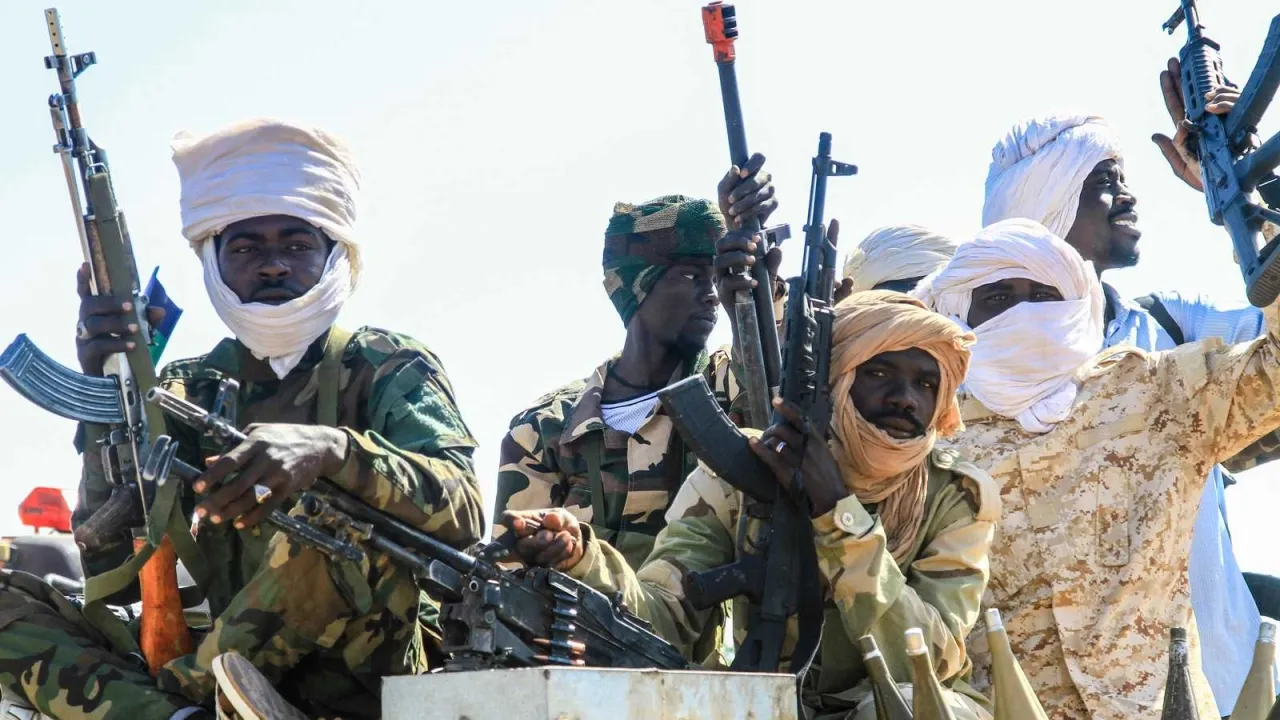
Khaberni - CNN revealed, in a joint investigation with the investigative newsroom Light House Reports, that the Port Sudan forces committed war crimes described as "horrific" in Gezira state, south of the capital Khartoum, under the supervision of their commander Abdel Fattah al-Burhan.
The investigation was based on satellite images, survivor testimonies, and field analysis, which revealed a "systematic" violence campaign targeting civilians. A UN official who reviewed the investigation described it as "genocide on ethnic grounds."
According to CNN, it is notable that these violations committed by the Port Sudan forces and their allied militias "remained largely under wraps.
Unprecedented brutality"
The investigation documented violations that included the use of brutal methods "unprecedented" such as mass killings and field executions, based on testimonies from survivors about arbitrary executions of civilians suspected of sympathizing with the Rapid Support Forces, especially those from non-Arab tribes in Darfur and Kordofan areas.
The investigation also presented testimonies of sexual violence and "systematic rape" used as a tool of war, focused on women and girls in the targeted villages, in addition to the policy of "ethnic cleansing," which revealed the burning of entire villages and destruction of vital infrastructure such as markets and hospitals, aiming to force the population to move.
Regarding collective punishment policies in Gezira state specifically, there was indiscriminate bombing, from aerial attacks on densely populated civilian areas, resulting in hundreds of civilian victims, including children and women.
CNN pointed out that these violations were directed at the highest level of command in the forces of Port Sudan, revealing that an official in the General Intelligence Service was responsible for coordinating attacks in Gezira state, even stating that the force commander Abdel Fattah al-Burhan "was aware of the killings."
Theater of the massacre"
The investigation pinpointed the time of the horrific violations in Gezira state during last January, as Port Sudan forces attempted to retake the strategic city of "Wad Madani" from the Rapid Support Forces, noting that "atrocities escalated" as the Burhan forces neared the city.
In the village "Al Kareibah," videos showed the detention of dozens of young men by the Port Sudan forces and their brutalization "on suspicion" of belonging to the Rapid Support Forces. The investigation also pointed to a massacre near what is known as the "Police Bridge," where footage showed around 50 bodies in a "massacre scene," according to CNN.
The American network conveyed from what it described as a "source" within the upper ranks of the General Intelligence Service in Port Sudan, who spoke anonymously "out of fear of retribution," indicating that the victims killed at the Police Bridge "were buried in mass graves."
Notably, the "intelligence" source admitted that the dead were not only from the Rapid Support Forces, but there were also civilians executed "based on suspicions," while satellite images of the area after days of the massacre showed white bodies presumed to be corpses wrapped in a mass grave.
However, mass graves were not the only method used by the Port Sudan forces and their militias to dispose of bodies. According to CNN's investigation, a second "source" from the intelligence described that some civilians accused of cooperating with the Rapid Support Forces were shot and then thrown into a water channel.
Burhan above the bodies"
Four miles from the village of "Bika," the informant reported that bodies were thrown into the water, while days later, Burhan addressed his soldiers from behind the same channel where the bodies were dumped, according to the intelligence source.
Satellite images captured in May, after the water level receded, appear to show dozens of bodies at the bottom of the channel, meters from where Burhan stood.
According to CNN, the horrific attacks committed by the forces of Port Sudan along the road to "Wad Madani" were not "isolated" but were "part of a broader campaign of ethnically motivated assaults" that targeted at least 39 villages in Gezira state.
The violations targeted the "Kanabi," predominantly a non-Arab agricultural community often referred to by militias as "Black Sudanese." A member of the UN fact-finding mission described the military campaign as "targeted ethnic genocide."
CNN's investigation concludes that impunity is the main reason for the continuation of these violations, as the Port Sudan forces failed to conduct a serious investigation into the crimes of their own forces and the militias allied with them.