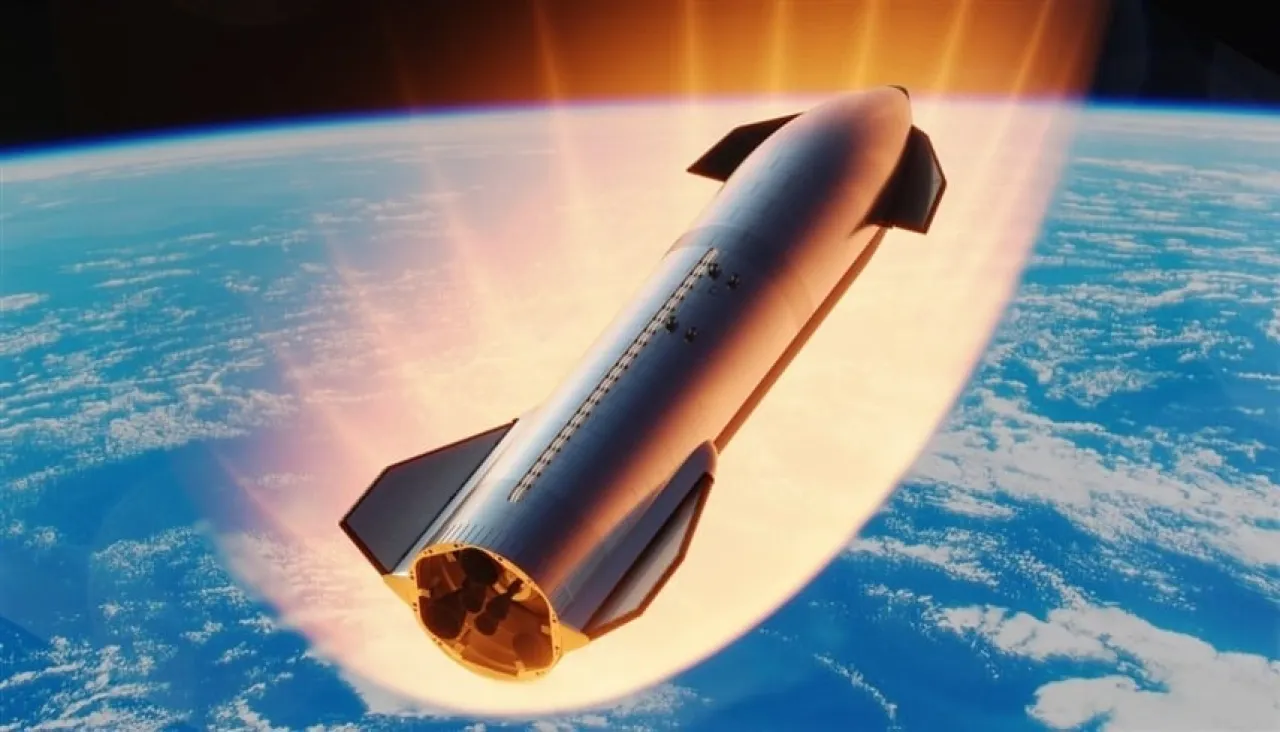
Khaberni - Artificial intelligence has transformed from just a software tool to a pivotal player in the future of space, given its increasing ability to enhance the propulsion technology driving rockets and spacecraft beyond the solar system boundaries.
As space agencies and private companies race to launch hundreds of rockets annually, attention is turning to new technologies that make cosmic travel faster, cheaper, and safer, thanks to artificial intelligence leading this race.
From rocket design to operation
According to "Space" website, a team of engineers, researchers, and postgraduate students is striving to utilize "machine learning" technologies, specifically reinforcement learning; to develop more efficient engines capable of making autonomous decisions and adjusting their performance during the flight.
"Machine learning" is a branch of artificial intelligence concerned with identifying patterns in data that has not been explicitly trained, and it is a broad field with many branches, and it has many applications, where each branch simulates intelligence in different ways: through pattern recognition, language analysis and generation, or learning from experience.
This last branch, specifically based on learning from "experience," is known as "reinforcement learning," which teaches machines how to perform their tasks by evaluating their performance, enabling them to continuously improve through experience.
These systems are capable of analyzing data, testing an infinite number of scenarios, and determining the best possible configurations for the rocket and reactor.
Scientists liken the role of these systems to a chess player who has played thousands of matches "not calculating all the possibilities, but building his intuition from ongoing experience," and establishing a similar intuitive expertise in machines and systems, but with speed and computational efficiency surpassing human capability.
By relying on "reinforcement learning," it is possible to improve human understanding of highly complex systems that challenge the limits of human intuition, as it helps in determining the optimal path for a spacecraft headed anywhere in space, through the improvement of the necessary propulsion system to reach its destination.
It can also design better propulsion systems, starting from selecting the best materials to innovating designs that improve heat transfer between engine parts.
Towards nuclear rockets
According to scientists, one of the most promising trends is "nuclear propulsion" either through "fission or fusion," which has the capacity to significantly reduce the travel time between planets, harnessing the same forces that power atomic bombs and fuel the sun.
Nuclear fission works by splitting heavy atoms like uranium or plutonium to release energy, a principle used in most terrestrial nuclear reactors. Fusion, on the other hand, merges lighter atoms like hydrogen to produce greater energy, but it requires more extreme conditions to start.
However, "nuclear fission" is considered more mature, and this technology has been previously tested in NASA's "NERVA" program, where it could enable faster trips to Mars with less fuel consumption.
"Nuclear fusion" remains the biggest dream, but it requires controlling highly energetic plasmas inside complex magnetic fields - according to scientists - which is an area where artificial intelligence plays the role of a smart supervisor capable of adjusting the magnetic fields moment by moment, meaning it is nearly an impossible task for humans.
Future engines
Early designs of nuclear thermal propulsion used in the 1960s - such as those used in NASA's "NERVA" program - involved solid cast uranium fuel molded into prismatic shapes, and since then, engineers have explored alternative configurations, from layers of ceramic pebbles to grooved rings with complex channels.
Scientists agree that the greater the reactor's efficiency in transferring heat from the fuel to the hydrogen, the greater the thrust it generates, and in this field, reinforcement learning has proven its significant importance.
But the main challenge facing "nuclear propulsion" remains the management of heat within the engine and converting it to thrust energy efficiently, and here, engineers have been testing multiple fuel designs and internal reactor structures for decades.
In this regard, artificial intelligence has achieved in just months what would have taken years of costly human trials, by analyzing hundreds of variables, selecting the best designs, and predicting the performance of each part before manufacture.
However, controlling magnetic fields inside a multi-layered well "is no easy task," as these fields must be strong enough to keep "hydrogen" atoms in constant motion until they merge, a process that requires immense energy to start but becomes self-sustaining once initiated.
Overcoming this challenge is now necessary to expand the scope of this technology for "nuclear thermal propulsion" applications.
Fuel management for dynamic missions
The role of artificial intelligence does not stop at the design stage, as in the midst of changing space missions from military applications to scientific exploration, "reinforcement learning" helps in: predicting fuel consumption, planning efficient routes, and making moment-by-moment decisions during the flight allowing the rocket to adapt to a changing environment.
The element of "adapting to variables" is also a concern for scientists, as they highly regard spacecraft capable of performing different roles in response to changing variables and important needs over time.
For example, "military applications" must respond quickly to rapidly changing geopolitical conditions, and examples of technologies adapted to these rapid changes include Lockheed Martin's "LM400 satellite," which boasts capabilities such as ballistic missile warning and remote sensing.
Just as bikes, planes, and cars have advanced human development, "machine learning" can become the essential foundation for interplanetary travel.