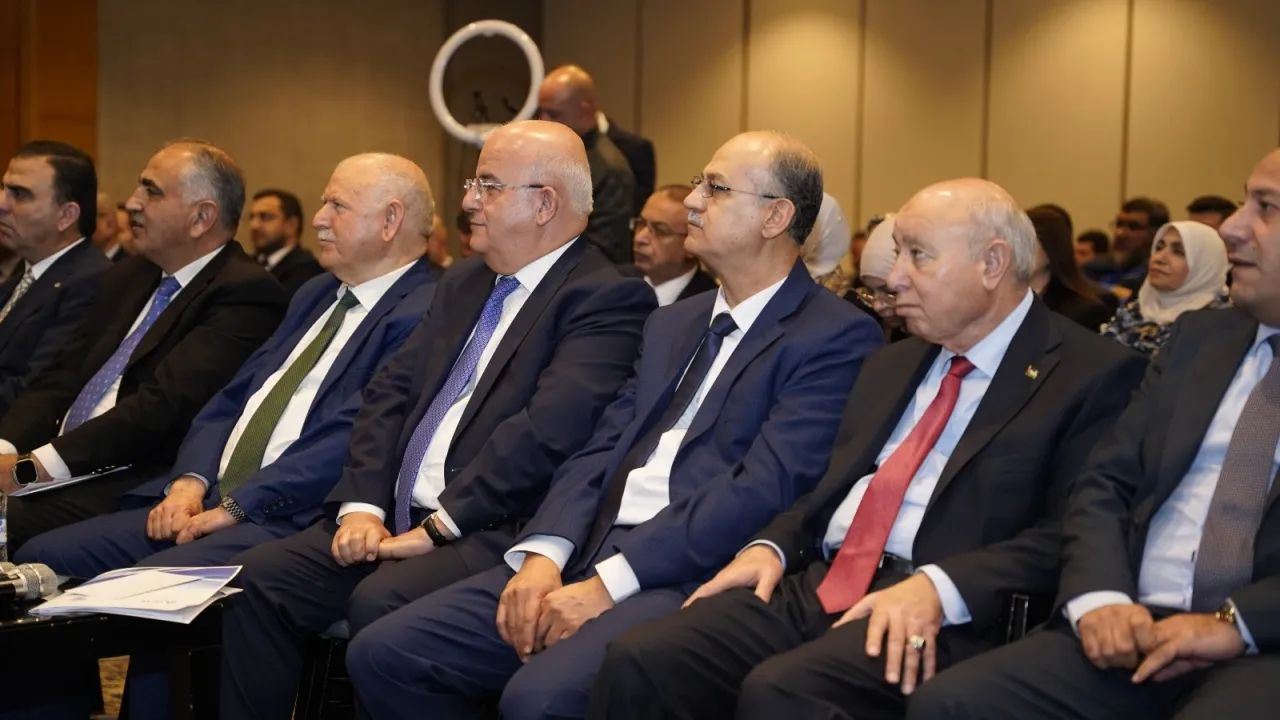
Khaberni - The works of the honorary scientific symposium kicked off in Amman to announce the results of the annual report on the impact factor and Arab reference citations “Arcif” (Arcif) for the year 2025, with extensive participation from the heads of Jordanian universities, Jordanian and Palestinian academic leaders, a selection of researchers and academics, and representatives of Arab scientific journals.
The symposium opened with the royal anthem and recitation of verses from the Holy Quran, followed by a speech by Dr. Najib Al-Sharbaji, a member of the scientific committee of “Arcif”, and the former general director of Knowledge Management, Research and Ethics at the World Health Organization – Geneva, who discussed the importance and objectives of the impact factor “Arcif”, emphasizing its reliability and accuracy.
Then, the former Secretary-General of the Association of Arab Universities, Professor Dr. Sultan Abu Orabi, spoke, addressing the reality of Arab scientific research, its challenges and problems, and ways to address them.
Additionally, the president of Hashemite University, Professor Dr. Khaled Al-Hyari, delivered a speech in which he affirmed that “our meeting today is not just an occasion for honor, but a moment to reflect on the reality of Arab scientific research and an opportunity to appreciate the efforts made by our academic institutions and researchers in building a knowledge system capable of competing and contributing culturally”.
Dr. Al-Hyari explained that “the achievements of Jordanian universities in this year’s Arcif report reflect significant progress in the quality of scientific research and academic publishing”, adding that “Arcif represents an advanced Arab model for monitoring the impact of scientific production published in Arabic, responding to the urgent need to enhance the independence of the Arab knowledge system from foreign indices”.
The President of Hashemite University indicated that the results achieved by Jordanian universities in this year’s “Arcif” report reflect a clear path of development and interest in scientific research, affirming that the Jordanian researcher, with their effort and persistence, has proven their ability to compete and innovate, and that the academic environment in Jordan – despite challenges – continues to nurture excellence.
He confirmed that Hashemite University, like all national universities, continues to work on developing its research policies, enhancing academic publishing, supporting peer-reviewed scientific journals, and expanding partnerships with regional and international research institutions.
Also, the President of Hashemite University expressed pride that one of the academic competencies at the university played a central role in establishing this leading Arab project, the impact factor “Arcif”, emphasizing that these shining Jordanian contributions reflect the civilizational role played by Jordanian universities in building and developing the Arab scientific scene, and defending the status of the Arabic language as a language of science and research.
The event also saw a scientific session chaired by Dr. Al-Sadiq Al-Faqih, Secretary-General of the Arab Thought Forum, discussing the reality and problems of Arabic digital content.
The symposium also included a lecture by Professor Dr. Sami Al-Khazendar titled: “The Research Impact of the Arabic Scientific Production between Missing Growth and Knowledge Dependence: A Comparison between Western and Arab Indices”, in which he reviewed the journey of the Arab impact factor “Arcif”, its necessity and its civilizational importance in serving the Arabic language.
Dr. Al-Khazendar also explained that there is a pivotal relationship between research impact and the use of the mother tongue in scientific research, noting that the top ten countries in the world in terms of patent applications use their mother tongue in scientific research.
He also mentioned that foreign indices for measuring research impact and Arabic scientific production have contributed to marginalizing Arabic scientific publications, excluding them from the credit of Arab countries and universities, negatively affecting the ranking of Arab universities in global ranking bodies, such as the Times and QS rankings.
He pointed out the case of Jordan as an example, explaining that during the period 2012–2023, the number of Arabic articles cited in “Arcif” exceeded 8800 articles, receiving more than 42 thousand citations, while the number of Arabic articles in the “Scopus” index did not exceed 1225 articles, with a total of 615 citations only, representing a significant marginalization of Jordanian universities.
At the Arab level, during the same period, the comparison showed that the number of Arabic articles cited in “Arcif” exceeded 452 thousand articles, with more than 473 thousand citations, compared to only 5600 Arabic articles in the “Scopus” index, and 5367 citations, reflecting significant marginalization and injustice against the Arabic scientific production of Arab countries and their universities and authors.
Dr. Al-Khazendar stressed the need for Arab universities to exert effective pressure on global university ranking bodies to ensure fairness and adopt the high-quality and transparent data provided by the Arab impact factor “Arcif”.
At the conclusion of the scientific symposium, Jordanian universities, magazines, and Arab authors who had the most impact according to the “Arcif 2025” report were honored. The list of honorees included Jordanian universities that achieved advanced Arab ranks in terms of citations, headed by the University of Jordan and Yarmouk University, alongside honoring scientific magazines from Jordan and Palestine within the list of the top ten Arab magazines in various fields, such as law, Islamic studies, social sciences, economic and administrative sciences, and psychology.
The ten most influential Arab authors were also honored, in addition to the top 15 Arab authors according to the Hirsch index (H-index), amid wide participation from representatives of academic institutions from Jordan and Palestine.
The event concluded in a scientific and interactive dialogue atmosphere, reflecting the importance of the symposium and its role in supporting Arab scientific research and publishing.