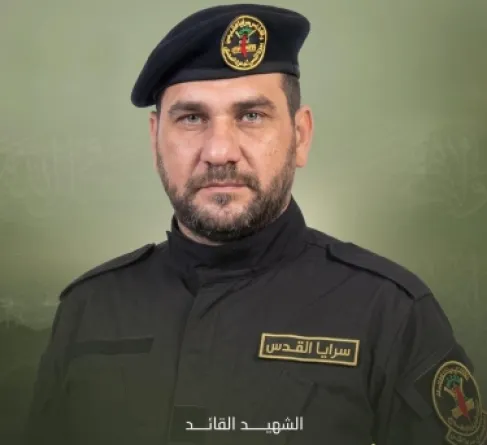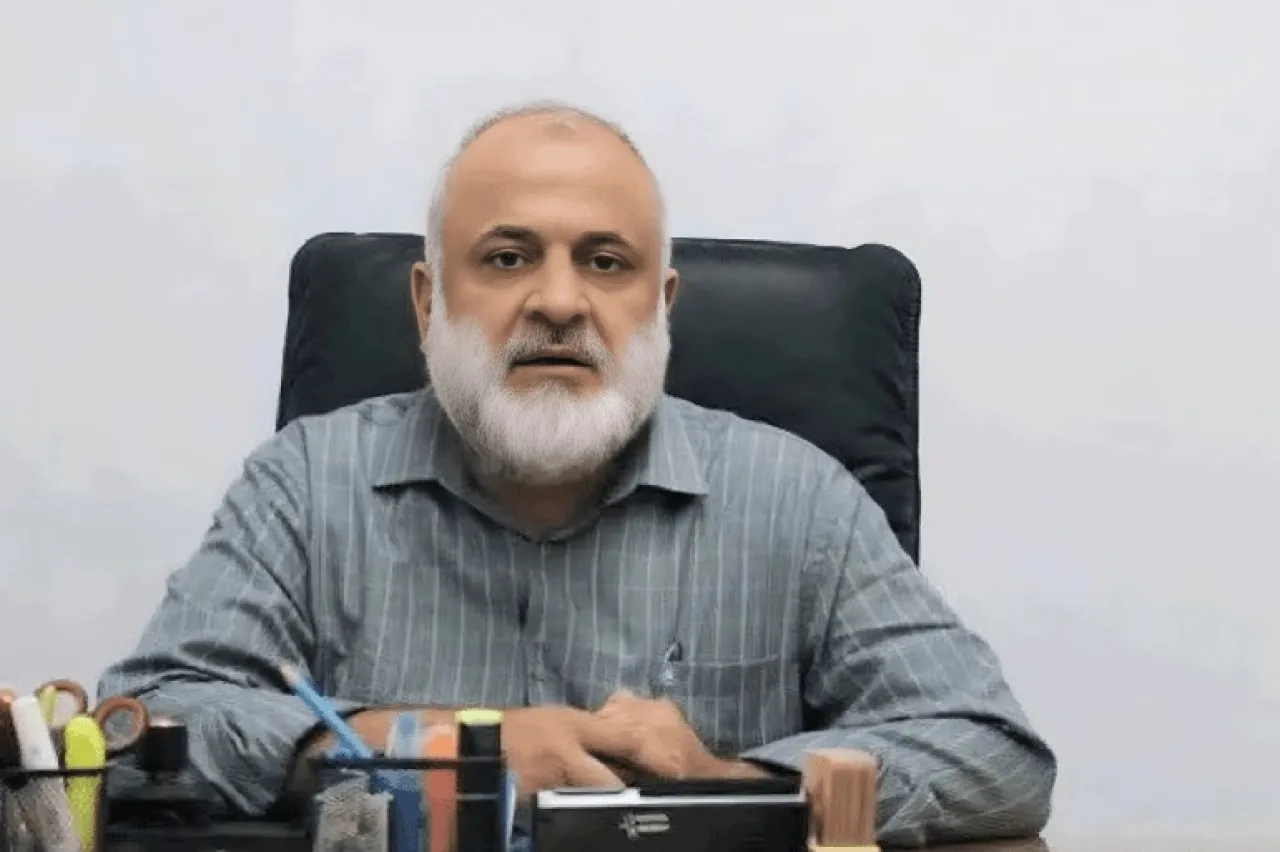
Khaberni - The Israeli occupation army announced this evening, Saturday, the assassination of Raed Saad, a leader in the Al-Qassam Brigades, the military wing of Hamas, by targeting a civilian car on the coastal road southwest of Gaza City.
The occupation claimed that Saad's assassination was in response to a breach of the ceasefire agreement, with an explosive device detonated earlier by an Israeli army force inside Gaza, but Channel 12 Hebrew said that "the favorable circumstances were exploited to assassinate him without any relation to any violation of the calm."
The Israeli army named the assassination operation "Fast Meal", as it found the opportunity to assassinate the currently second man in the military wing of Hamas, after the leader Izz al-Din Haddad who leads the Al-Qassam Brigades.
With the assassination of Raed Saad, Israel succeeded in reaching him after more than 35 years of pursuit, during which he faced many assassination attempts.
Leadership Journey
Raed Hussein Saad was born on August 15, 1972, in Al-Shati camp, west of Gaza City, and joined the ranks of Hamas early, and the occupation began chasing him at the beginning of the first intifada that erupted in 1987. He was arrested by the occupation forces several times.
He obtained a bachelor's degree in Sharia from the Islamic University while in prison in 1993, where he was active at the time in the Islamic Bloc, the student arm of Hamas, and Saad obtained a master's degree in Sharia from the same university in 2008.
According to special information obtained by Al Jazeera Net, Saad joined military work early, and worked with veterans of the pursued from the Al-Qassam Brigades such as Saad Al-Arabid, and is considered one of the last generation of the pursued in the phase of the Al-Aqsa Intifada that erupted in 2000.
Saad held the position of the Northern Gaza Brigade in the Al-Qassam Brigades in 2007, and was among those who supervised the establishment and qualification of the naval force of the brigades in Gaza.
In 2015, he headed the Operations Corner and was a member of a reduced military council consisting of the leadership of the Al-Qassam Brigades in the Gaza Strip, alongside the leaders Mohammed Deif and Marwan Issa, during the period between 2012 and 2021.
Israel says that Saad was responsible for the operational plans of the war, where he supervised two strategic steps that formed the basis of the executive preparedness for the operation Storm Al-Aqsa: the first creating elite battalions, and the second preparing the "Jericho Wall" plan, aimed at deciding the battle against the Gaza Division in the Israeli army.
The occupation claimed - during the last war on Gaza - his arrest during the storming of the Shifa medical complex in March 2024, and published his picture at the time among a group of those arrested, before admitting that it was mistakenly received indicating the weaknesses in the intelligence information available about him to the Israeli occupation.
Saad was also targeted during the war by several assassination attempts, the most notable of which was in May 2024, by bombing a residential area in the Al-Shati camp, and the Israeli army offered a financial reward of $800,000 for information that leads to reaching him after failing to assassinate him.
The army radio reported that Israel had been looking for Raed Saad for a very long time, and sought to assassinate him twice in the past two weeks, but the opportunity was not completed, and as soon as he was identified on Saturday evening while he was riding a vehicle accompanied by his personal guards, the raid was immediately carried out.
A New Security Reality
Facing the assassination of Israel's most prominent military figure in the Palestinian resistance since the ceasefire agreement took effect on October 10 previously, the researcher in security affairs, Rami Abu Zubaida, believes that "the occupation does not deal with the calm in the Gaza Strip as a cessation of war, but as a different operational stage where the battle is managed with less noisy and more precise tools."
He explained in his talk to Al Jazeera Net that the recent targeted assassinations and selective targeting clearly reveal that the war has not ended, but has been recycled within a new pattern based on intermittent strikes, and managing the conflict rather than deciding it.
He pointed out that the occupation is keen to fabricate field justifications for marketing its aggression as a defensive response, "however, this narrative does not go beyond being a blatant attempt to redefine the concept of violation itself, so that any security incident, limited clash, or creation of non-existent events - within its control inside the Green Line - becomes a sufficient pretext for carrying out an assassination."
Abu Zubaida believes that the occupation seeks to impose a new equation where "calm does not imply safety", and it retains the right to strike whenever it wishes, and through this behavior, it aims to impose unilateral rules of engagement, granting it the freedom of aerial and intelligence work inside the sector without political or legal obligations.
He also pointed out that the limited strikes not only aim to cause direct losses, but also to maintain the initiative, prevent the resistance from moving from the stage of endurance to the stage of recovery and reorganization, and keep the organizational structure of the resistance in a state of constant depletion.
In the security aspect, Abu Zubaida pointed out that the intensity of intelligence work indicates that the occupation is exploiting the period of calm to update its target bank in preparation for upcoming rounds, which explains why the Air Force and drone units have not been disbanded, and the continuation of the full capacity operation of the military intelligence division.
The researcher in security affairs believes that "the riskiest scenario lies in normalizing this pattern of infringement, whereby striking raids become a permanent condition, implemented all the time, even if they are less intense than full-scale war, meaning practically the establishment of a new security reality in the Gaza Strip, where the calm is continuously violated, opening the door to ongoing bloodshed without time limits or real guarantees."