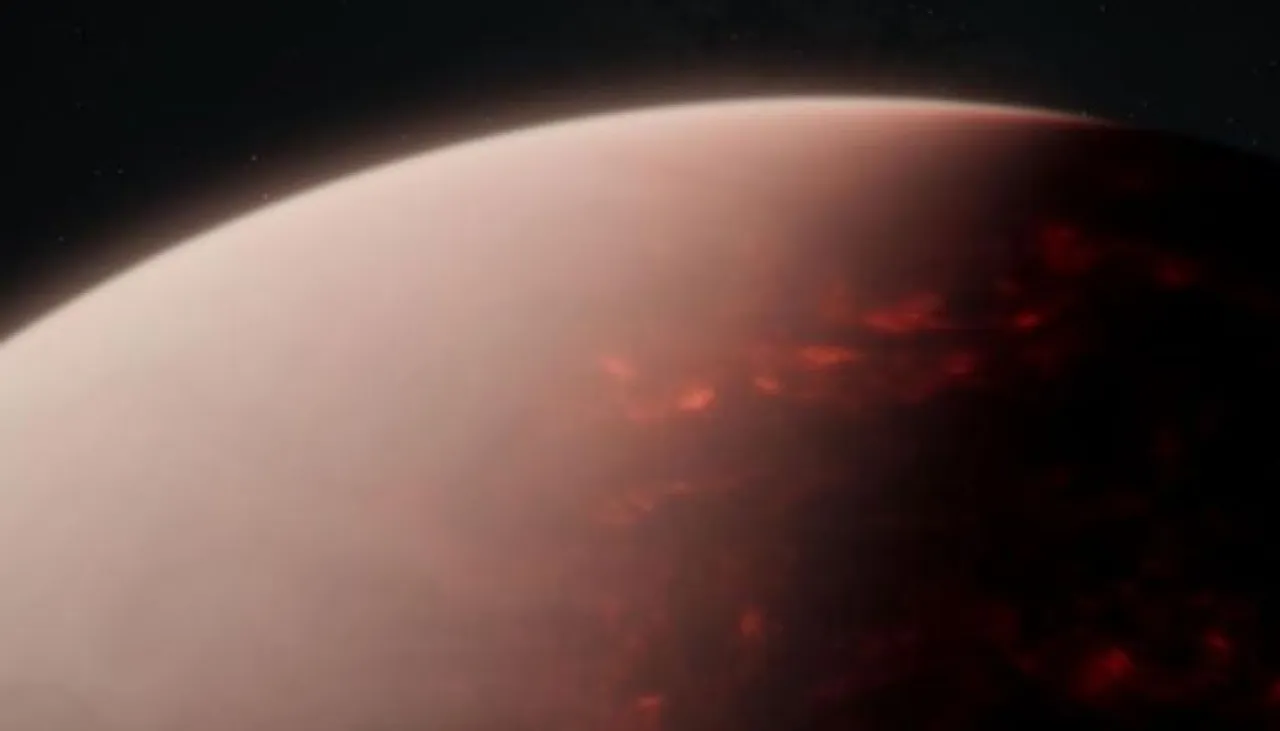
Khaberni - Astronomers have unveiled the clearest evidence yet of an atmosphere surrounding a rocky exoplanet outside our solar system.
A team led by the "Carnegie" institution, using NASA’s James Webb Space Telescope, managed to study "TOI-561 b", an extremely hot rocky planet that completes a full orbit around its star in just 10.56 hours.
The existence of an unexpected atmosphere around this planet poses a significant challenge to old hypotheses about how small, extremely hot planets evolve, which suggested that they quickly lose their atmospheres after forming.
"TOI-561 b" is about twice the size of Earth, but it orbits very close to its star—about a tenth of the distance between Mercury and the Sun—making one side of it always lit and never experiencing darkness.
It was expected that a small, hot planet like this would lose its atmosphere quickly.
Nicole Wallack, a co-author of the study published in The Astrophysical Journal Letters, explained: "Based on what we know about other systems, it was believed that such a small and very hot planet could not retain its atmosphere for long after its formation."
She added, "But these observations turn the prevailing notions about planets with very short orbital periods upside down."
Despite the planet's star being significantly older than the Sun, its atmosphere appears intact, which is partially attributed to its lower density compared to Earth, yet it is not classified among the large, puffy, gas giant planets known as 'hot Jupiters'."
The team investigated whether the planet’s low density might be due to a small iron core and a lighter mantle, which aligns with the characteristics of the host star.
Main author Joanna Teske clarified that "TOI-561 b" stands out from other planets with very short orbital periods because it orbits a very old and iron-poor star.
The scientists speculated that the planet formed in a different chemical environment from planets in our solar system, making it a potential window for understanding planet formation in the early universe. However, internal composition alone cannot explain all the observations; the team suspected that a dense atmosphere makes the planet appear larger and less dense.
The "NIRSpec" instrument aboard the James Webb Space Telescope helped test this idea by measuring the heat of the planet's day side during the secondary eclipse; it was expected that, if the surface were bare rock, the temperature would reach about 4900 degrees Fahrenheit (2700 degrees Celsius), while the actual measurements showed a temperature of merely 3200 degrees Fahrenheit (1760 degrees Celsius), indicating active redistribution of heat.
The team explored several scenarios, such as the existence of a magma ocean or a thin layer of rock vapor, but none aligned with the data.
The team concluded that a dense atmosphere is the only explanation for the observed cooling.
Co-author Angali Pyette explained, "The strong winds cool the day side of the planet by transferring heat to the night side, and gases such as water vapor absorb the light before it can escape."
She added that bright clouds might reflect the stars' light, contributing to the cooling of the planet. However, scientists still do not understand how the planet can retain its atmosphere under such intense radiation.
Further analysis is currently underway to create detailed temperature maps and improve understanding of the planet's atmospheric composition.