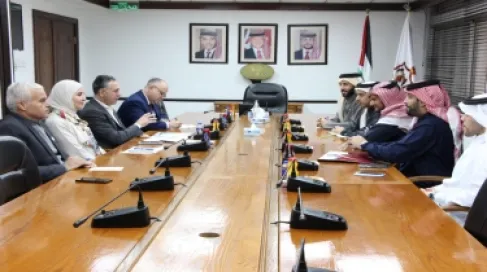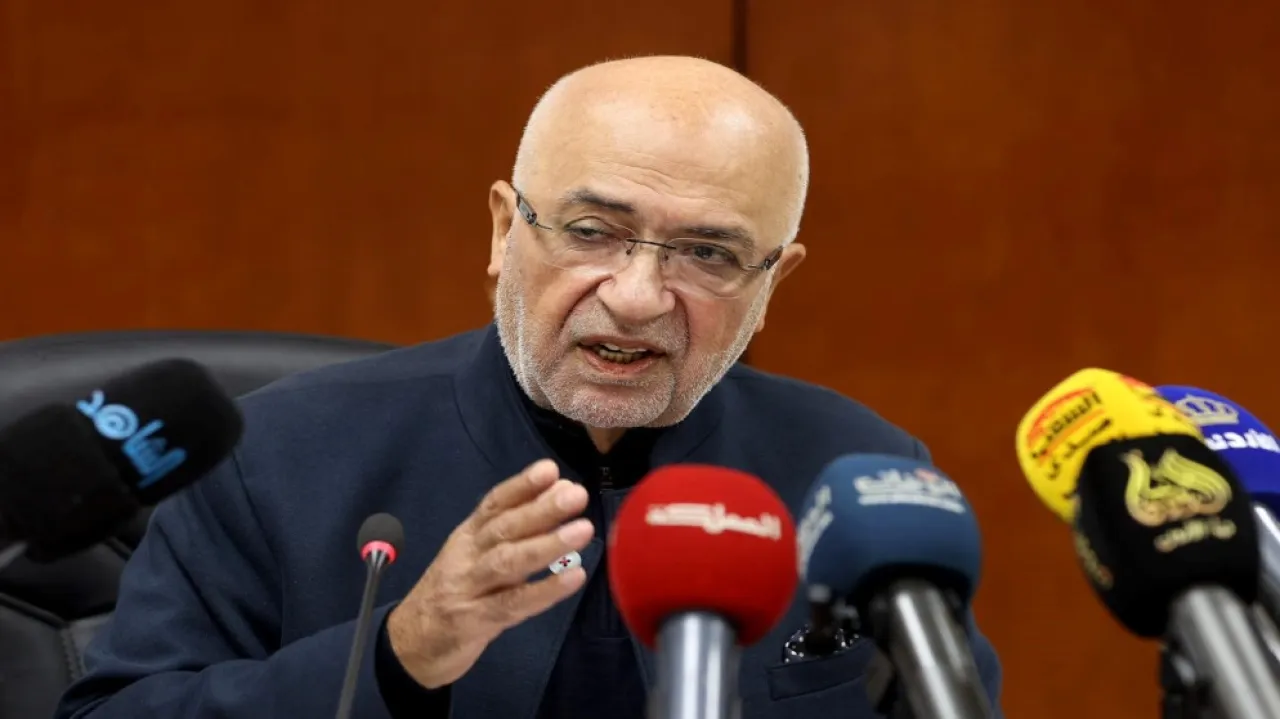
Khaberni - Today at the University of Jordan, the Al-Hayat Center Rased organized the National Conference titled "Jordanian Youth in Political Modernization: Young Parliamentarians as a Model" under the patronage of the President of the Independent Electoral Commission, Engineer Musa Al-Maaytah, with the presence of the President of the University of Jordan, Dr. Nadhir Obeidat, the Deputy Ambassador of the European Union to Jordan Angela Martini, the attendance of the General Director of the Al-Hayat Center Rased Dr. Amer Bani Amer, and with the participation of a group of young parliamentarians and experts concerned with political affairs, as well as students from Ana Ashareek program and students from the University of Jordan.
During the opening, the President of the Independent Electoral Commission, Engineer Musa Al-Maaytah, stated that the political modernization project in Jordan came to establish a firm national path, aiming to enhance public participation, especially among the youth and women, considering them a fundamental pillar in the democratic process. He noted that the results of this path were clearly seen in the composition of the current parliament, which includes 27 women for the first time in the history of the Jordanian parliamentary life, in addition to 17 young deputies under the age of forty, reflecting a significant transformation in the structure of political representation.
Al-Maaytah explained that providing safe and organized spaces for youth engagement in partisan and political work is a main part of the state's vision, confirming that the "system of practicing party work inside universities" came to establish an environment that guarantees freedom of partisan engagement within legal frameworks and away from any pressures or fears, and enhances the culture of pluralism and commitment to institutional work.
In response to a question posed by one of the youth, Al-Maaytah clarified that Jordanian laws are clear regarding the bases of partisan work, where it is not permissible to establish parties on religious, sectarian, or regional bases, emphasizing that these controls are a guarantee for the neutrality of the political sphere and preventing its monopolization or use for narrow purposes.
In the context of discussing "party governance" instructions, Al-Maaytah confirmed that it is a national legal requirement that the Independent Electoral Commission enforces based on the current Party Law, and with a methodology based on the principle that "democracy without the rule of law cannot evolve or be respected."
He also explained that the authority continuously monitors the parties' compliance with the constitution and their internal regulations, and so far, the internal regulations of most parties active in the political scene have been adopted.
Al-Maaytah concluded by affirming that the success of political modernization requires mutual cooperation between the parties, the authority, and the community, and that building a healthy party environment is an essential step to ensure the sustainability of democracy and enhance the citizens' confidence in political life.
For his part, the President of the University of Jordan, Professor Dr. Nadhir Obeidat, emphasized that youth constitute the strongest pillar in the course of political and social modernization in Jordan, as they are not only the leaders of the future but also today's leaders, with their energy and ability to innovate and change. Obeidat stressed that empowering youth and equipping them with modern tools in education, knowledge, and skills has become a national necessity, pointing out that any reform project is incomplete without active youth participation, capable of shaping ideas and turning them into initiatives that contribute to nation-building and enhancing its progress
Obeidat explained that the University of Jordan has a major responsibility in keeping up with the times and developing curricula and pedagogy to meet the needs of a generation born in a different era, confirming that education alone is no longer sufficient for change, but must be accompanied by a system of laws and regulations that ensure youth the right to knowledge and innovation. He added that the university strives to link sciences with logic and critical thinking, and to build an educational environment that fosters creativity and gives students the ability to understand the world and shape their future, calling on the youth to be faithful sons of this nation, and to write their own story with perseverance, faith, and the capacity to accomplish.
Angela Martini, Deputy Ambassador of the European Union to Jordan, emphasized during her participation in the national conference on youth and parliamentary work, that supporting youth participation in political life is a fundamental pillar in the European Union's partnership with Jordan. She explained that the project implemented by Al-Hayat Center - Rased with support from the European Union reflects a long-term commitment to promoting good governance, transparency, and accountability, stressing that the youth are not just leaders of the future but are leaders of the present as well.
Martini added that enhancing communication between youth and young parliamentarians has become a necessity to bridge the gap between aspirations and policies, noting that young deputies represent a cornerstone in the course of reform due to their bold ideas, new visions, and positive energy.
Martini concluded by emphasizing the continuous support of the European Union for initiatives that empower youth and expand their participation in shaping public policies, which enhances Jordan's efforts in the course of political modernization.
Dr. Amer Bani Amer, General Director of Al-Hayat Center – Rased, clarified that the results confirm a clear gap between the expectations of the youth and the opportunities available to them to influence the political process, and that young deputies face institutional and professional challenges that hinder their ability to present a full model of the role they aspire to play in the parliament. He pointed out that these data necessitate adopting a more inclusive path to support youth participation, based on integrating the perspective of youth in policies and legislation, enhancing their presence in parliamentary discussions, and providing training programs that enable young deputies to develop their legislative and supervisory tools. Bani Amer also called for building permanent channels of communication between Jordanian youth and legislators, and enhancing the supportive environment for party work within universities, ensuring the flow of qualified youth leaders capable of influence. Bani Amer concluded by reaffirming Rased's national role in monitoring parliamentary performance and providing scientific knowledge that contributes to empowering the new generation and consolidating the course of political modernization.
The conference included a discussion session moderated by the media personality Hazem Al-Rahahleh, in which a number of honorable deputies participated, discussing the challenges facing youth and their role in the course of political modernization.
Deputy Khalid Abu Hassan emphasized that addressing youth unemployment requires a shift towards the private sector and genuine administrative reform to address the manifestations of sluggishness that hinder job opportunities, while Deputy Rand Al-Khuzouz stressed the importance of aligning education outputs with labor market needs, considering that creating new investment opportunities begins with enhancing the supervisory role of deputies on the government, and that constructive criticism and accountability of the executive authority do not conflict with national constants.
Meanwhile, Deputy Malik Al-Tahrawi pointed out that universities form the first base for building society, and that attention to education is the foundation upon which progress and prosperity are built, asserting that youth are the banner of any development and that empowering them means drawing a prosperous future. Al-Tahrawi also explained that Al-Rahahleh emphasized the importance of cooperation between universities, civil society, and the parliament to build a generation qualified and capable of influence.
Dr. Abdullah Jabareh, the Executive Director of Majlisna, stressed that empowering youth can only be achieved through actual spaces for dialogue and participation, affirming that youth are capable of creativity whenever appropriate platforms are available, emphasizing the importance of cooperation between universities, civil society, and the parliament in building a generation that is qualified and capable of influence.
It should be noted that this conference was conducted within the project of Jordanian Youth and Parliament, which was implemented by the Al-Hayat Center Rased with support from the European Union.