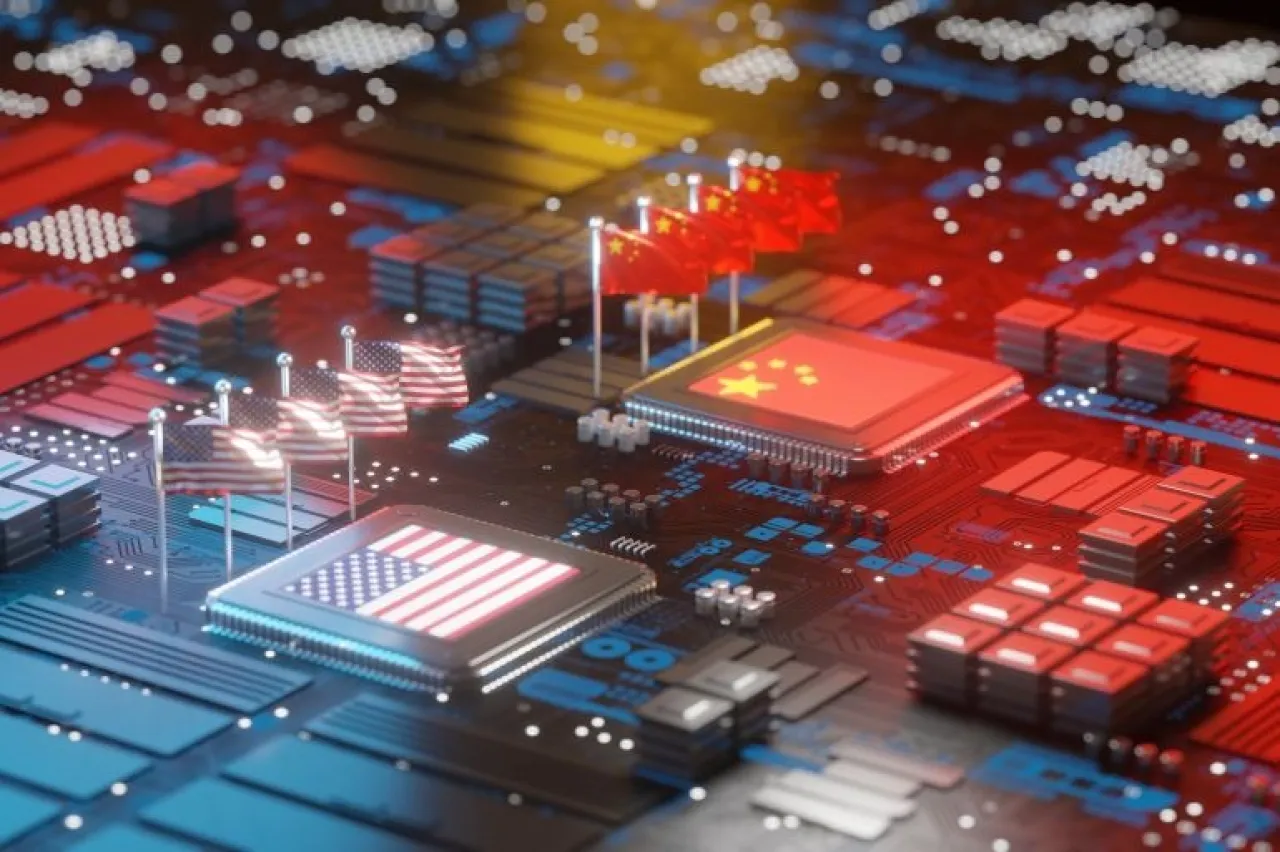
Khaberni - As the race for technological supremacy between Beijing and Washington intensifies, China is preparing to impose restrictions on its companies' access to the latest artificial intelligence processors, the H200 model produced by American company Nvidia, despite US President Donald Trump's approval of their export to "approved customers" in China.
This mutual movement reflects a complex struggle that combines protecting American national security from Chinese technological influence and Beijing's determination to enhance self-sufficiency in the semiconductor industry and reduce reliance on external sources.
Financial Times explained that Chinese regulators are discussing requiring companies to seek prior official approval and justify why local processors cannot meet their needs, alongside a move to prevent the public sector from purchasing these processors to support competing Chinese companies, without making a final decision yet.
The newspaper also mentioned that Beijing took advantage of the American ban under Joe Biden's presidency to push the local chip sector towards developing competitive alternatives by intensifying customs inspections and providing energy support for data centers relying on local processors.
Pressure from Nvidia and Discrepancies within Washington
On the other hand, the British Broadcasting Corporation "BBC" reported that Trump's decision came after a wide-ranging lobbying campaign led by Nvidia CEO Jensen Huang, who called in an interview with them in September to "ensure access to technology for the whole world, including China."
According to American media reports, President Donald Trump announced that Nvidia would pay 25% of its revenue from selling H200 processors to China to the US government, in exchange for allowing the re-export of this technology to "approved customers" in Beijing.
The network also confirmed that the decision includes other American companies such as "AMD", but it will face opposition from national security hawks in Congress concerned about the transfer of advanced technology to the Chinese military.
Researchers at the Center for Security and Emerging Technologies at Georgetown University note that "providing access to high-quality processors enables China to deploy artificial intelligence systems for military purposes more easily", pointing out that the People's Liberation Army is already using American processors to enhance the development of its AI-supported combat capabilities.
Rare Metals and Reducing Dependence on the West
While Washington considers its decision "buys time," Alex Capri, an expert from the University of Singapore—according to BBC—believes that allowing the sale of "H200" might give the United States an opportunity to negotiate over Chinese influence in the rare earth metals sector, which are crucial for the global electronics industry.
However, Beijing, according to Capri's perspective, will "clearly continue to seek to reduce dependency on American technology", especially after Chinese officials had previously ordered local companies to stop acquiring the less performant "H20" processor and encouraged the use of national alternatives.
Financial Times points out that major Chinese companies such as Alibaba, ByteDance, and Tencent still prefer Nvidia processors due to their high performance and easy maintenance, but they resort to training AI models outside China to acquire processors that were banned domestically.
Huge Market and Concerns About Sales Viability
Investing.com recalls that China represents a $50 billion market for Nvidia processors, noting that the "H200" model is—according to the "Advance Institute"—about six times more powerful than the "H20" model, but it remains "much less" than the latest generation at Nvidia according to analysts at "Vital Knowledge", which may make some Chinese companies "hesitant to purchase."
The platform also clarified that the future of Nvidia's sales in China remains uncertain as Beijing tightens controls on reducing its companies' dependence on American technology. While Nvidia—according to BBC—welcomed Trump's decision, confirming that it "strikes a thoughtful balance in favor of America," the scene is still dominated by open questions about whether this restricted détente paves the way for balanced technological cooperation or a new round of the chip war between Washington and Beijing, as owning advanced artificial intelligence represents the most influential power in tomorrow's economy.