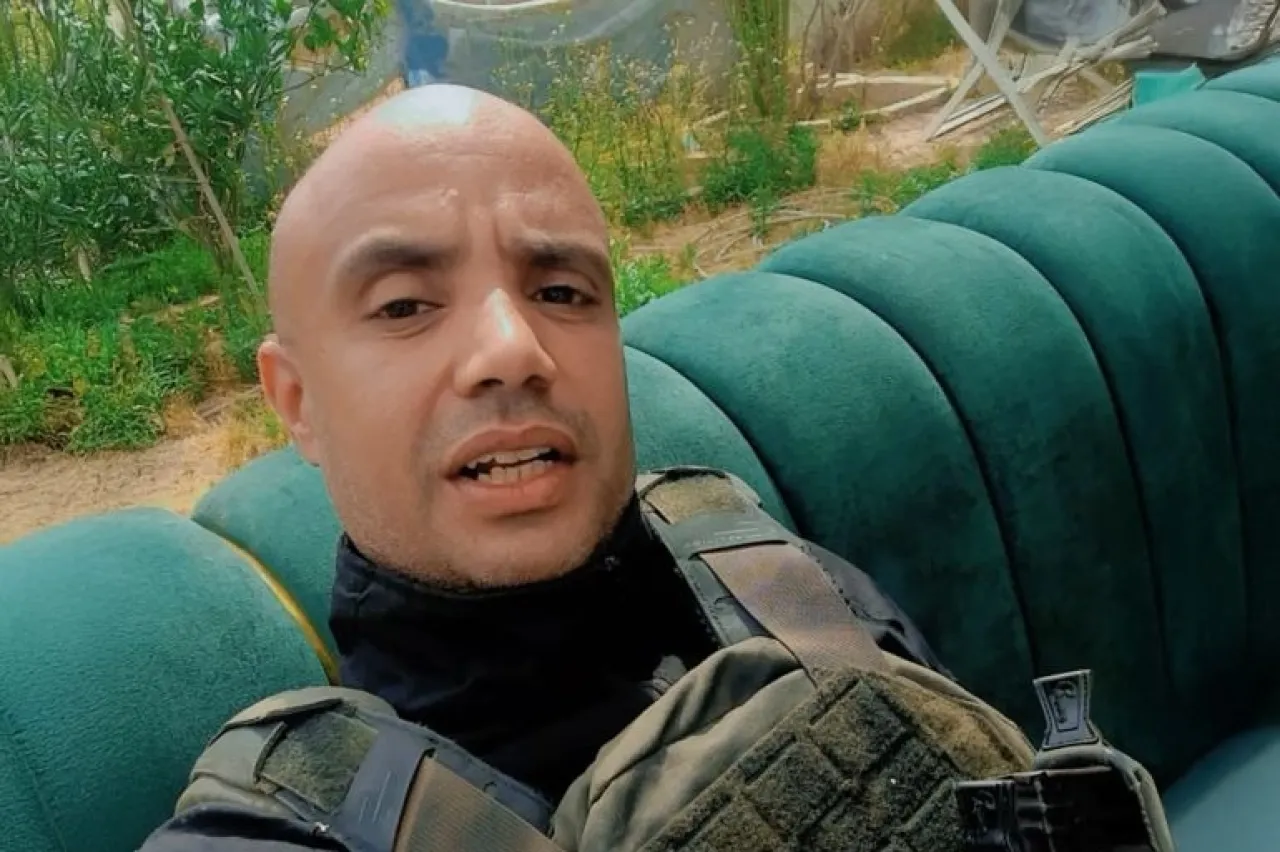
Khaberni - Shortly after the killing of Yasser Abu Shabab, the leader of the militia “Popular Forces” cooperating with Israel in Gaza last Thursday during an attempt to mediate in a family dispute, Ghassan Al-Dahini - who was said to be injured in the same fight - appeared in an online video dressed in military apparel and walking among masked fighters under his command.
But who is Ghassan Al-Dahini? And how did he become the new leader of the militia "Popular Forces"?
Who is Ghassan Al-Dahini?
Palestinian media sources indicate that Ghassan Al-Dahini (39 years old) has long been the actual commander of the militia "Popular Forces" although Yasser Abu Shabab was prominently featured as the official leader.
Sources suggest that Al-Dahini’s experience and seniority made him the operational mind of the group while Abu Shabab - who is widely viewed as a collaborator with Israel - played the public face.
Al-Dahini was born on October 3, 1987, in Rafah, southern Gaza Strip, and belongs to the Tarabin tribe, one of the largest Bedouin tribes in Palestine.
He previously served as a first lieutenant in the security services of the Palestinian Authority, before later joining the ranks of "Army of Islam," an armed faction in Gaza aligned closely with the Islamic State organization.
Has Al-Dahini officially become the new leader after Abu Shabab's death?
The militia "Popular Forces" announced on its official Facebook page last Friday the appointment of Al-Dahini as the new leader, hours after Abu Shabab's death, pledging to continue the group’s operations against Hamas.
Al-Dahini confirmed in comments to Channel 12 in Israel that he is not afraid of Hamas, saying, "Why should I fear Hamas when I am fighting against it? I arrest its members and seize their equipment in the name of the people and the free."
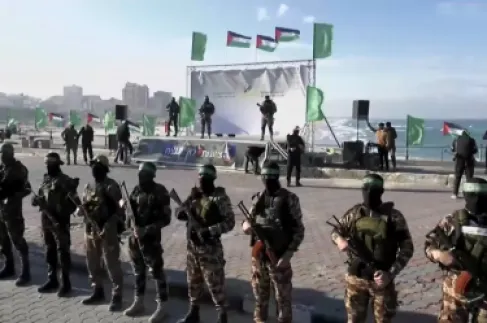
The group released a promotional video on the Facebook page last Friday showing Al-Dahini inspecting a formation of armed fighters.
Al-Dahini told Channel 12 in Israel that the purpose of the video is to prove that the group "is still operational" despite the death of its leader.
Al-Dahini stated to the channel that "his (Abu Shabab's) absence is painful, but it will not stop the war against terrorism."
Has Al-Dahini always been hostile to Hamas?
According to Hamas, Al-Dahini is one of its most wanted, accused of collaborating with Israel and looting aid, and gathering intelligence on tunnels and military sites.
There is scant information about why he left the security services of the Authority, but his appearances increased clearly in recent months, particularly in a video showing "Popular Forces" members arresting individuals from Hamas inside one of the tunnels in Rafah.
Abu Shabab's group claimed that these arrests took place "according to security guidelines in force and in coordination with the international coalition."
Al-Dahini also appeared in another post alongside several bodies said to be of Hamas fighters who were "liquidated" during the militia's operations against the movement.
Hamas tried to assassinate Al-Dahini twice, killing his brother in one operation, and almost killing Al-Dahini in another when a rigged house exploded east of Rafah.
A source in Hamas stated that Al-Dahini survived the explosion "by sheer coincidence," while four members of the attacking unit were killed and others were injured.
What is the militia "Popular Forces"?
The militia "Popular Forces" first appeared in 2024 under the leadership of Abu Shabab, with an estimated number of fighters between 100 and 300 operating a few meters away from Israeli military sites and moving under direct supervision from the Israeli army.
The militia is based in eastern Rafah near the Kerem Shalom crossing, currently the only crossing through which Israel allows humanitarian aid to enter Gaza.
There is a second unit in western Rafah near a distribution point for US-Israeli aid to the notorious "Gaza Humanitarian Foundation," where hundreds of Palestinians have been shot in their quest for aid.
The Israeli Broadcasting Corporation reported the day before yesterday, Sunday, that militants belonging to tribal militias opposed to the Islamic Resistance Movement (Hamas) began during the past 48 hours to voluntarily surrender themselves to Hamas's security forces in the Gaza Strip following Abu Shabab's death.
Sources reported that the self-surrender operations accelerated significantly since last Friday, concentrating in the areas of Rafah and Khan Younis, where the most prominent armed militias that had been receiving open support from the Israeli occupation are active.
Who supplied Abu Shabab's militia with weapons?
Security sources say that the Israeli army oversaw arming the militia, with Abu Shabab leading "criminal gangs specialized in intercepting aid convoys coming from the Kerem Shalom crossing in southern Gaza and shooting at civilians," according to Al Jazeera.
Furthermore, the Israeli newspaper Maariv reported that the Israeli intelligence service (Shin Bet) was who recruited the Abu Shabab group as part of what was called the "Pilot Project," where its head, Ronen Bar, advised Prime Minister Benjamin Netanyahu to recruit and arm the group.
The newspaper stated that the so-called "Pilot Project" included arming the militia with a limited and monitored number of weapons.
The purpose - according to Maariv - was to test the possibility of forming an "alternative governance nucleus" to Hamas in a limited area in Rafah, yet other Israeli security officials considered the group unfit to be a real alternative.
The United Nations later included Abu Shabab's name in an internal memo at the end of 2024, identifying him as a key figure in the systematic looting of humanitarian aid within Gaza.
Multiple reports on the financial affairs and special operations of the group indicate a clear pattern of the militia exploiting the humanitarian crisis in the sector to expand its influence and collect funds.