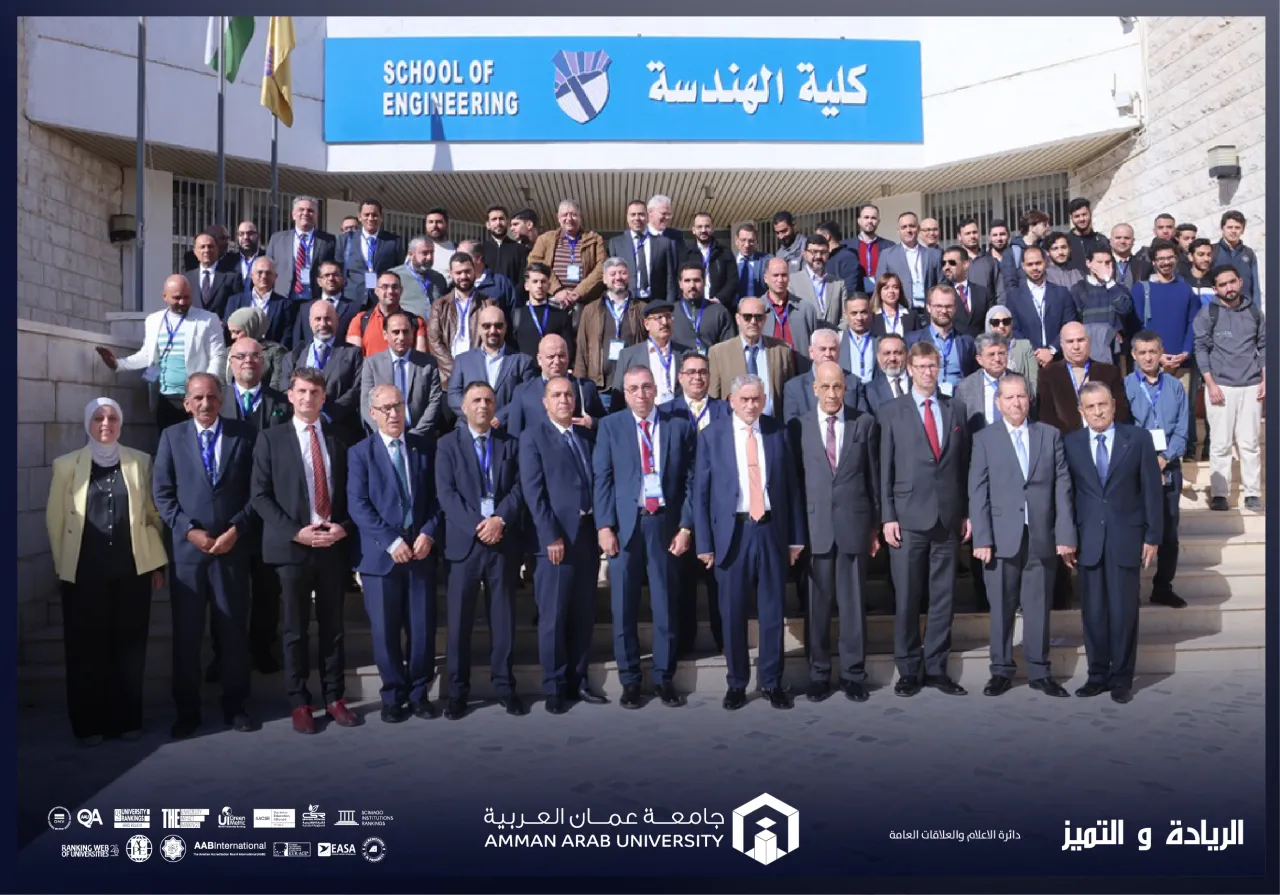
Amman Arab University participated in the works of the first regional conference "Green Energy in the Middle East and North Africa: Solar Power, Green Hydrogen, and Agricultural Technologies" (GE-MENA 2025), launched by the Faculty of Engineering at Jordan University, with wide participation from experts and international institutions.
Representing Amman Arab University at the conference were its President, Professor Mohammad Al-Widian, Dr. Anwar Al-Assaf, Dean of the Faculty of Engineering, and Dr. Ayman Agha, a faculty member in the Faculty of Engineering, in alignment with its vision and mission to support applied scientific research, enhance international partnerships, and develop the capacities of students and researchers in the fields of renewable energy, green hydrogen, and smart agriculture, contributing to enabling Jordan to transition towards a green economy based on knowledge and innovation.
During the opening events of the conference, Professor Nidhal Obeidat, the President of Jordan University, emphasized that green energy represents a "historic investment in the future of generations". Engineer Baker Al-Balawneh, representing the Minister of Agriculture, praised the role of innovation and partnership with universities in developing smart agriculture and addressing the challenges of climate change and water scarcity.
Participating in the opening session was Mr. Patrick Limbrechts, representing the European Union mission in Jordan, who pointed out that the priorities of the new Mediterranean agreement align with Erasmus+ programs, supporting green skills and higher education, as well as Dr. Bertram von Moltke, the German Ambassador, who confirmed that renewable energy "is the only way forward", praised Jordan's promising capabilities in solar power and green hydrogen. Professor Munwar Traiqeh, Dean of the Faculty of Engineering at Jordan University, presented his vision for the future of energy based on smart systems and digital analytics and artificial intelligence, asserting that the projects participating in the conference embody this scientific shift; Dr. Ahmad Abu Al-Haija, director of the Erasmus+ office in Jordan, presented environmental projects implemented by the program in Jordanian universities and their role in enhancing sustainability skills and digitalization.
Professor Ahmed Al-Salaymeh, President of the Organizing Committee, affirmed that the conference represents the fruit of many years of international cooperation between Jordan University and European and Arab institutions, through projects such as HYMENSO, INNOMED AgroTec, and GREEN, which have contributed to building capacities and developing advanced programs in energy and smart agriculture.
Experts and academics from more than (15) countries participated in the conference, including: Germany, Italy, the Netherlands, Austria, Morocco, Algeria, Egypt, Palestine, the UAE, Sudan, Slovakia, Greece, and Cyprus, in addition to global universities and institutions such as Hamburg University of Technology, Berlin Technical University, University of Innsbruck, University of Salento, and University of Cyprus, alongside Jordanian universities: Amman Arab University, Mutah, Science and Technology, Al-Hussein Technical, and the National University for Technology, as well as prominent participation from Arab universities including Cadi Ayyad University, Mohamed V University in Morocco, Palestine Polytechnic University, Palestine Technical University–Kadoorie, the Arab Academy for Science and Technology, and Ras Al Khaimah University.
The conference offered a rich scientific program including more than (10) specialized research sessions addressing key themes in solar energy, green hydrogen, hybrid energy systems, energy consumption efficiency, smart agriculture, using artificial intelligence in water management and agriculture, entrepreneurship, and innovation in the energy sector, in addition to discussing outputs of international research projects and scientific papers on chemical energy storage, thermal energy, smart grids, and advanced hydrogen production technologies.
It is noteworthy that Amman Arab University, through its participation in this conference, reaffirms its commitment to its national and regional role in supporting the research and innovation system and enhancing the contribution of youth in developing sustainable future solutions that serve the energy and agriculture sectors and support water and food security in Jordan and the region.