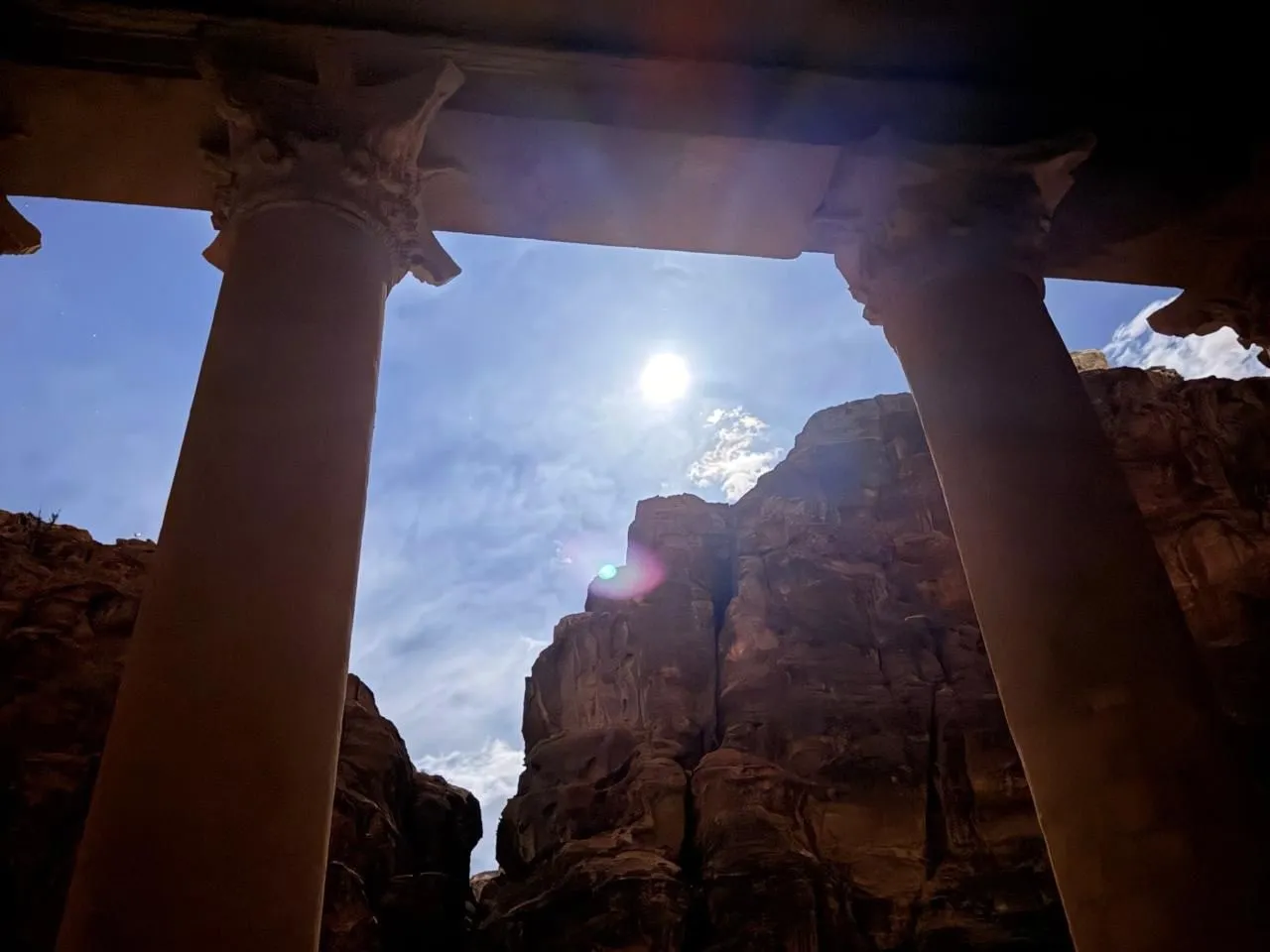
Khaberni - The city of Petra witnessed the observation of a rare astronomical phenomenon characterized by the appearance of the supermoon above Al-Siq, aligning with the Treasury building, in an exceptional scene that was documented directly in front of the Treasury through the Pioneers Association for Astronomical Tourism, in collaboration with the Petra Development and Tourism Region Authority.
Theoretical Physics Professor, Dr. Ammar Al-Sakaji, explained that this phenomenon coincides with the period of major lunar stability, which recurs every 18.6 years, where during this period the moon reaches its maximum range in its orbit around the Earth, rising and setting from the furthest points north and south on the horizon, making its appearance in Petra during this time rare and unique.
For his part, the head of the Pioneers Association for Astronomical Tourism, researcher Mamoun Al-Nawafleh, indicated that the moon rises above the Petra site at an angle of 57 degrees northeast, which is the maximum angle for moonrise during the lunar stability, and with its apparent movement on the horizon, it gradually shifts to reach an inclination angle of 62 degrees at the moment it appears from above Al-Siq aligning with the Treasury building, which nearly follows the same astronomical direction, which is the same angle at which the sun rises in Petra during the summer solstice.
This precision in astronomical alignment confirms that the Nabataeans conducted long-term systematic observations of celestial bodies before constructing the Treasury, reflecting an advanced level of astronomical knowledge that they employed in the planning and engineering orientation of their city landmarks.
Both Al-Nawafleh and Al-Sakaji emphasized that the Pink City is rich in many archaeological astronomy landmarks, affirming that the association will work in cooperation with the Petra Region Authority on organizing future observational and tourist events to document more important astronomical phenomena within the site.
This observation re-emphasizes the scientific and cultural value of Petra, and the unique astronomical and architectural heritage that the Nabataeans presented more than two thousand years ago.