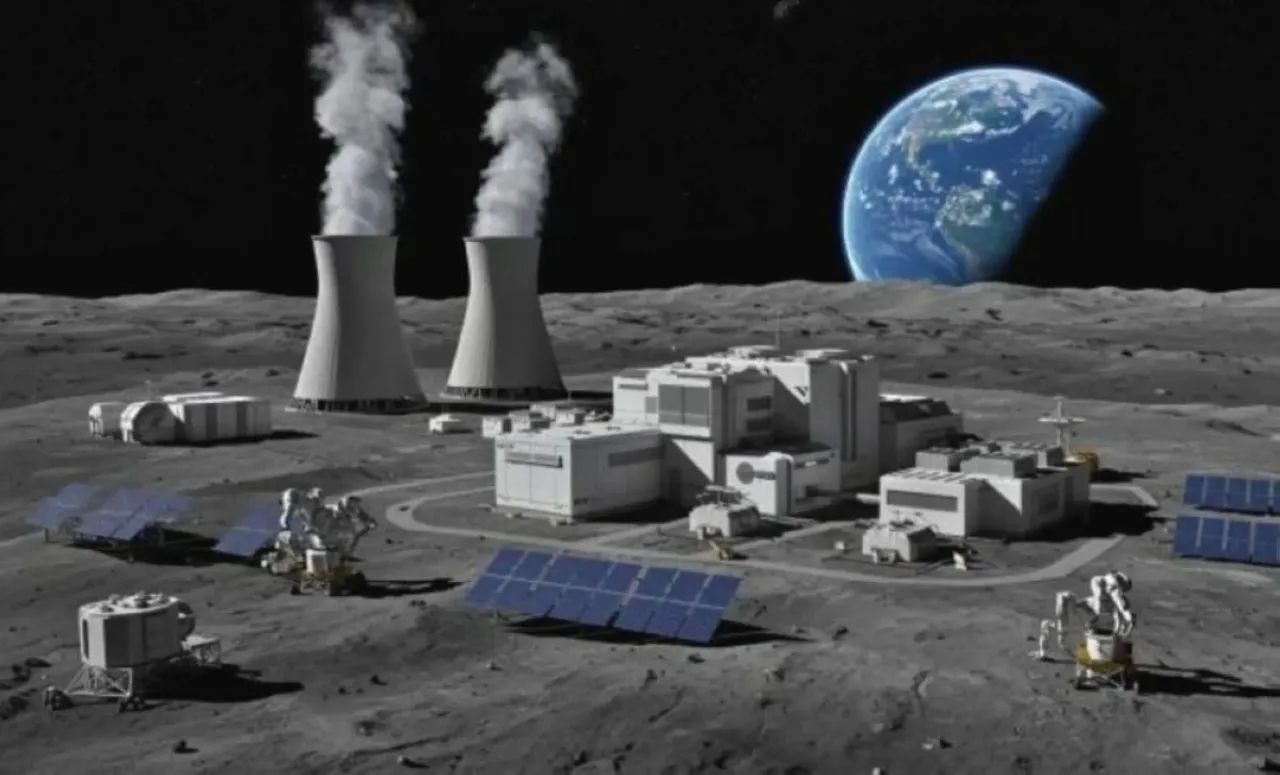
Khaberni - As the global race towards lunar colonization escalates, NASA has unveiled a bold plan that could completely change the future of space exploration: sending a nuclear reactor to the surface of the Moon by 2030. A step that may seem like science fiction, but has today become part of a real strategy aimed at establishing the first permanent human base outside Earth.
Given the long periods of darkness on the Moon, and the failure of solar power to provide a stable supply, NASA sees nuclear power as the only solution to enable sustained human life on its surface.
With China and Russia entering the competition with similar projects, it's no longer just a scientific experiment, but an early battle for who will lay the first foundations for survival in space.
NASA plans to send a nuclear reactor to the Moon by 2030 as part of its efforts to establish a permanent human habitation base, the project aims to provide a reliable power source on the lunar surface, where solar power alone is insufficient due to long periods of darkness.
The United States has accelerated the implementation of this proposal in response to increasing international competition. NASA's push to build a nuclear reactor supports future lunar exploration, including the Artemis missions that will send humans to the Moon.
The need for reliable power on the Moon
One of the biggest challenges in establishing a lunar base is generating sufficient power for human life. A lunar day lasts about 28 Earth days, with two weeks of sunlight followed by two weeks of darkness, making reliance on solar power difficult, especially for missions that require continuous power.
Dr. Sungwoo Lim, a senior lecturer in space applications at the University of Surrey, said: "Even building a modest lunar habitat to accommodate a small crew requires generating power on the megawatt scale. Solar panels and batteries alone cannot meet these needs."
With the limited capacity of solar panels and batteries, experts agree that nuclear power may be the only solution to meet these needs.
NASA's plan includes a reactor capable of producing at least 100 kilowatts, which is relatively small compared to a wind turbine on Earth, which can produce between 2 and 3 megawatts. Despite its small size, nuclear power can provide a stable and reliable power source, which is crucial for long-term lunar missions, according to "dailygalaxy".
Space Power Struggle
The race to establish a presence on the Moon is accelerating, with NASA facing increasing competition from China and Russia, who also plan to have nuclear power stations on the Moon by 2035.
US officials, such as Sean Dauffy, Acting Chief of NASA, have expressed concerns that China and Russia might create exclusive zones around their lunar operations, which could complicate international cooperation.
Some experts, like Dr. Simeon Barber, a planetary science specialist at the Open University, believe that competition may spur innovation, while others worry that focusing on national interests could hinder broader scientific goals. Barber said: "It seems we are returning to the days of the first space race, which from a scientific perspective is disappointing and concerning."
Can these obstacles be overcome?
Launching radioactive materials into space carries known risks, especially concerning safety during transportation. Dr. Barber explained that obtaining the necessary permits is required, but the task is not impossible, and similar technologies are already under development. However, the technology needed to operate a reactor safely on the Moon remains complex and costly.
He added: "If you build a nuclear reactor or any base on the Moon, you can then start claiming a safety zone around it, because you have equipment there."
Aside from the challenges of launching nuclear materials, NASA also needs to find a way to build the necessary infrastructure on the Moon. With the progress of the Artemis program, which aims to send humans to the Moon by 2027, delays and budget cuts have raised concerns about the timeline.