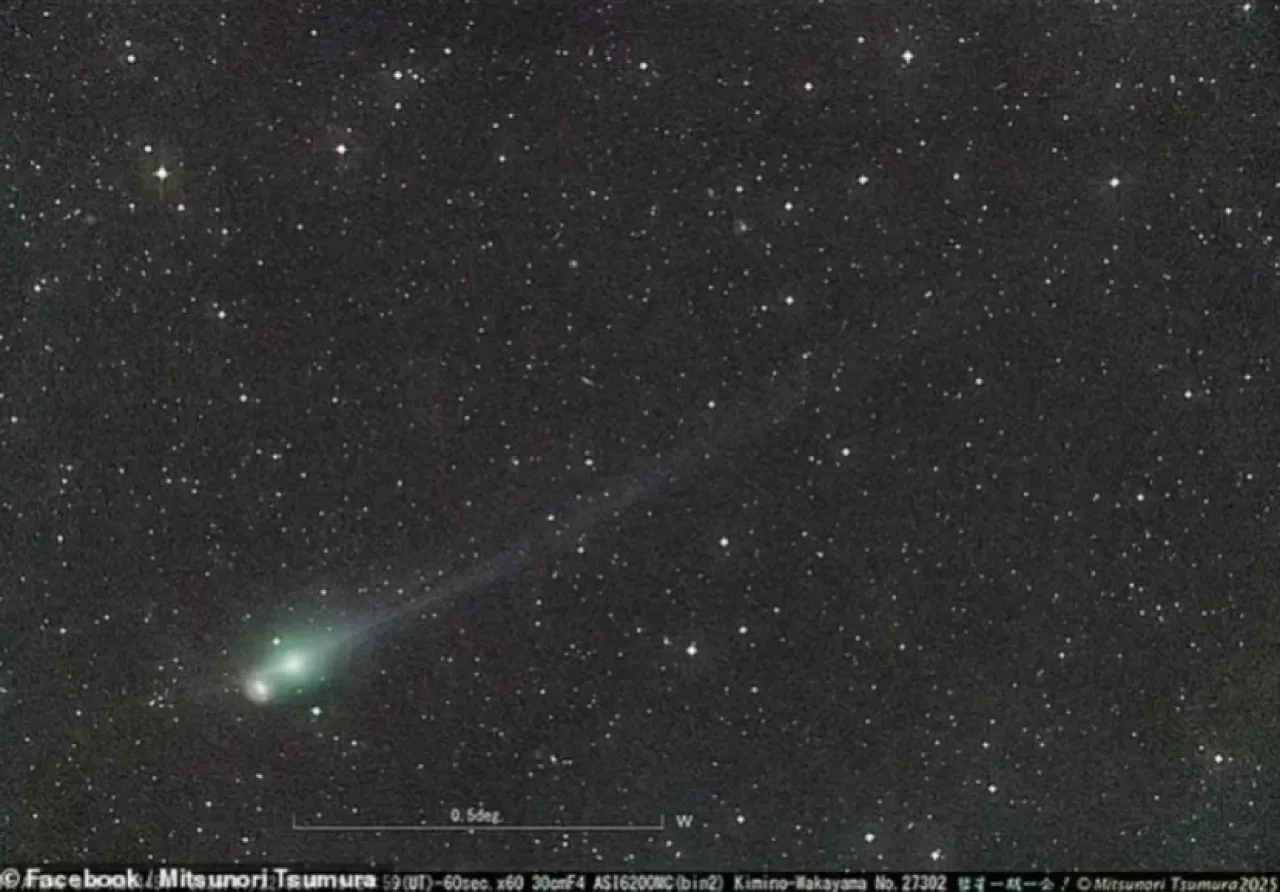
Khaberni - In an astronomical phenomenon that puzzled scientists and sky enthusiasts, the mysterious interstellar object 3I/ATLAS began emitting regular pulses resembling heartbeats, causing its brightness to increase and decrease by 20 to 40% every 16.16 hours as it gradually approaches Earth over the next two weeks.
Recent observations show periodic eruptions of gas and dust, known as jets, rhythmically bursting from the comet's surface, resembling a pulsating space heart, creating a stunning astronomical spectacle visible with terrestrial telescopes. According to scientists, this phenomenon has been continuous since the comet entered the solar system, and may have started much earlier.
Professor Avi Loeb from Harvard University has reopened the debate on the nature of this object, indicating that the large gas halo surrounding the comet, known as the coma, is the source of the light, not just the nucleus itself, which makes the brightness fluctuate more than expected, and raises new questions about the behavior of this strange object.
However, NASA and the European Space Agency confirmed that 3I/ATLAS is just a natural comet. The agencies explained that the pulses result from the rotation of the comet's nucleus, which heats the ice patches when they face the sun, causing them to leak out as regular jets with speeds up to 985 miles per hour, spanning a distance of 15,900 miles, resembling a self-operating engine.
Prior observations have added to the mystery, as scientists noticed that the comet exhibits unusual phenomena, including a tail pointing in the opposite direction, a color change to blue near the sun, and shifts in its course not explained by gravity alone. NASA believes these oddities could be the result of the comet originating from another solar system with a different chemical composition.
The space agencies assured that the comet poses no threat to Earth, as it will pass at a distance of 170 million miles on December 19, but they confirmed that this opportunity is valuable for enhancing global capabilities for monitoring space objects. The United Nations planetary defense systems started monitoring 3I/ATLAS since November 27, in coordination with the International Asteroid Warning Network (IAWN), in an observation campaign that will continue for two months.
Given all these observations, Professor Loeb urges scientists not to underestimate the phenomenon, stating: "These pulses may have a significant impact on our understanding of space and the future of humanity, therefore, this object should be studied with complete openness and not just with conventional explanations."