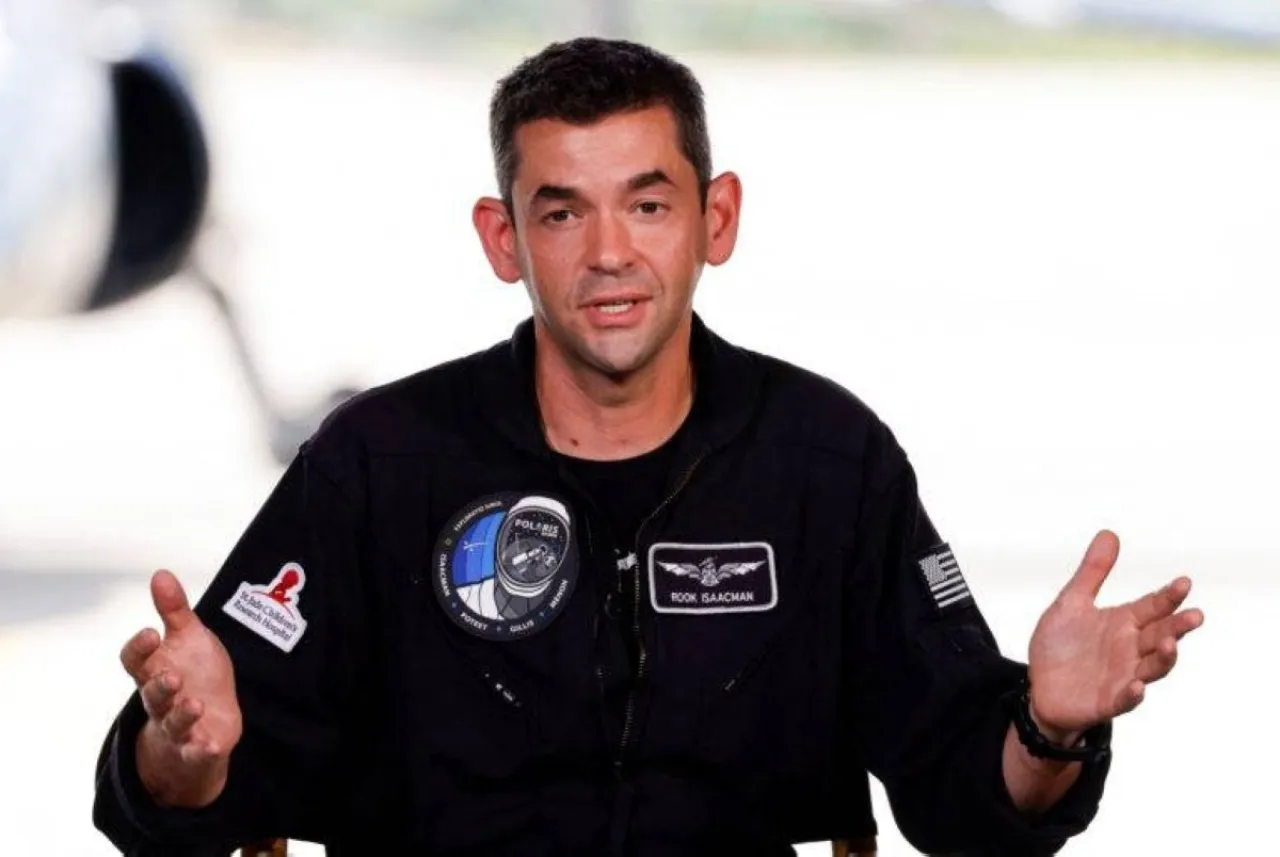
Khaberni - Jared Isaacman is an American entrepreneur and seasoned astronaut who started his career by founding the payment processing company Shift4 Payments at age 16, which serves thousands of hotels and restaurants in the United States, and thanks to this company, he amassed a fortune estimated at about 1.4 billion dollars according to "Forbes".
In 2012, he founded "Draken International" to train military pilots, which owned a fleet of private military aircraft, showing the diversity of his interests between business, aviation, and defense.
His ambitions went beyond money to a passion for space and leadership, as he led the (Inspiration4) mission in 2021, which was the first orbital flight with an all-civilian crew, a mission he personally funded, and it ended successfully after 3 days in orbit.
Afterwards, he led the "Polaris Dawn" mission in 2024, which was the first private space mission to include a spacewalk by civilians, part of a series of private missions he himself funds within his vision for commercial space.
Today, Isaacman is running to lead NASA, carrying a vision to make space more open to the private sector and speed up American space programs towards the Moon and Mars.
In addition to being a businessman, he is a professional pilot and has extensive experience in aviation, and turned into a "private astronaut" after personally funding and contributing to civilian space flights.
His achievements in space
In 2021, Isaacman led Inspiration4, which was the first orbital space flight fully crewed by civilians, onboard SpaceX's Crew Dragon.
Isaacman also led the Polaris Dawn mission, which marked a historic event as he became the first civilian not affiliated with a government space agency to perform an extravehicular walk outside orbit, reinforcing his status and affirming his pioneering role in the world of commercial space.
Thanks to his balance of experience in the business, aviation and space sectors, many see Isaacman as a unique figure blending private leadership and an ambitious commercial approach, which could give NASA a boost different from traditional methods.
His candidacy for leading NASA
In December 2024, President Donald Trump nominated him to be NASA’s 15th director, a move that is out of the ordinary, nominating someone from outside the traditional space establishment.
However, in May 2025, Trump withdrew his nomination amid political tensions and disagreements with Elon Musk, founder of SpaceX, according to the "Guardian" newspaper.
Weeks after a temporary administration led by the Secretary of Transportation, Trump renominated Isaacman in November 2025, bringing his candidacy back into the spotlight.
During the final hearing before the Senate Committee on Commerce, Science, and Transportation, Isaacman emphasized that NASA needs "dedicated and stable leadership" ahead of its first manned mission to the Moon in years, warning that delays could give international competitors, implicitly referring to China, the upper hand.
Why is he seen as a fresh choice for NASA?
His supporters believe that his mix of experience in business, private space, and civilian spaceflight leadership provides NASA with a modern character in line with the era of commercial space and space globalization.
Isaacman believes that advancing the Moon program (and later preparing for Mars) must be accompanied by adopting a commercial space economy involving private companies, not just government agencies.
In his message to Congress, he requested immediate, stable leadership to enable NASA to adhere to ambitious timelines, and not miss the opportunities in the global space race.
Challenges and criticisms
Isaacman faces criticism for being an outsider, not from the ranks of NASA government astronauts or military research leaders, but as a businessman and private aviator, and there is also concern about potential conflicts of interest between his relationships with private space companies (especially SpaceX) and his potential responsibilities as NASA director.
Some scientists and traditional space cadre fear that priorities of profit and efficiency may overshadow basic scientific research tasks or long-term space programs.
Jared Isaacman represents a bridge between traditional government space and the modern commercial space, as he is a billionaire and civilian astronaut, combining money, ambition, and executive experience, presenting himself as a man capable of leading NASA into a new era of ambitious missions like the Moon and Mars.
While his nomination has support from several astronauts and politicians, it raises an important question: Will NASA be able to maintain a balance between profitability, innovation, and its noble scientific mission, or will its priorities change completely?
Finally, the billionaire astronaut promoted his plans to return American astronauts to the Moon before China arrives and sought to present himself as independent from Elon Musk, CEO of SpaceX, while facing a second Senate hearing to confirm his appointment.
Isaacman, the e-commerce tycoon who traveled to orbit twice on entirely private space missions as a client and collaborator with SpaceX, told the Senate members that lagging behind in the Moon race with China "could shift the balance of power here on Earth".
Isaacman confirmed in his latest statement before the Senate Committee that the United States is committed to sending manned missions to the Moon before China, amid a technical and geopolitical race between the two powers, emphasizing the need for constant and effective NASA leadership to ensure readiness for manned flights under the "Artemis" program.
He clarified that the current priority is the Moon, with sending humans to Mars being a later step, noting that potential delays in developing SpaceX's landing craft could delay the program, which requires close monitoring.
He asserted that his relationship with Elon Musk is strictly professional and that he is committed to achieving NASA's goals without conflicts of interest.