Khaberni - The Omani Association for Writers and Literature in the North Eastern Province in Ibra hosted an exceptional critical and poetic evening that combined the sensitivity of poetic writing and the depth of critical analysis. The event was notably attended by academics, poets, critics, and intellectuals. Prof. Saad Al-Tamimi delivered an extensive lecture discussing the aesthetics of romantic poetry by the poets Jumana Al-Tarawneh and Fawz Riya, revisiting through a dense critical reading the pathways of emotional and aesthetic transformation in their experiences, and how their romantic poetry opens up a horizon that transcends personal confession to construct a vision where language, identity, and the resistant female voice intertwine. Al-Tamimi clarified that women's poetry, as it has emerged in recent decades, is no longer merely an extension of a male voice that imagines a woman and dresses her in his language. Instead, it has become a space for women to craft their unique language, and carve their existential experience from within. The lecturer paused to mark this shift, showing that the poets broke the centrality of the Khaleelian rhythm with its authoritarian structure, thus paving the way for free verse and prose poetry to become suitable mediums for expressing nuances of intimacy, internal unrest, and intense physical and spiritual experiences.
Al-Tamimi started from this theoretical framework to reflect on how women's writing has become a space to rebuild the relationship with the self and the world, through bold texts that explore pain, resistance, silence, absence, and maternal longing, and the formation of identity. In this context, he noted that contemporary female poetry can only be understood as a cultural act that repositions the woman within the language itself, liberating her from being merely a foundation for metaphors or imagined aesthetics. As the expressive space expanded, the female poem today has become a document of emotion, a laboratory of the inner self, and a dramatic space where the voice interacts with its existential surroundings. From here, the importance of reading two different poetic experiences, Jumana Al-Tarawneh and Fawz Riya, emerged as they exemplify the shift from the structure of traditional love to a cognitive love structure that questions itself and its relationship with the world.
Al-Tamimi discussed the experience of Jumana Al-Tarawneh as a voice that builds its linguistic body on rhythmic tension and emotional richness, where the music in her collection "The Ruby Ring" becomes a carrier of meaning, not just a decorative element. He pointed out that Al-Tarawneh combines the precision of poetic sentence and the strength of imagery, in a balance that makes the confession intense and charged with the moment of admission, yet it is an admission that implicitly contains fear and desire, and makes the body a central metaphor shining through non-direct linguistic layers. Through his reading of selected verses, Al-Tamimi illustrated the conflict between containment and asphyxiation, and how the beloved transforms into a transcendent being, not as a person, but as an emotional destiny that tests the self and reveals its fragility.
He then moved on to the experience of Fawz Riya through her collection based on invoking the mother on the verge of coma, where the call "My great lady" transforms into a sound and spiritual system that reconstructs the mother's presence within the language. Al-Tamimi indicated that Riya writes a silent pain that flows in a calm yet deep tone, and that sadness for her is not merely an emotional state, but a daily ritual in which absence turns into a form of companionship, and into a poetic time accumulated by calls that open up to the spiritual and existential dimension. He offered a comparison between the two experiences, emphasizing that Al-Tarawneh writes the body as a question, while Riya writes sadness as a path to revealing the self. Yet, both voices converge in the belief that poetry is not a linguistic comment on life but a space where the inner world of the woman is reshaped through the language itself. Al-Tamimi concluded that the transformation of the female voice from traditional couplet love poetry to prose invocation is a comprehensive cultural shift that redefines the function of poetry and paves the way for a new phase where the female text is a laboratory for vision, not a repetition of an image.
After the critical lecture, the audience moved to a parallel space celebrating live poetic voice, as if the evening wanted to bridge theory with its manifestations, and analytical reading with the voice of the text itself as it breathes on the stage. The poets Jumana Al-Tarawneh and Fawz Riya read selections from their poems, offering attendees a tangible representation of the aesthetics discussed in the critical analysis. Their readings were a natural extension of the essence of the lecture, touching the listeners' emotions with their mature emotions and emotional tensions ranging from brokenness and richness, and between flashing shadows and flowing confession. The tone of romantic expression differed between the two poets; Al-Tarawneh's was more inclined to complex nostalgia mixed with artistic honesty, while Riya's took a form closer to deep confession that reveals the fragility of the soul and strength of its presence simultaneously. Between the two, the poems illuminated a diverse path showing how love in modern female experiences becomes a tool for reshaping the self, not just restoring a fleeting moment of passion, but building a new meaning born from the language and returning to it.
The evening continued with a reading by the poet Hamoud Al-Aissari, who added a different dimension through poems pulsating with tense rhythms and images that open up to multiple imaginative spaces. His reading formed a complementary presence that allowed the audience to discover the diversity of poetic sensitivity in the evening, where the interplay of three voices seemed to weave a complete poetic tapelety, juxtaposing women's emotional tones with the more open language for self-reflection in Al-Aissari's works, creating a panoramic poetry of multiple levels of amazement.
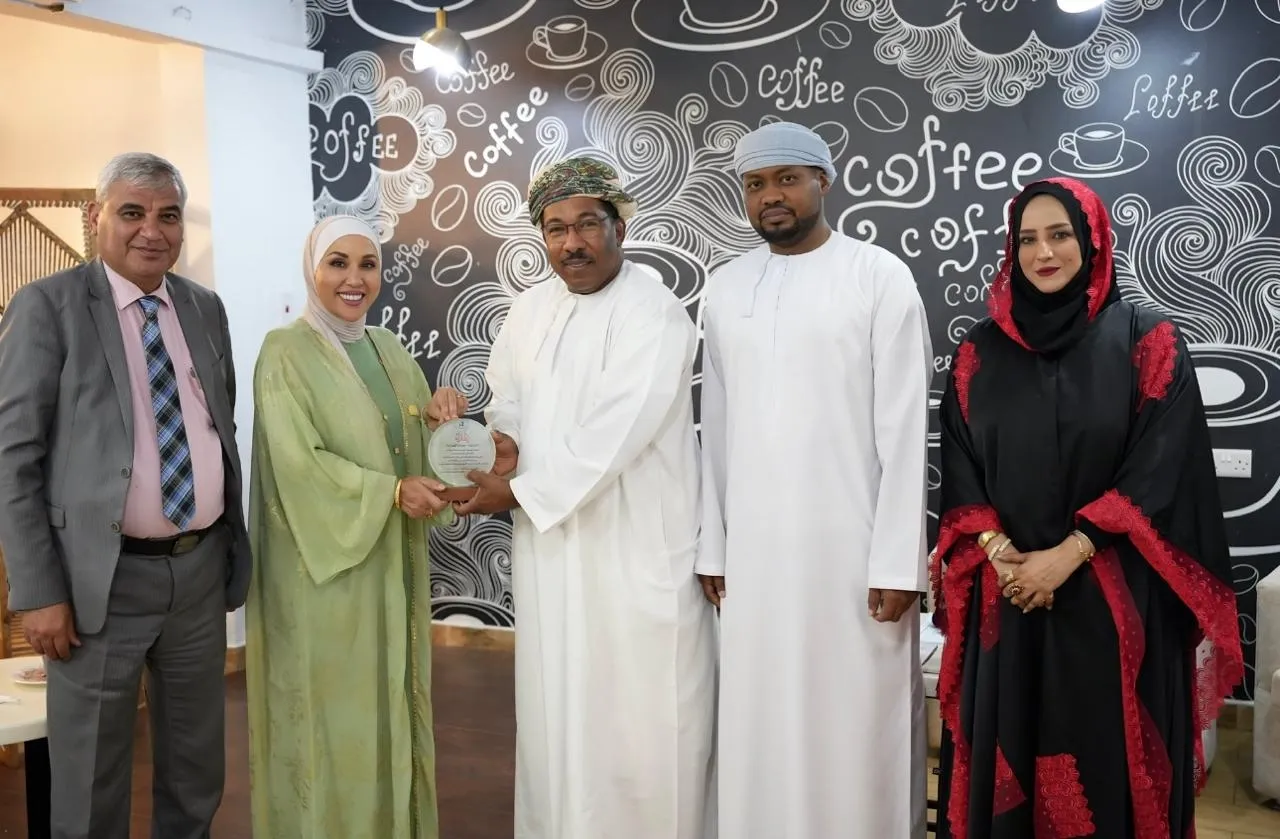
At the end of the session, the Omani Association for Writers and Literature honored Prof. Saad Al-Tamimi and the poets Jumana Al-Tarawneh and Fawz Riya, in a moment of celebration that recognized the intellectual and creative effort that enriched the evening and broadened its horizons. With this recognition, the scene was complete, as the audience left carrying the impact of an evening that joined criticism with poetry, and knowledge with experience, in a night that restored the poem's presence and the cultural platform's role in stimulating taste and reviving aesthetic dialogue.