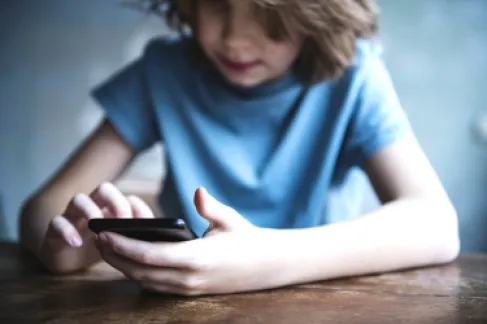
Khaberni - The timing of giving a child a smartphone often sparks much debate among parents, who find themselves torn between the desires of teenagers on one hand, and the warnings of researchers on the other. In this context, the "New York Times" reported that a new study supports the calls to delay giving children smartphones as much as possible.
The study, published in the Journal of Pediatric Medicine, revealed that children who received their phones at age 12 were more prone to depression, obesity, and lack of sleep compared to those who had not yet received a phone. The researchers based their analysis on data from more than 10,500 children involved in the Adolescent Brain Cognitive Development project, which is the largest long-term study of brain development in the United States.
The results showed that the younger a child was when they received their first phone, the higher the risk of health problems. The lead author of the study, Dr. Ran Barzilai, says that giving a child a phone should be viewed as a "health decision" that requires careful consideration.
Although the study shows a correlation and does not prove a direct causal relationship, researchers point to previous evidence indicating that owning smartphones reduces the time children and teenagers spend on social interaction, exercising, and sleeping, which are fundamental elements for physical and psychological health. They emphasize that adolescence is a very sensitive phase, and minor changes in sleep or mood can have long-lasting effects.
Researcher Jacqueline Niece warns against rushing to adopt phones at a young age, stressing that parents do not need to wait for "conclusive evidence" to hesitate in giving their children digital devices.