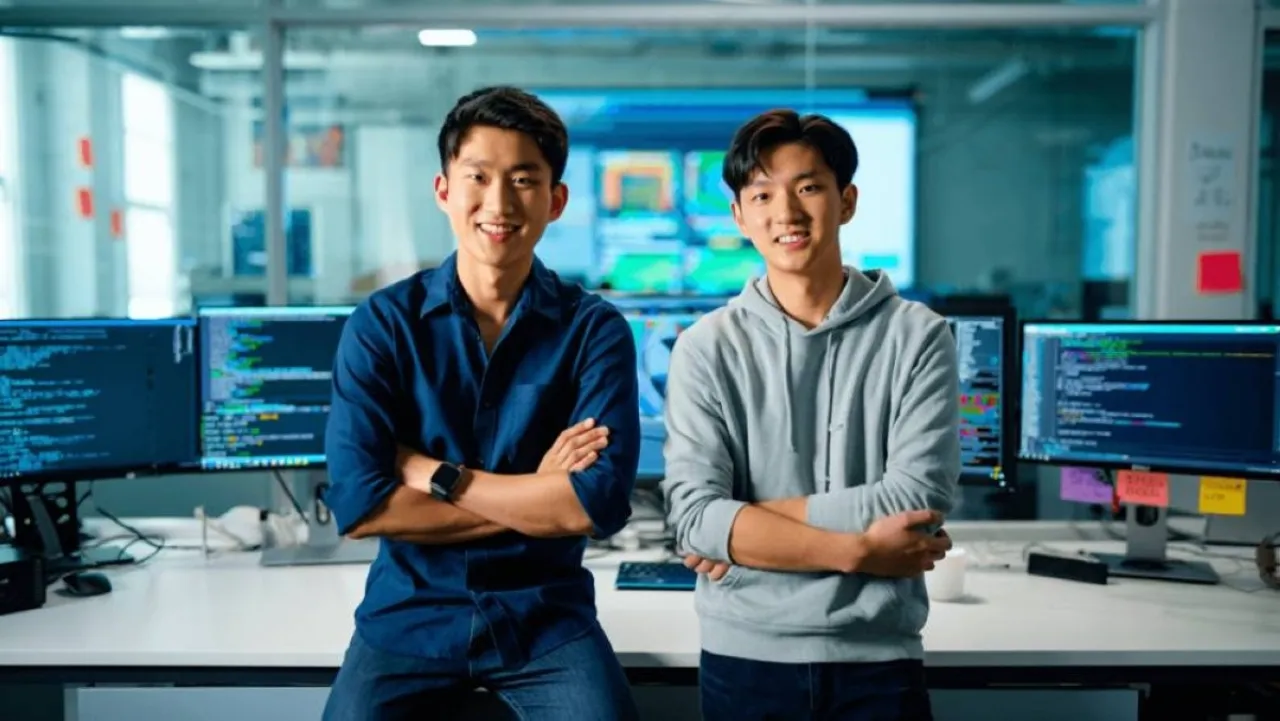
Khaberni - In a surprising move within the technology sector, two young Americans from Michigan, both 22, refused a substantial offer from the American billionaire Elon Musk through his company xAI, in exchange for acquiring their promising AI project. This decision is seen as a significant risk, but it reflects the deep conviction of the founders that their idea could change the rules of the game in this vital field.
The founders, William Chen and Guan Wang, who met in high school, were united by early interests in what they described as "superordinate goals", with Wang dreaming of creating an algorithm capable of solving any problem, while Chen focused on improving complex systems in engineering and real environments. After graduating, the two moved to Tsinghua University in Beijing, where they continued working on their ambitions under the guidance of university professors.
There, the young men developed a small linguistic model named OpenChat, trained on high-quality conversations based on reinforced learning. Despite its small size compared to well-known massive models, OpenChat received significant attention in academic circles until it caught the eyes of Musk, who tried to acquire it in exchange for a multi-million dollar deal, but the young founders preferred independence and to freely develop their idea.
Chen says in an interview with Fortune Magazine: "The massive language models have reached their limits. We wanted to build a new architecture that transcends the structural constraints of machine learning." From here, the two established their new company, Sapient Intelligence, which developed an innovative model they named Hierarchical Reasoning Model - HRM.
HRM relies on a dual iterative structure that mimics human thought processes by integrating deliberate thinking and quick responses, unlike traditional models that mainly rely on statistical prediction.
In June, the prototype model, which was only 27 million parameters in size, amazed researchers after it outperformed leading models from OpenAI, Anthropic, and DeepSeek in abstract thinking tests such as advanced sudoku solving, navigating mazes, and the ARC-AGI standard designed to measure near-human reasoning capabilities.
Chen points out that the new model "analyzes and perceives instead of guessing," confirming that it has a much lower rate of hallucination than traditional models, and it has shown advanced performance in practical applications including weather forecasting, quantitative trading, and medical monitoring.
Experts believe that rejecting Musk's offer could represent a turning point for the startup, especially since the founders aim to achieve General Artificial Intelligence (AGI), a goal pursued by the world's largest companies.
Sapient Intelligence plans to open a new office in the United States in the coming period, in a move aimed at expanding its operations and enhancing its presence in global competition.
With this bold move, the young men continue to shape the future of artificial intelligence, placing their ambition above financial temptations and betting on a new architecture that could change the entire industry.