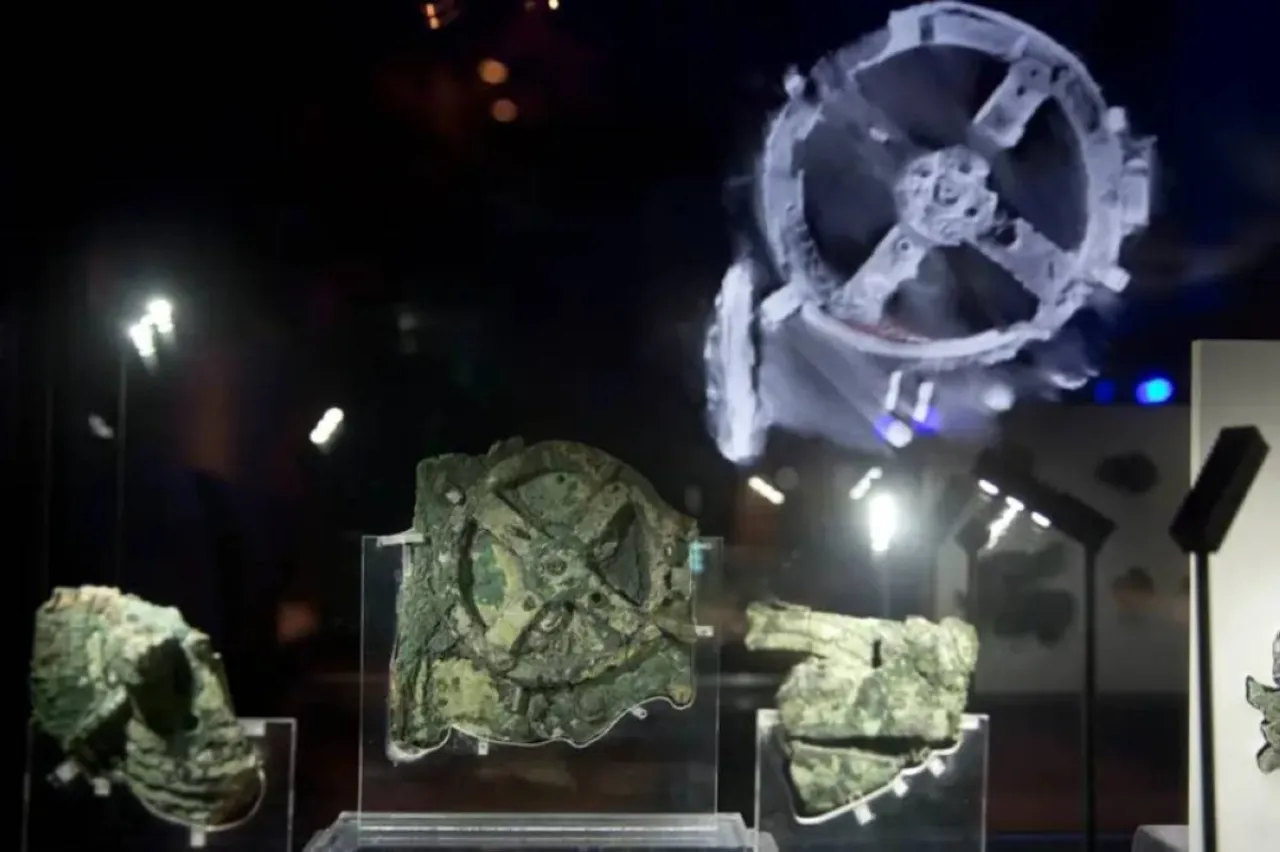
Khaberni - More than two thousand years ago, the Greeks created a mechanical device so advanced that it still remains a mystery to scientists today. The discovery, named the Antikythera mechanism, was found in the early twentieth century in the wreckage of a Roman ship off the Greek island of Antikythera, and is believed to be the world's first "computer".
The mechanism dates back to the period between the third and first centuries BC, and represents a staggering model of ancient Greek technology, containing more than 30 intricately interlocking bronze gears.
The device was designed to track the movements of the sun and moon and the five visible planets—Mercury, Venus, Mars, Jupiter, and Saturn—as well as to determine the dates of eclipses and sporting events such as the Olympic Games, according to dailygalaxy.
One of the most prominent elements of the mechanism is its system of advanced circular gears, which allowed it to simulate the varying speed of the moon due to its elliptical orbit, a technique not used in Europe until the fourteenth century.
The mechanism also contains two spiral dials that track long astronomical cycles, such as the Metonic cycle, which synchronizes the lunar and solar calendars over a period of 19 years, and the Saros cycle, which predicts solar and lunar eclipses over a period of 18 years.
Over time, the mechanism deteriorated due to the corrosion of the bronze from salts and minerals in the seawater, and only 82 pieces remain, while the rest is believed to be buried under the sea bed or lost forever.
In the 1970s, X-rays revealed the complexity of the internal device, confirming that it was not merely a decorative piece, but an advanced astronomical computer. Physicist Derek de Solla Price described it as akin to "opening a pyramid and finding an atomic bomb."
In the early new millennium, scanning techniques and modern imaging revealed thousands of Greek letters inscribed on the gears, which included complex astronomical instructions, confirming the device's precise scientific use.
The discovery of the mechanism has raised new questions about the level of scientific and engineering knowledge in Hellenistic Greece, and why such advanced technology disappeared for centuries.
A recent study in 2024 suggested that the device might have relied on a lunar calendar, which sparked a complex debate among researchers about the accuracy of the ancients' understanding of astronomical calendars and multiple time systems.
The Antikythera mechanism remains a symbol of lost science, a testament to the ingenuity of ancient civilizations, and continues to pose a significant challenge to scientists and engineers trying to decipher it, potentially revealing secrets that could change our understanding of scientific history.