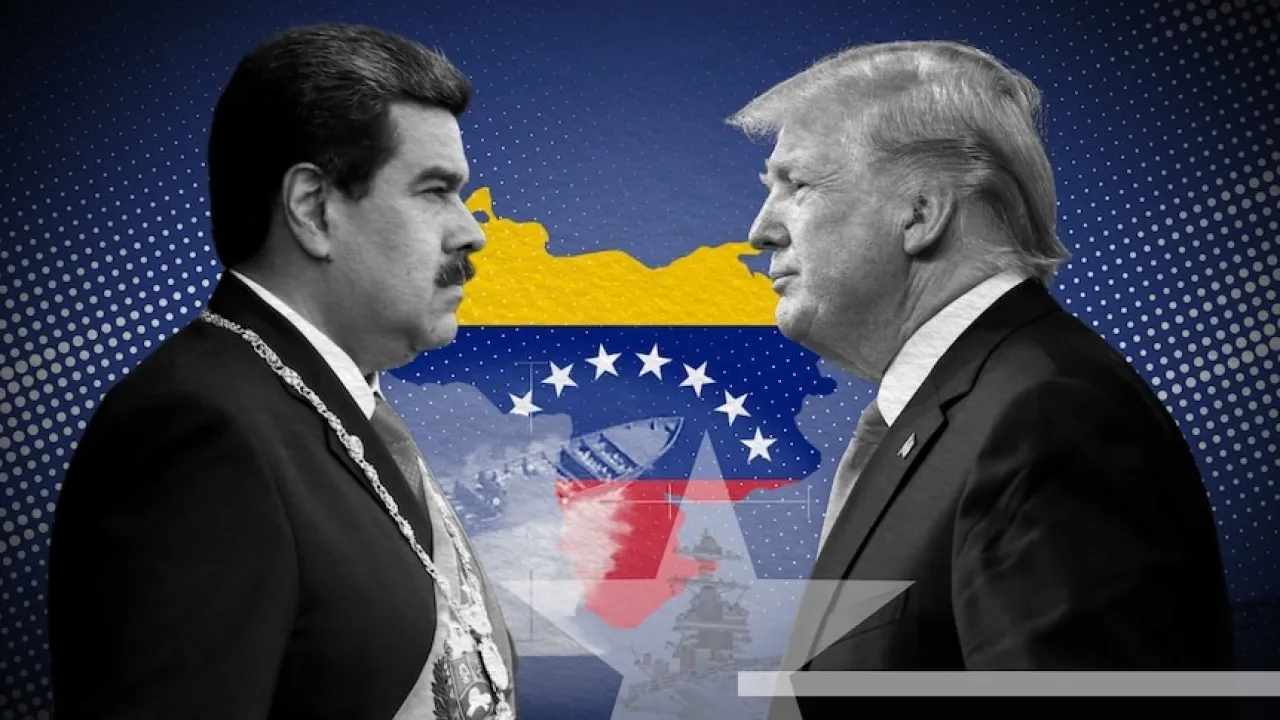
Khaberni - The American newspaper "Miami Herald" reported that President Donald Trump asked his Venezuelan counterpart Nicolas Maduro in a phone call, "to resign immediately and leave the country."
The newspaper reported on Sunday, citing informed sources, that the phone call between Trump and Maduro last week was abruptly cut off.
According to sources, Maduro requested Trump to maintain control over the Venezuelan military in exchange for allowing free elections, and the request, according to the newspaper, was rejected by Washington because it would create a structure for a "shadow government."
The sources claimed that Maduro also requested a "global amnesty" for himself and his inner circle regarding "crimes" they are alleged to have committed, which Trump rejected, telling his counterpart that "a safe passage (out of the country) could be provided for him, his wife, and their son, provided they leave immediately," according to the sources.
Trump confirmed the accuracy of what was published by the "New York Times" regarding a phone call with Maduro, but he avoided discussing the details, saying, "I can't say whether it went well or badly. It was a phone call."
Venezuelan Complaint
In this context, Venezuela complained to the International Civil Aviation Organization about the American president's announcement last Saturday about closing its airspace, considering it a violation of sovereignty.
Venezuelan Transport Minister Ramon Velasquez Araguaya stated in a declaration on Sunday that his country submitted a written complaint to the International Civil Aviation Organization, explaining that Trump's step bears the nature of illegal foreign intervention and constitutes a violation of sovereignty and the provisions of the International Civil Aviation Agreement, considering that Washington endangers the safety of civil aviation by providing misleading information.
Additionally, Venezuelan journalistic reports indicated that the government of President Maduro clarified in a message to the Organization of the Petroleum Exporting Countries (OPEC), that the American military movements in the Caribbean Sea pose a significant risk that may threaten the balance in the energy markets.
The message confirmed that Venezuela would "firmly" defend its natural energy resources and would not succumb to any threats or pressures.
On Saturday, Trump stated in a post on his platform "Truth Social" that all airlines, pilots, drug dealers, and human traffickers should consider Venezuelan airspace and its surroundings as completely closed.
Washington's Options
Washington is considering options regarding Venezuela to combat what it described as Maduro's role in supplying illegal drugs that have killed Americans, which the socialist Venezuelan president denies.
Tensions have recently escalated between the United States and Venezuela, with Trump issuing an executive order last August to increase military use under the pretext of combating drug trafficking gangs in Latin America.
Washington announced the deployment of warships and a submarine off the coast of Venezuela, while the American War Minister Pete Higseth stated that the military is ready for operations including regime change in Venezuela.
Maduro announced, in response, the mobilization of forces totaling 4.5 million people in the country, ready to repel any potential attack.
The attacks carried out by the American military on boats in the Caribbean Sea and the Pacific Ocean, under the pretext of smuggling drugs, sparked controversy over "extrajudicial killings" in the international community.
Since last September, American forces have targeted more than 20 vessels suspected of involvement in drug smuggling in the Caribbean and eastern Pacific, resulting in at least 83 deaths.