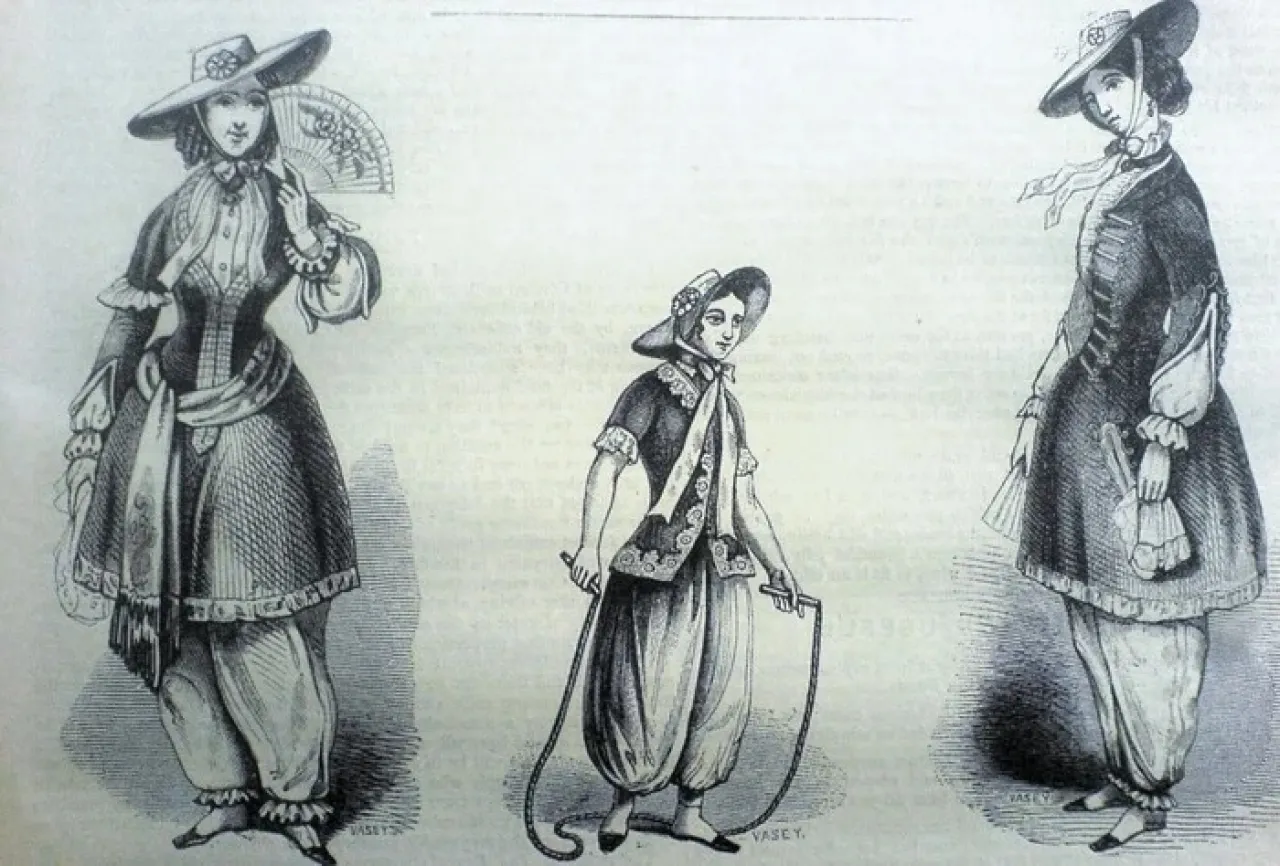
Khaberni - A century and a half ago, pants were not a normal piece of clothing in women's lives as we see today, but were a behavior deserving of cries of disdain, and perhaps arrest.
In 19th century Paris, it was not possible to see a woman walking in the street wearing pants without being met with scornful looks, and she could even be arrested by the police!
The European scene, particularly in France, was governed by strict laws prohibiting women from wearing trousers, as this was seen as a violation of the prevailing male order and a challenge to the institutionalized social distinctions between genders.
This prohibition dates back to post-French Revolution, specifically in 1799, when a law was enacted preventing women from wearing men's clothes, requiring any woman who wished to defy this tradition to go to the police station to obtain a special permit.
Obtaining this permit was not easy, as a woman had to provide a convincing reason, either for a medical condition related to her health or for a professional necessity that did not allow her to wear a dress. Despite these restrictions, hundreds of permits were recorded throughout the 19th century, including prominent figures like the famous animal painter Rosa Bonheur, and the archaeologist and novelist Jane Dieulafoy.
One of the notable challengers of this ban was the famous French writer George Sand, who was known for her masculine attire and her supportive stance towards women. When asked why she wore pants, she cleverly replied: "I am too poor and cannot afford dresses." This answer carried a biting sarcasm as, in fact, dresses at that time were really more expensive compared to men's suits, but the fundamental reason was not so much the cost as the desire to experience freedom of movement and emancipation from the traditional clothing restrictions that women had been denied for centuries.
The end of the 19th century and the beginning of the 20th century saw some minor relaxations; in 1892 and 1909, women were allowed to wear pants without prior approval in limited circumstances, such as while cycling or horseback riding. However, the intriguing paradox is that these restrictive laws officially remained in effect until late in the 20th century, when female members of the Senate and the National Assembly were finally allowed to wear pants during sessions in 1980.
Behind this long-standing ban were various economic, political, and moral arguments. Economically, men feared competition from women in the labor market if they wore clothing that allowed them freedom of movement and the performance of jobs that had been reserved for men. Politically, wearing pants was seen as an attempt by women to equal men and deviate from traditional roles. Morally, there were objections that pants showed body details and pressed on the lower section, which was considered indecent. Also, pants were viewed as a symbol of masculinity in Western culture, a symbol that was not deemed appropriate for a woman to touch.
In the face of these arguments, doctors stood by women, warning of the severe consequences of corsets and tight dresses that deformed bodies and deprived women of comfort and natural movement. This medical support contributed to breaking some of the social reservations. Gradually, step by step, French women gained the right to wear pants in limited contexts, during activities like cycling, sports, or working in male-dominated professions. Yet, the prohibition remained in place for loose clothing in public spaces.
World War I marked a major turning point in this issue, as society was forced to accept the idea of women wearing pants while they worked in factories and performed tasks left by men who went to the fighting fronts. By the mid-20th century, pants became more common and comfortable in women's wardrobes, but the law prohibiting them was not repealed until much later.
Women's rights to wear pants remained a hot topic of debate even in modern times, to the point that leaders like Nicolas Sarkozy failed to fully repeal this ban. The ban was not officially lifted until February 1, 2013, by the French Minister of Women's Rights, Najat Vallaud-Belkacem, who declared that the law from 1800 conflicted with the principles of equality between men and women as stipulated in the French Constitution.
Interestingly, the prevailing belief that "pants entered women's wardrobes from men" is not entirely accurate historically, as in Eastern cultures, women have worn wide trousers since ancient times.
It is worth mentioning that the traveler and writer Mary Montagu in the 18th century brought several pairs of women's trousers to London from her travels in the East, and although these trousers did not become very popular at that time, they represented a significant moment in the history of women’s struggle to obtain this right.
Over time, despite all the opposition that continues to this day from traditional groups, the new status of women wearing pants has become commonplace, almost as if it has been established forever.
This long journey of a specific piece of fabric reminds us that the freedoms we take for granted today were once the subject of bitter struggle for centuries and generations.