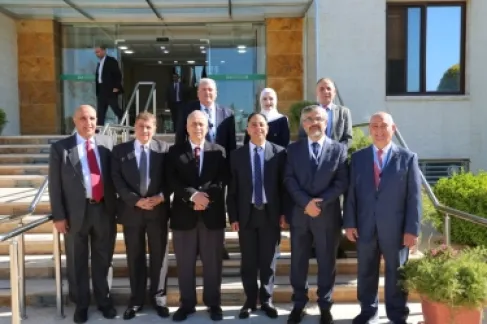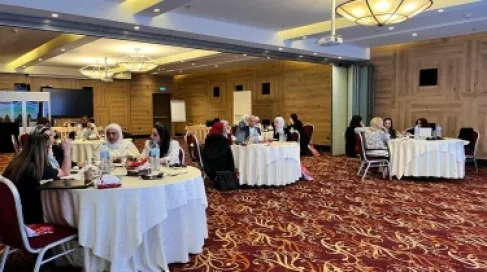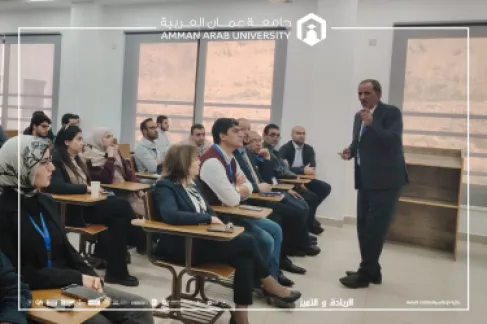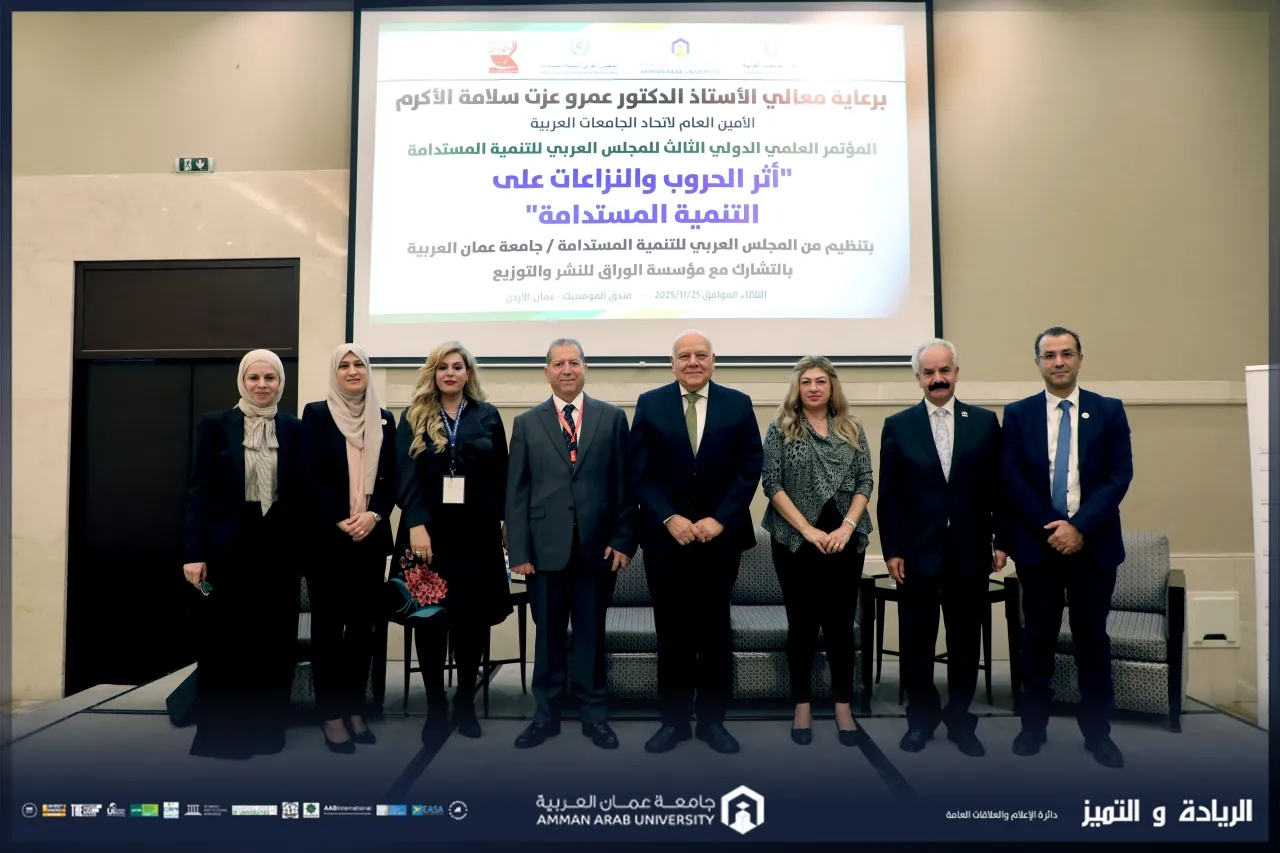
Khaberni - Under the patronage of His Excellency Professor Dr. Amr Ezzat Salama, Secretary General of the Association of Arab Universities, Amman Arab University hosted the third international scientific conference of the Arab Council for Sustainable Development at Amman Arab University, titled "The Impact of Wars and Conflicts on Sustainable Development", in cooperation with Al-Waraq Publishing and Distribution Foundation and attended by: Professor Dr. Mohammed Al-Widian, President of Amman Arab University and President of the Conference, Dr. Sherine Abu Ghazaleh, the General Coordinator and Director of the Arab Council for Sustainable Development, Professor Dr. Hassan Al-Zaubi, Chairman of the Preparatory Committee, the Vice President, his assistants, deans of faculties, and members of the faculty and administrative bodies, with the participation of a group of experts and academics and researchers from various Arab and international countries including three key international speakers, held at the Mövenpick Hotel – Amman.
In this regard, Dr. Amr Ezzat emphasized the importance of holding this conference under exceptional circumstances prevailing in the region, noting that wars not only destroy infrastructure but also leave deep impacts that extend for many years on the paths of economic, social, and human development, and that enhancing Arab cooperation and integration of efforts between governments and academic institutions and research centers is a necessity at this stage, as post-conflict challenges cannot be faced in isolation from scientific expertise and developmental experiences, stressing that Arab universities have a great responsibility in producing knowledge, providing evidence-based consultations and policies, and building a conscious generation that believes in and works for the culture of peace, pointing out that scientific knowledge is the strongest tool for confronting the effects of wars, enabling countries to transition from damage to paths of development and stability.
Dr. Al-Widian pointed out that sustainable development is no longer just a theoretical concept but has become the framework governing the principles of justice, peace, and good governance, being the foundation upon which the renaissance of modern societies is based, and that wars and conflicts weaken indicators of education and health, drain economic resources, destroy the environment, and disintegrate the social fabric, making achieving development in such circumstances a significant challenge requiring efforts at all levels, highlighting that the responsibility of Arab universities today extends beyond their traditional role in education, to include instilling a culture of peace in future generations, enhancing awareness of the value of dialogue and rationality in resolving conflicts, and reinforcing the conviction that development can only thrive in a stable environment characterized by security, supporting creativity, and respecting human rights.
Dr. Abu Ghazaleh affirmed that the convening of this international scientific meeting comes at a sensitive moment experienced by the region and the world, where states face complex challenges that reshape the course of development and test the resilience of societies, indicating that the conference's title "The Impact of Wars and Conflicts on Sustainable Development" touches a reality we all live, as wars not only destroy infrastructure but also affect human security, education, and health, leaving deep impacts on the development trajectory.
Dr. Al-Zaubi emphasized that wars are no longer confined to battlefields but have effects extending to affect the economy, education, health, environment, and cultural identity of nations, noting that more than half of the countries facing armed conflicts struggle to achieve Sustainable Development Goals, explaining that the conference serves as a platform for scientific dialogue about the relationship between conflicts and development, and for formulating visions that contribute to building societies capable of overcoming crises and creating a more secure and stable future, noting that the conference featured the participation of a distinguished group of locally and internationally renowned researchers with high scientific competence and international experiences, where all research papers were submitted to an international scientific committee composed of university professors and Arab experts of high competence to review the research papers according to international standards, and Dr. Al-Zaubi noted that the conference included (4) specialized axes in the field: environmental sustainability, economic sustainability, social sustainability, in addition to an axis on lessons drawn from Arab experiences, with (45) research papers received and (29) research papers endorsed that met the scientific research criteria, where these papers were discussed over two days, and Dr. Al-Zaubi highlighted that the scientific sessions and the visions and discussions presented by researchers and experts resulted in several important recommendations that will play an active role in supporting the paths of sustainable development in conflict-affected countries, among them: emphasizing the importance of enhancing the role of Arab universities in studying the effects of wars and conflicts and developing evidence-based policies to support sustainable development in conflict-affected countries, calling for adopting more effective Arab – regional – international partnerships to reduce the impacts of conflicts on economic, social, and environmental sectors, the importance of building capacities of governmental and non-governmental organizations in crisis management, planning for recovery and sustainable development to ensure their readiness in emergency situations, encouraging specialized scientific research in the fields of reconstruction, social justice, governance, and economic development in conflict-affected countries, enhancing the role of youth and women in decision-making processes and peacebuilding, and achieving sustainable development as they are essential elements in rebuilding the social fabric, and launching joint research initiatives and projects between Arab universities and study centers to produce interdisciplinary knowledge about mechanisms for adapting to the effects of wars and conflicts, and the importance of developing educational curricula and training programs focused on the culture of peace, conflict management, and sustainable development in higher education institutions, in addition to promoting the role of responsible media in combating hate speech and supporting the culture of peace and development.