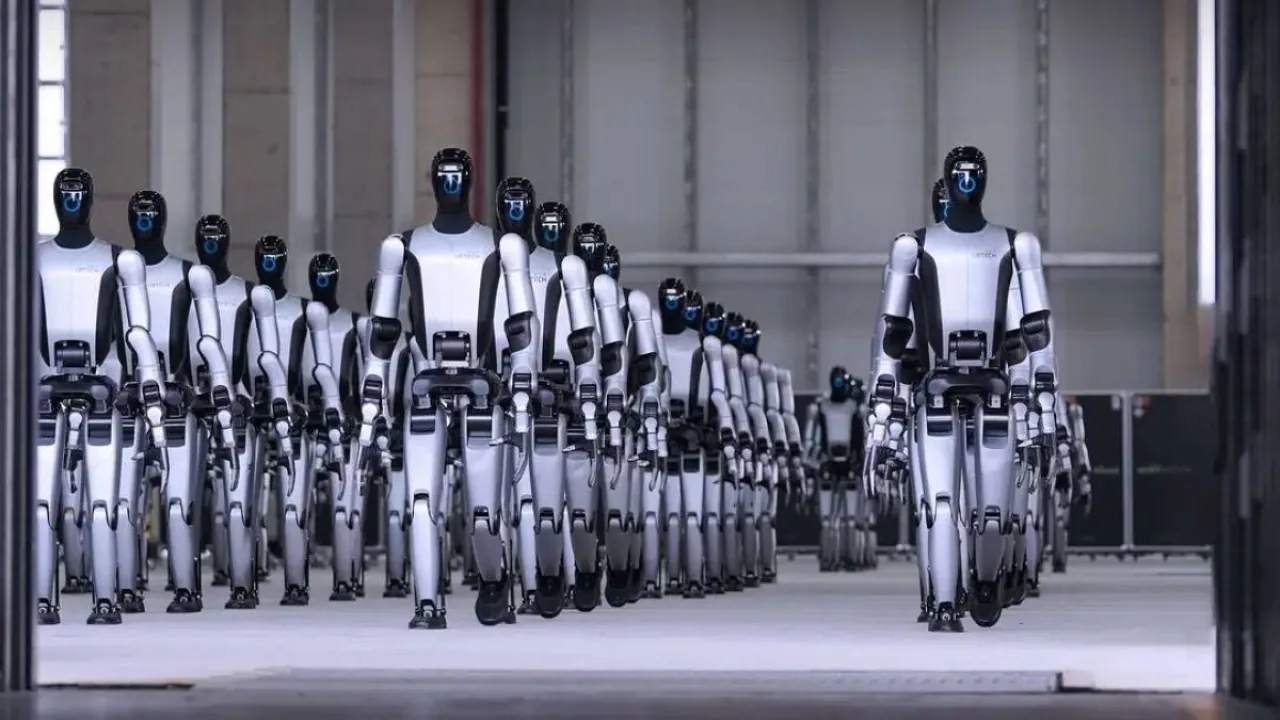
Khaberni - In an unprecedented step to boost the use of artificial intelligence and robots in public and industrial settings, Chinese company UBTech Robotics has secured a contract worth 264 million yuan (approximately US$37 million) to deploy humanoid robots along the border with Vietnam in Guangxi Province.
Deliveries are scheduled to begin in December, as part of China's accelerated efforts to deploy robots across various government and industrial sectors.
According to the deal, Walker S2 robots, described as the first humanoid capable of autonomously replacing its own batteries, will be used to perform a variety of tasks including guiding travelers at border checkpoints, managing the flow of people, supporting patrols, carrying out logistics operations, and assisting in business and immigration activities. They will also be used in industrial sites such as steel, copper, and aluminum factories to conduct precise inspections.
This project is one of the largest real-world deployments of humanoid systems in China within governmental operations, reflecting the rapid expansion of humanoid robotics technologies in the country. In recent years, China has seen similar deployments at airports, government offices, and even during major events, where multilingual robots have been used to provide assistance, as happened at Hangzhou Xiaoshan International Airport and at the Shanghai Cooperation Organization summit.
Walker S2
Walker S2 was designed to operate in complex operational environments for extended periods. It stands 1.76 meters tall and is equipped with an articulated frame that allows for 52 degrees of freedom, including fourth-generation precision hands with 11 degrees of freedom each, enabling it to perform intricate tasks such as handling and assembly.
It can also handle loads up to 15 kilograms per arm across a working range from the ground to a height of 1.8 meters, with high-torque joints in the waist allowing it to squat and bend flexibly. One of the robot's distinguishing features is its autonomous battery system with fast swap capability, which enables it to replace its depleted battery with a fully charged one within just three minutes, allowing it to operate continuously for approximately 24 hours without human intervention, according to the website “interestingengineering”.
The robot relies on its BrainNet 2.0 and Co-Agent AI systems from UBTech, along with a binocular stereo vision system providing human-like depth perception, enabling it to adapt to dense and dynamic industrial environments. Advanced dynamic balance algorithms help maintain its stability during movement and while carrying heavy loads at speeds up to 7.2 km/h.
UBTech has confirmed that orders for the Walker series have exceeded 1.1 billion yuan (115 million US dollars), with a plan to deliver 500 robots by the end of the year and a tenfold increase in production next year, aiming to reach an annual output of 10,000 units by 2027. The company also seeks to reduce manufacturing costs as production expands.
This development comes amid strong political support in China for the robotics sector, with the formation of the National Committee for Humanoid Robotics under the supervision of the Ministry of Industry and Information Technology, appointing prominent leaders from specialized robotics companies to oversee innovation and expansion in this field.
According to a report by the "South China Morning Post," the robotics sector in China is experiencing rapid growth in various fields such as healthcare, elderly care, city cleaning, traffic management, public security, and automated delivery using drones and metro systems, reflecting the country's direction towards integrating embodied artificial intelligence into daily and industrial life in a comprehensive manner.