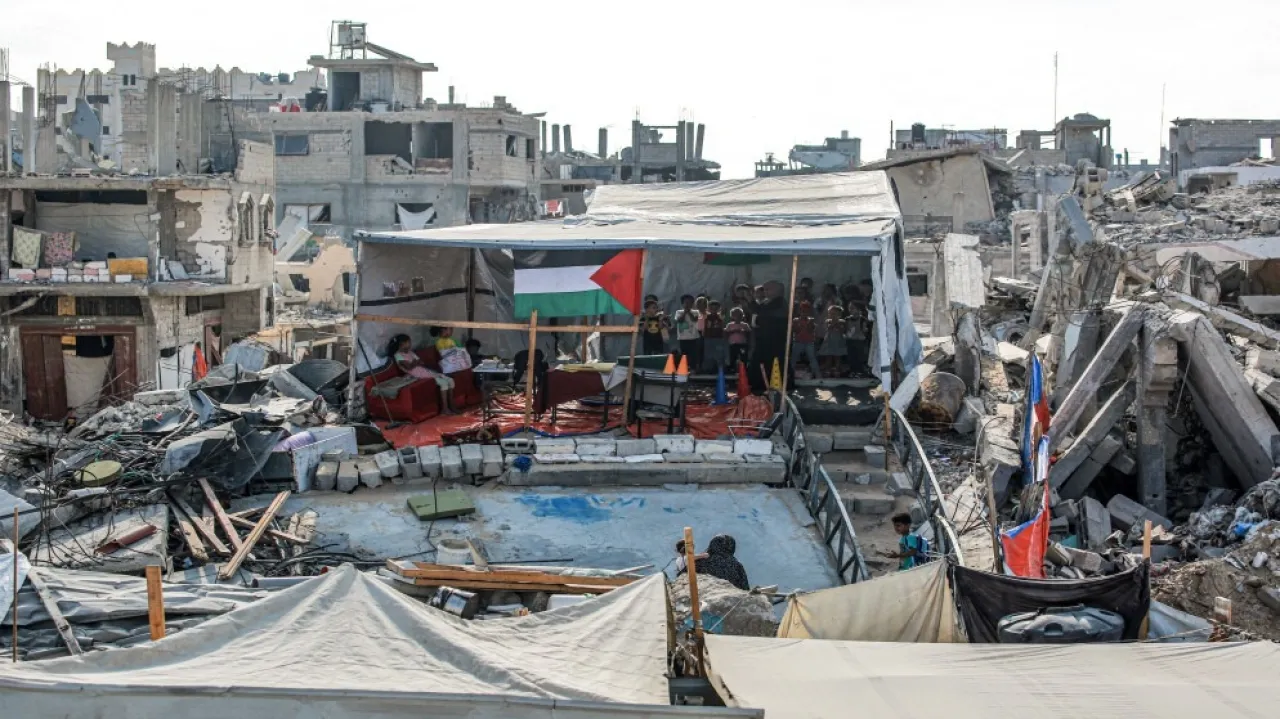
Khaberni - For the first time since the outbreak of the war on October 7, 2023, Al-Luluwa Al-Qatami School opened several classes in an old damaged building in the Al-Ramal neighborhood in West Gaza City, and about 900 students began their basic education there.
A month after the ceasefire between Israel and Hamas, the United Nations Relief and Works Agency for Palestine Refugees (UNRWA) and the Ministry of Education in Gaza announced a gradual return to schools in areas not under Israeli military control in the sector.
Faisal Al-Qassas, the project manager of Al-Luluwa School, explains that the war affected all students and now their main concern is breadlines, communal kitchens, and water.
Al-Qassas added, "We started from scratch and established an educational point initiative accommodating 900 students in two shifts, morning and evening. We try to address their psychological state and reintroduce them to study through extracurricular activities."
Philippe Lazzarini, the Commissioner-General for UNRWA, stated on the "X" platform a few days ago that over 25,000 students in the Gaza Strip joined "temporary learning spaces" offered by UNRWA, while about 300,000 students will continue lessons online.
The number of students in the sector is more than 758,000, according to the Ministry of Education in Gaza.
During the war on the sector, most of the schools belonging to UNRWA and public schools were turned into shelters for hundreds of thousands of displaced people fleeing the bombing, and most of them are still there.
According to UNRWA, 97% of schools in the Gaza Strip were damaged, some directly hit, and require substantial rebuilding or major rehabilitation.
In the Al-Mawasi area west of Khan Younis in the south of the sector, modest local initiatives aim to bring children back to schools.
The "Restoring Hope to Gaza" project, implemented by the Qatar-based "Education Above All" Foundation in partnership with UN-affiliated organizations, aims to aid over 100,000 students by distributing educational supplies and providing internet, electricity, psychological support, and tents.
Hazem Abu Habib, the director of one of the foundation-supported initiatives, points out that teaching in the Al-Mawasi school is limited to four core subjects: Arabic, English, Science, and Math.
Abu Habib said, "We aim to help as many students as possible to continue education in core subjects, to overcome the ignorance of the next generation."
He warned that "education is undergoing one of its most dangerous phases," noting that before the war, the Gaza Strip was "completely free of illiteracy."
11-year-old Layan Hajji explains that she walks a long and rugged road every day from her tent in the Tel Al-Hawa area southwest of Gaza to her new school, which is unlike any school she knew before.
Layan says, "I walk at least half an hour, through destroyed streets... rubble and stones, immense suffering and sadness."
She adds, "We have no books or notebooks, libraries are bombed and destroyed and there is nothing in them." As for the classrooms, most are merely tents set up within the damaged rooms.
Saeed Shaldan (16 years old) expresses his enthusiasm for returning to school by saying, "I am happy the war has stopped and I am back to school."
He continues, "Every morning I have to fill water and stand in the breadline... We were displaced dozens of times, we no longer have a home."
He adds, "I have no books or notebooks or pens or a bag. No classrooms, no chairs, no electricity, no water... not even streets."
Iman Al-Hanawi (50 years old), the principal of Al-Luluwa School, hopes to provide school books and stationery "for free as soon as possible for the students."
She points to the difficult psychological situation of the students "the war forced them to do hard labor (...), and they are children. They gather wood, fill water, and line up in queues to get food."
A math teacher teaches her students how to solve simple mathematical equations by dividing them into groups that compete by dancing. Meanwhile, an Arabic teacher divides his students into small groups in the schoolyard, each presenting a different color of poems through comedic plays performed by the children.
In the courtyard of the "Al-Hasayna" school in the Al-Nuseirat camp in the center of the Gaza Strip, girls gather in the morning to perform morning exercises, chanting "Long live, long live Palestine".
In one of the rooms, 50 female students sit on the floor without chairs or tables. But a smile spreads across their faces whenever they hold a paper or write on the blackboard.