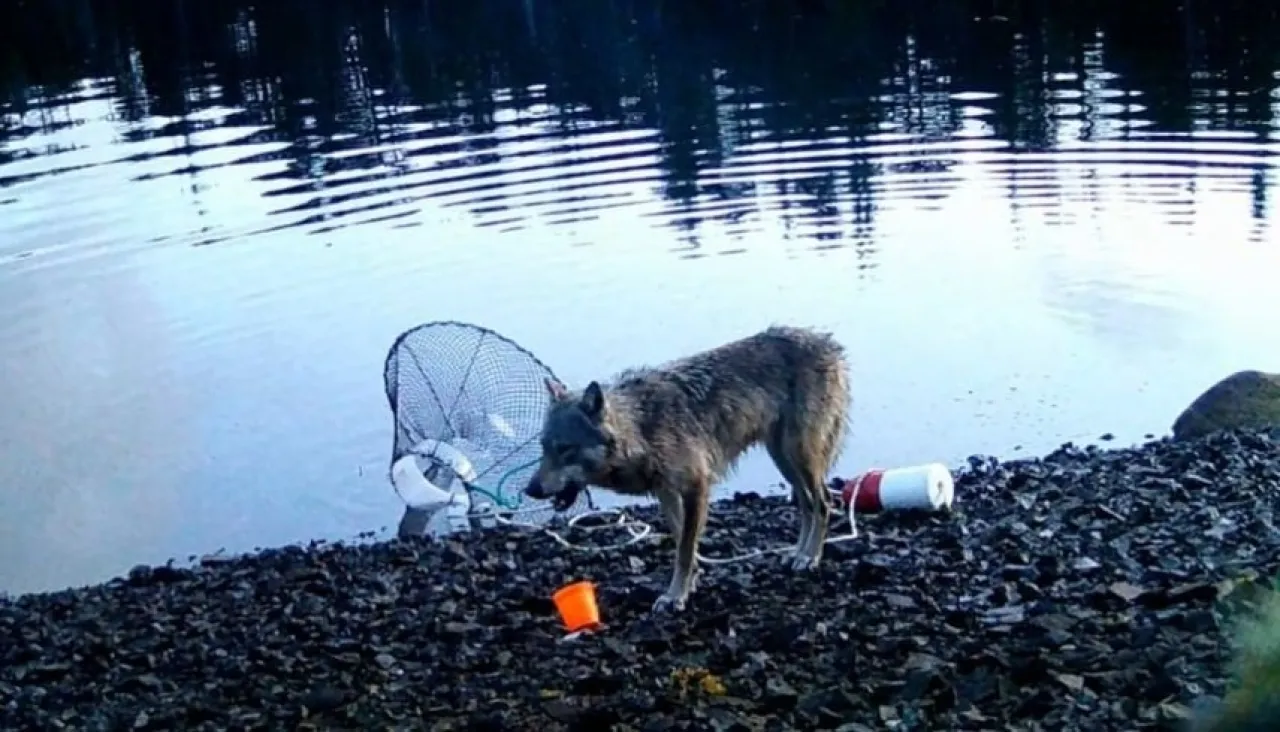
Khaberni - Biologists observed a wild wolf using tools to hunt its prey in an unprecedented scientific event, as cameras recorded a wolf pulling a crab trap from the depths of the central coast of British Columbia in Canada to access the bait inside.
The scenes were part of an environmental program run by the "Heiltsuk" people in Canada, native to the region, aimed at controlling the spread of an invasive European crab that threatens the local ecosystems.
The program managers had noticed repeated damage to the traps, leading them to believe that a bear or a wolf was behind it, but the depth of the water where some traps were placed made this unlikely, as those animals do not dive.
The scientists uncovered an unexpected surprise after setting up surveillance cameras, as the wolf appeared swimming towards the shore holding a buoy attached to the trap, before dropping it on the sand and beginning to pull the rope until the trap emerged from under the water.
The wolf continued dragging the trap to a shallow area and then opened the container containing the bait, which was a piece of herring, and then ate from it.
On his part, Kyle Artelle, an assistant professor at the State University of New York and one of the study's authors, stated that the wolf showed a series of interconnected steps resembling humans' methodology in problem-solving, confirming that its behavior was "focused and conscious" and not random.
The researchers speculated that the wolves may have discovered the traps after watching humans throw them from boats, or after reaching traps that became shallow during low tide and then learned how to pull deeper traps.
Artelle suggested that this behavior could be a product of a relatively safe environment, where the wolves in the Heiltsuk people's lands are not intensely hunted or chased, allowing them more space to learn and explore.
The behavior sparked a scientific debate over whether it could be considered "tool use," which Artelle and other experts tend to agree with, viewing the wolf's use of external objects, i.e., the rope and trap, to achieve a specific goal, as a definition fitting the concept of tools.
Animal behavior scientist Mark Bekoff praised the study, confirming that it might open the door to adding wolves to the list of species known for tool use, and anticipating that future research could reveal whether this behavior will expand or culturally transfer among wolf groups.