




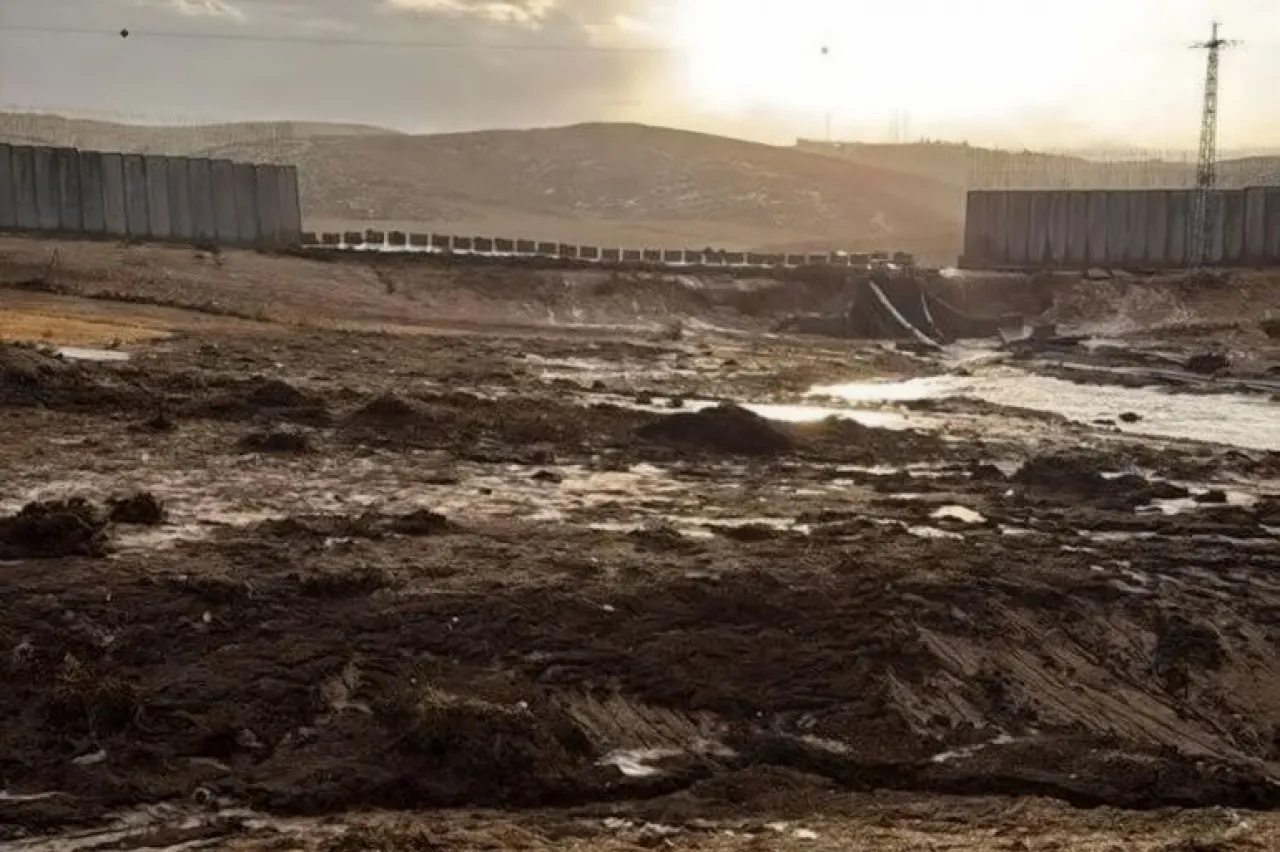
Khaberni - Heavy rains that struck the West Bank today, Tuesday, led to a partial collapse of the Israeli separation wall south of Hebron city, in addition to landslides and main road disruptions in central West Bank.
Eyewitnesses said that the torrential floods resulting from the low-pressure system completely destroyed part of the concrete separation barrier near Hebron.
The Israeli occupation authorities began constructing the separation barrier under the government of former Prime Minister Ariel Sharon on June 23, 2002.
Israel states that the purpose of constructing it is to prevent Palestinians from entering its territory or nearby settlements, while Palestinians see the barrier as intended to strangle their daily lives and annex parts of the West Bank to Israel.
In July 2004, the International Court of Justice in The Hague ruled that this separation barrier was illegal, and demanded that Israel stop its construction and compensate those affected, urging nations not to recognize the resulting situation.
Israeli Security Measures
Following the collapse of part of the wall, the Israeli newspaper Yedioth Ahronoth reported that the Israeli military began addressing the defect, while the Border Administration is assessing the extent of the damage and the steps for repair.
The newspaper added that the military received instructions to enhance security measures around the collapsed section to prevent any potential crossing through the gap created by the collapse.
In related context, the collapses and landslides caused disruption in traffic on main and secondary roads west of Ramallah, resulting in damage to a number of vehicles without any injuries.
A weather expert stated that the area experienced exceptionally high amounts of rainfall within a few hours, noting that the highest precipitation was recorded in the Salfit Governorate, ranging between 80 and 100 mm.
He added that the areas of Jerusalem, Bethlehem, and western Hebron also experienced significant rainfall, with precipitation decreasing towards the east.
Since Tuesday morning, the Palestinian territories have been experiencing unstable weather conditions accompanied by heavy rainfall and active winds, amid warnings of sudden floods and additional collapses in roads and slopes as the low-pressure system continues.