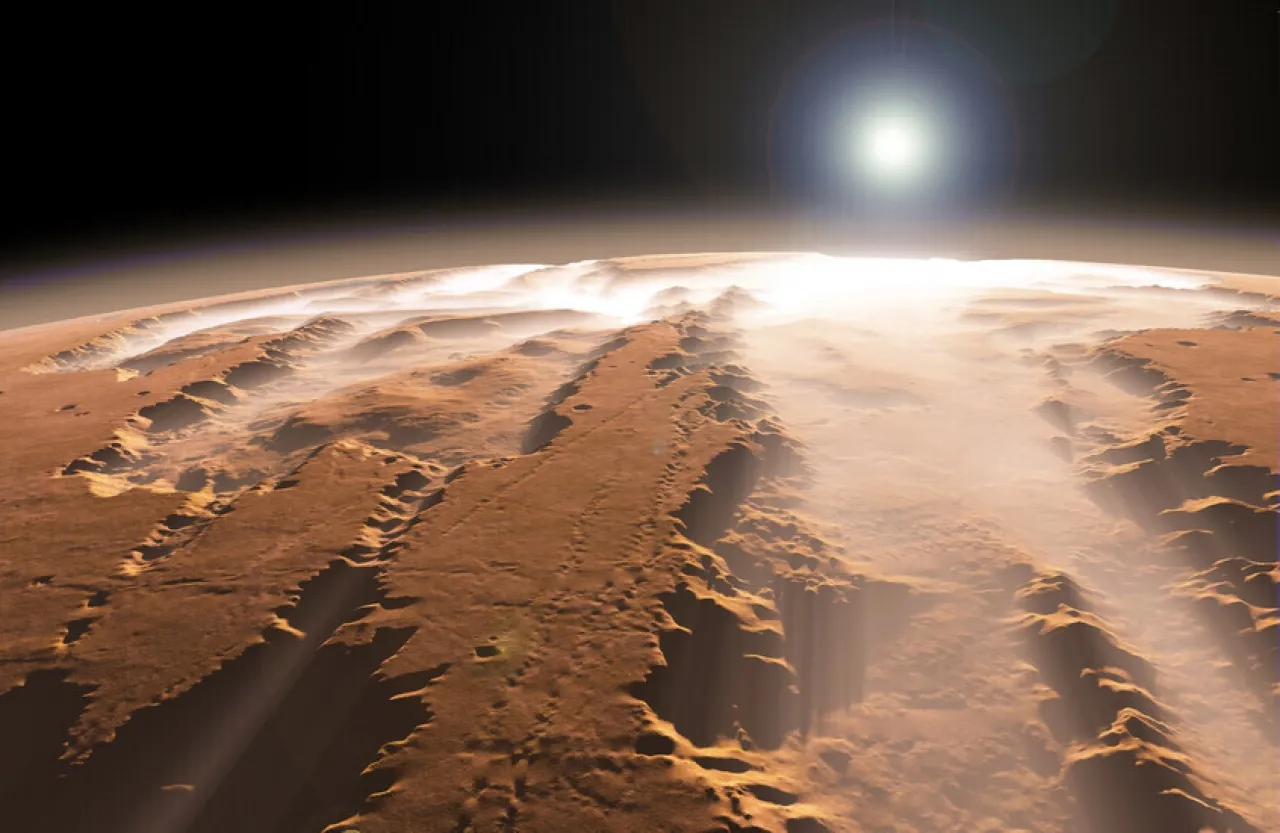
Khaberni - A stunning Japanese study reveals the ability of a type of algae, known as "Physcomitrella patens," to survive in the harshest space environments. These results, published by the iScience journal, spark hope for developing sustainable life support systems that may surpass the famous "potato farming" solutions we've seen in science fiction movies like The Martian, according to The Guardian.
The Silent Victory
Physcomitrella patens algae has long been known for its resilience and ability to grow in the barren clay areas on Earth. However, researchers from Hokkaido University in Japan, led by Dr. Tomomichi Fujita, wanted to test its limits in space.
The study focused on algae structures enclosed by what is known as "sporangium," which are vesicles that protect the spores.
Ground tests showed that these enclosed spores were capable of withstanding harsh levels of ultraviolet radiation (UVC) exceeding 100,000 joules per square meter, besides enduring vacuum conditions, deep freezing, and high temperatures. The researchers sent the enclosed spores to the International Space Station (ISS) aboard the "Cygnus NG-17" spacecraft, where they were exposed to the actual space environment for nine months.
Dr. Fujita points out that this resilience provides insightful perspectives for developing sustainable life-support systems in space, where algae could contribute to oxygen generation, humidity control, and most importantly, soil formation from planetary dust and rocks.
This discovery brings algae back to the forefront of space research, as it is already known that desert algae like "Syntrichia caninervis" can withstand Mars-like conditions in terrestrial simulation experiments.
Dr. Fujita said, "If these spores can withstand prolonged exposure during interplanetary travel, then successfully revive through rehydration and warming, they may someday contribute to establishing foundational ecological systems off Earth."
Dr. Agata Zubanska from the City Institute, who did not participate in the study, welcomed the results, but highlighted some important points.
Zubanska confirmed that the external environment of the International Space Station, despite its harshness, does not represent the complexities of real deep space or the environments of Mars and the Moon.
Zubanska stated that the true value of space plants "is only realized if they can actively grow and thrive away from Earth,” pointing out that the spores' ability to endure is only a "first step" towards broader goals of cultivating plants in extraterrestrial environments.