Khaberni - The United States has effectively started reducing its military presence at the joint civil-military coordination center with Israel, established in "Kiryat Gat", and consequently, a part of the approximately 200 military personnel who had been there to establish the center have left the country.
Two official American sources stated that Washington aims to bring the center under a "Peace Council" expected to be established soon. One of them explained, "The Peace Council, to be chaired by President Donald Trump, is a fundamental component of the American plan," adding, "As stated in the resolution of the United Nations Security Council approved this week, the council will coordinate the introduction of humanitarian aid and push for the development of the Gaza sector"; according to what the website of the newspaper "Haaretz" reported on Saturday evening.
He added that the council "will also support the Palestinian technocratic committee which will be responsible for the daily civil services management and administration in Gaza, while the Palestinian Authority will work on implementing its reform program."
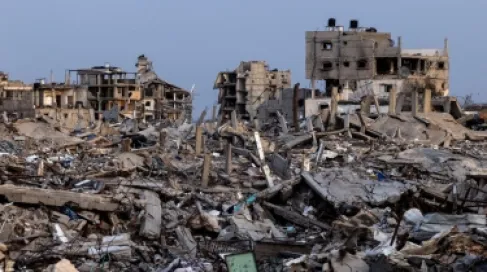
Two diplomatic sources informed about the situation in the coordination center, in addition to a source within the center itself, mentioned that the development of the sector, or rather the construction of "temporary alternative housing complexes" under the control of the Israeli military east of "the Yellow Line", is a high American priority.
One diplomat stated that the Americans have two goals, which are to open more crossings for the introduction of aid, and to build the temporary housing complexes, estimating that this might also be in the interest of Israel, as the establishment of these complexes would divide the Gaza sector into two parts.
Over 20 countries participate in the civil-military coordination center, including European and Arab countries such as Egypt and the UAE. Within their participation, these countries raise legal and ethical questions to the Americans regarding the plan, which calls for the construction of new neighborhoods in the sector. Among the questions: Who will be chosen to reside there? What are the criteria? Will residents be able to leave? And what is the fate of the original landowners?
One diplomat explained that the current American approach is based on confiscating lands from their owners and compensating them, noting that the planning work at the coordination center, related to rubble removal in preparation for building the temporary complexes, is progressing at a rapid pace.
According to several other sources, the countries participating in the coordination center do not strongly oppose the American plan at the current time, while some of these countries are trying to convince Washington to use the creation of new neighborhoods to grant the Palestinian Authority a role in the sector. A European diplomat stated that there will be those who manage the schools and hospitals in Gaza.
Despite the pressure exerted by the countries on the United States, several sources confirmed that the actual decision-making body regarding the construction of the neighborhoods is not in the coordination center, which only provides technical and engineering solutions for construction, while decisions are made in the White House or through consultations with the political level in Israel.
Last week, the powers of the Israeli government's coordinator regarding coordination of entry of humanitarian aid were transferred to the coordination center, according to an official American source and another source inside the center. Several sources mentioned that tensions have surfaced between the Israelis and Americans in the center regarding decisions related to aid.
However, an informed diplomat stated that both sides are succeeding in reaching compromises regarding the number of trucks and types of goods allowed to enter (given Israeli concerns about "dual use" of some materials). Another diplomat added that he has not noticed any significant change in the Israeli position on the ground in terms of introducing humanitarian aid.
According to an American source, despite the ceasefire agreement obliging Israel to admit 600 trucks a day of humanitarian aid, the number has recently risen to about 800 trucks on average, which he attributes to the work of the coordination center. The source mentioned that the government coordinator's unit is an "integral part" of the center and operates "in full coordination to pump as much aid as possible to the needy residents of Gaza."
However, United Nations data show that only a small percentage of the trucks that entered Gaza since the ceasefire began are part of the humanitarian system (the United Nations and international organizations working in cooperation with the center). Since the ceasefire took effect, 4335 trucks belonging to the humanitarian system have entered, which equals only about one week's worth of aid. The bulk of food and goods enter through the private sector or from countries providing aid outside the framework of United Nations mechanisms.
A United Nations source stated, "Most of the goods entering for commercial purposes are fast food, chocolate, candies, and the like. This does not concern us much, but we would like to see the entry of nutritious foods through the private sector as well," and confirmed that despite a month and a half since the ceasefire, meat products, milk, and vegetables are still rare in the sector, while most residents rely on carbohydrates.
According to an American official source, quoted by the website "Haaretz", "The coordination center and all the partners in it are actively working to increase the proportion of humanitarian aid compared to commercial goods."
Meanwhile, the Israeli coordinator of government activities in the Palestinian territories said that the process of integrating the Americans into the coordination mechanisms for introducing aid to Gaza has already begun, including exchanging information and moving the joint coordination room from the Gaza Coordination Office to the Kiryat Gat center.
He noted that it "does not involve transferring powers or responsibilities from the government coordinator to the Americans, but integrating them into formulating and implementing the coordination, control, and supervision mechanisms related to humanitarian aid, in cooperation with Israeli security authorities." He added that "there is no change in the policy of inspecting the aid and its content. The aid trucks will be scrutinized at the crossings by security authorities and Israeli authorities, alongside taking the necessary steps to limit Hamas's interference in the humanitarian aid."