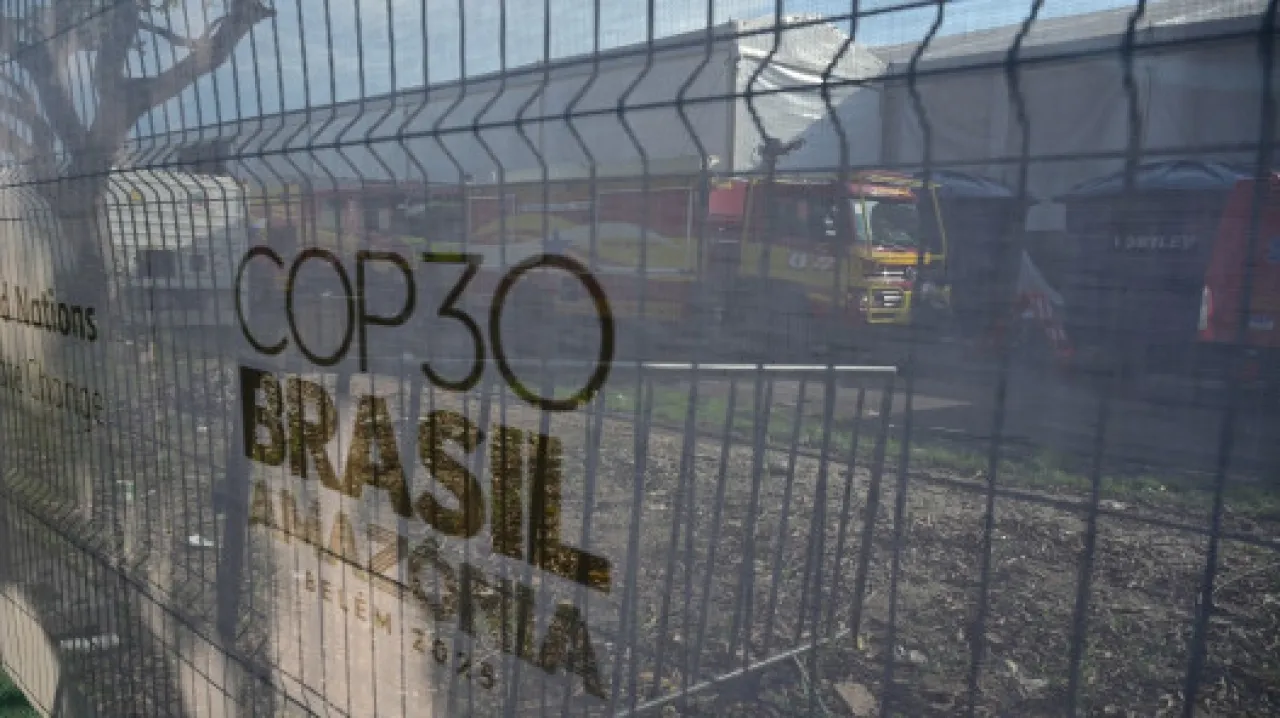
Khaberni - Negotiations within the framework of the climate conference entered the official extension phase on Friday, following two weeks of unproductive negotiations, amid the absence of any signs of agreement among the 200 participating countries, whose positions remain very divergent on fossil energy sources.
Since last week, the Brazilian presidency of the conference held in Belem has proposed a draft agreement on the last day, however, a key phrase was omitted, as it did not include "fossil energy sources", nor did it address the "roadmap" demanded by at least 80 European, Latin American, and island nations.
The European Union's Climate Commissioner Fopke Hoekstra said that the bloc does not rule out the possibility that the climate conference "may end without an agreement," because the text draft presented by the Brazilian presidency is not ambitious enough regarding the reduction of greenhouse gas emissions.
French Minister for Ecological Transition Monique Barbot stated in a message that "this text is disappointing, as it does not mention fossil fuels responsible for over 80% of global warming. This omission is incomprehensible in the current climate emergency."
Non-governmental organizations immediately rejected the draft. Tracey Carter from Greenpeace commented that "the draft is like a blank page, containing little to fill the gap in ambition to limit warming to 1.5 degrees Celsius, or to prompt countries to accelerate action." The World Wide Fund for Nature described the text as "very disappointing."
According to a negotiator who declined to be named, China, India, Saudi Arabia, Nigeria, and Russia strongly opposed any roadmap.
France accused Russia, India, and Saudi Arabia of blocking any progress towards gradually phasing out fossil fuels, while Germany warned that negotiations for an ambitious text would be "difficult."
Monique Barbot said, "Who are the major obstructing countries? We all know them. They are the oil-producing countries, of course. Russia, India, and Saudi Arabia. But many emerging countries have joined them."
German Environment Minister Karsten Schneider said that "the text cannot remain as it is," warning that "negotiations will be difficult."
During the night, about thirty countries, including France, Germany, and Colombia, deemed this unacceptable and threatened to block the draft agreement, in a message addressed to the conference president Andre Correa do Lago.
These countries wrote, "We cannot support a text that does not include a roadmap for a just, orderly, and fair transition away from fossil fuels."
The Brazilians, already behind schedule, consulted throughout the night.
They will have to continue negotiations on Friday, facing a daunting task to reach a consensus among 194 countries and the European Union to adopt a series of texts unanimously, as is usual at climate conferences.
The "roadmap" entails accelerating the gradual phasing out of oil, coal, and gas, largely responsible for climate change, in pursuit of a commitment to phasing out fossil fuels as agreed at COP28 two years ago.
The Brazilian president brought this issue to the forefront Wednesday during his visit to Belem.
Correa de Lago said, "Those who doubt that cooperation is the best we can do for the climate will be very pleased to see our inability to reach an agreement."
In the afternoon, Correa de Lago lifted a session that lasted more than four hours, giving delegations a break to eat, asking them to use the time to think about solutions that could be proposed, according to participants.
Since 2003, no Conference of Parties has managed to conclude its proceedings on schedule.