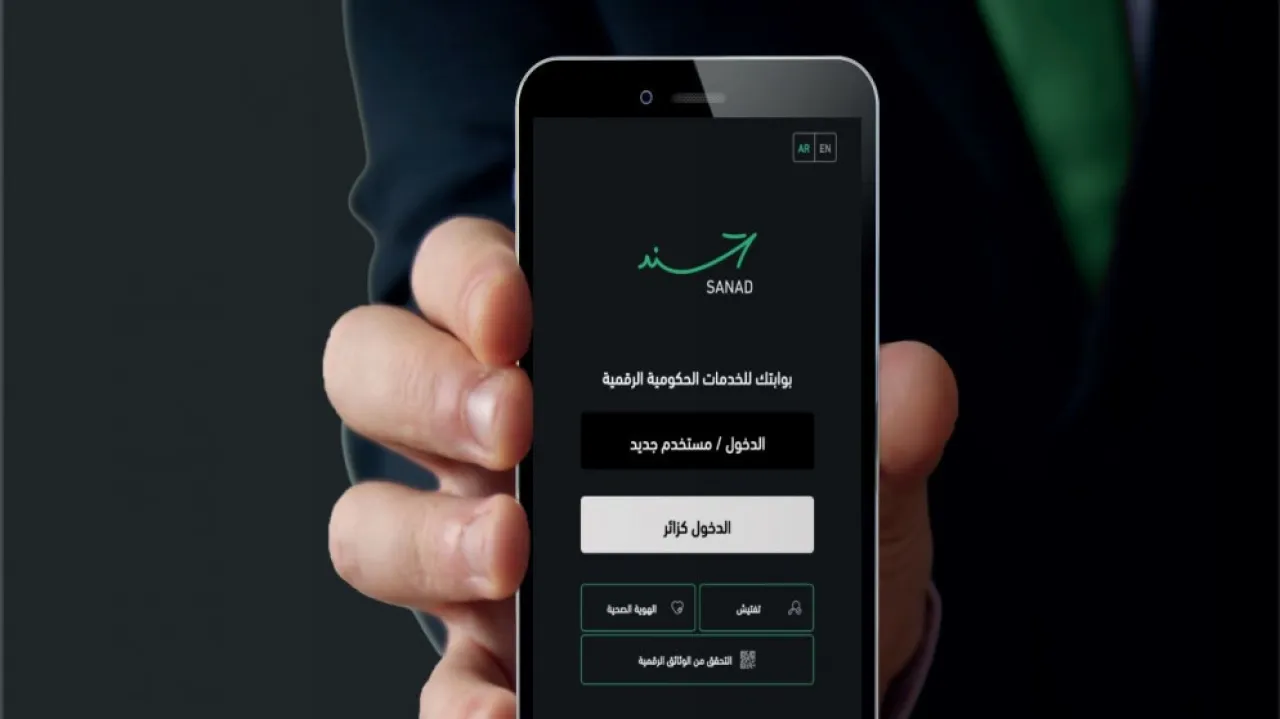
Khaberni - Experts in information technology confirmed that the government application "Sanad" has contributed to simplifying citizens' access to government services, through unifying the entry to various institutions through a digital identity and a single account.
They said that the application has become today the official and only gateway for electronic government services in Jordan, and that it has saved a lot of time and effort in completing transactions, whether from the side of employees in government departments or from the side of citizens.
The Minister of Digital Economy and Entrepreneurship, Engineer Sami Samirat, confirmed that the application records between 3 – 5 million digital movements per month, and serves about half a million users weekly.
He explained that the number of digital identity activators via the "Sanad" application until mid-2025 reached about 1.8 million citizens, with more than 500 digital government services available through the application, linked to a number of institutions and government bodies, while the number of application downloads exceeded 3.5 million operations.
He pointed out that the percentage of government services that have been digitized cumulatively (across the government and not just through the "Sanad" application) reached 80 percent of the total government services, with 1920 digital services out of about 2400 services targeted for digitization.
Samirat said that "Sanad" contributed to simplifying citizens' access to government services, through unifying the entry to various institutions via a digital identity and a single account, instead of multiple usernames and passwords for each institution or service.
He added that the application serves as a unified digital gateway that enables the user to access their personal data, and their digital government documents, such as the personal status card, family book, driving license, vehicle license, birth certificates, and educational certificates, in addition to electronic payment services and invoices, from anywhere and at any time, without the need to physically visit the departments.
He indicated that this integration between digital documents and government services in one window has significantly reduced the time, effort, and costs incurred by the citizen, and helped reduce congestion in government departments, and connected the citizen to a single digital platform that is continuously expanding in terms of the number of services and participating entities, in line with the vision of economic modernization and the public sector modernization plan targeting the digitization of all government services by the end of 2026.
In his turn, Information Technology Consultant and Engineer Abdelhamid Al-Rahamneh said that after five years since the launch of "Sanad", it has become today the official and sole gateway for digital government services in Jordan, offering more than 500 digital services covering about 30 government entities, and allows users to create a unified digital identity and access their personal documents securely and easily.
He added that this project is a major national achievement whose efforts are recorded for the Ministry of Digital Economy and Entrepreneurship, which succeeded in laying the foundation for digital transformation in government services.
He indicated that after five years since the launch of "Sanad", and with the expansion of the user base and increased reliance on it, a series of observations emerged that could contribute to the development of the experience and improve the quality of services provided.
He pointed out the importance of making the application simpler and smoother in use, focusing on the basic services needed by most citizens, and activating the feature of unified access that enables seamless transition between government entities via the app without the need to re-log each time, enhancing the user experience and making it smoother and more modern.
He pointed out that the process of updating data is still manually done often, which leads to delays in presenting accurate information, calling for the adoption of an instant automatic update system that ensures continuous accuracy of data.
He also emphasized the importance of enhancing data protection and information security using advanced encryption technologies that prevent unauthorized access to personal information, especially with the increasing reliance on the digital identity in official transactions.
He confirmed the importance of developing services and electronically linking between various ministries and institutions, so that the government transaction becomes digital and integrated without the need for field reviews or paper transactions.
He pointed out that what the citizen ultimately wants is a service that saves them time, effort, and money, and gives them a sense of comfort and confidence in the digital government system.
He added that five years of working on the "Sanad" app represents an important step in the journey of Jordan's digital transformation, but it requires a qualitative leap that makes the application more effective, comprehensive, and integrated among institutions.
In her turn, The Head of the Scientific Laboratories Department at the College of Artificial Intelligence at Al-Balqa Applied University, engineer Diana Al-Tahrawi, said that "Sanad" clearly contributed to facilitating access to government services, by integrating a large number of them within a unified digital platform, which saved citizens time and effort in completing their transactions electronically, and contributed to promoting digital transformation and the application of the concept of e-government in Jordan.
She added that regarding the expected role of artificial intelligence technologies in developing the application, they will play a pivotal role in improving the user experience through interactive smart assistants, and data analysis to provide customized services, alongside enhancing security and identity verification through smart recognition technologies, contributing to increasing the efficiency of the application and its reliability.
She explained that the main challenges facing "Sanad" include the weak digital culture among some user categories, in addition to challenges related to information security and privacy protection, as well as the varying quality of technical infrastructure in some areas, and the continuous need to enhance integration and coordination between government entities to ensure the continuity and smoothness of services.
For his part, the General Manager of the Pioneers Information Systems Company, Tariq Al-Safarini, said that "Sanad" has saved a lot of time and effort in completing transactions, whether from the side of employees in government departments or from the side of citizens.
He added, "We expect that if artificial intelligence technologies are added, it will improve and develop services so that transactions can be completed with a lower percentage of human intervention and errors, in addition to the possibility of automatically developing services by these softwares."
He noted that the legislations should be developed to allow electronic transformation using artificial intelligence technologies.