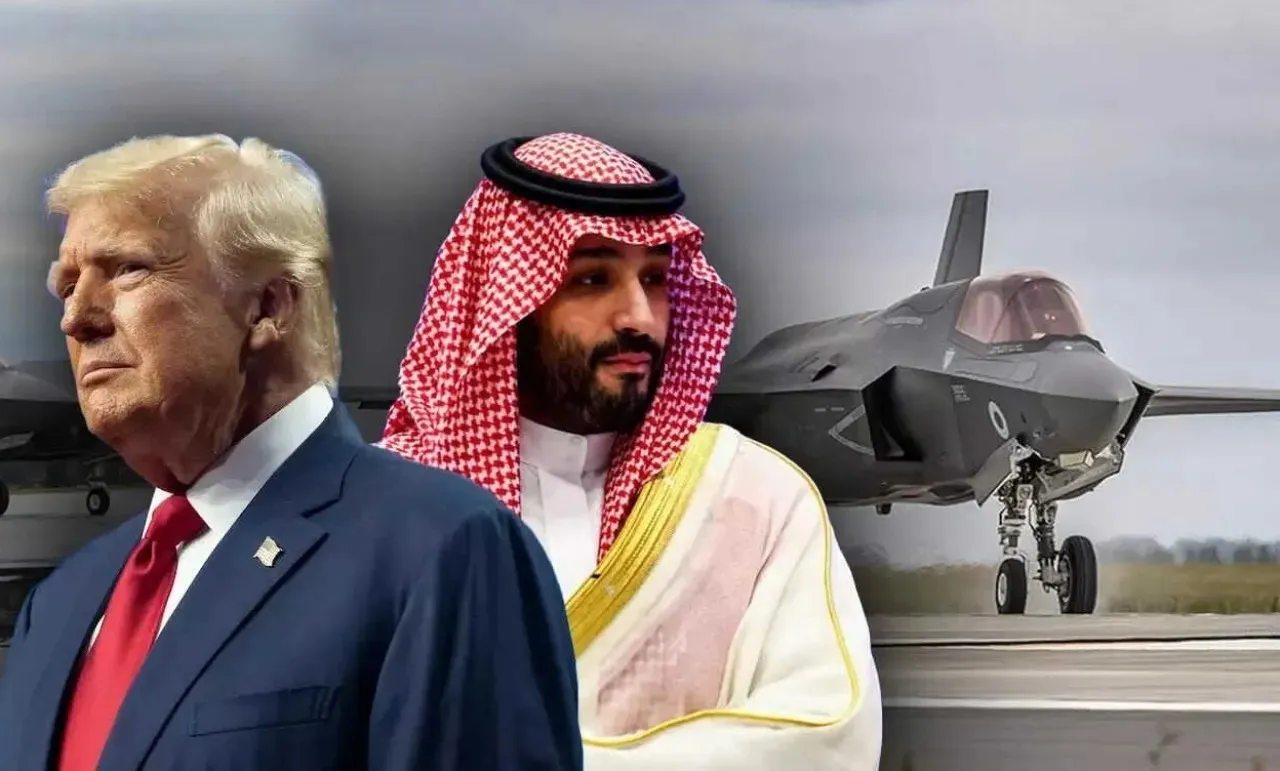
Khaberni - U.S. President Donald Trump approved the sale of F-35 fighter jets to Saudi Arabia; a move that increases the number of countries relying on these aircraft, which are considered one of the most important U.S. military exports.
The announcement came during the visit of Saudi Crown Prince Mohammed bin Salman to the United States, the day before yesterday, Wednesday, where he reached a series of agreements that deepen the economic and defense partnership between the two countries.
According to a statement from the White House, Trump and bin Salman signed a bilateral strategic defense agreement, and Trump approved a major defense deal that includes the future delivery of F-35 jets, and an agreement was reached for Saudi Arabia to purchase about 300 American tanks.
This step represents the endeavor of many countries around the world to acquire the F-35 jets "widely recognized as the best and most advanced American fighter jet," according to what Brad Bowman, the first director of the Center for Military and Political Power at the Foundation for Defense of Democracies, told the Associated Press.
Almost two decades since the production of the first model of F-35 jets, about 20 countries across Europe and Asia, in addition to America and Canada, operate or have ordered this fighter which costs between 80 and 110 million dollars each, according to recent contracts.
Production and Maintenance Costs
Primarily manufactured by Lockheed Martin, an American defense contracting company headquartered in Maryland, close to Washington D.C., it produces between 150 and 190 warplanes annually.
Last year, the company delivered 110 F-35 jets, bringing the total number of aircraft manufactured and exported since 2006 to 1255, which has helped provide nearly 300,000 jobs linked to its supply chain across 49 American states and Puerto Rico.
Lockheed Martin, which employs more than 120,000 people, plans to produce up to 2470 F-35 jets, and it is expected that maintenance, operation, and upgrades over a period of 77 years will cost more than two trillion dollars.
International Customers
The U.S. Department of War currently has the largest fleet of F-35 jets, totaling 1763 aircraft of various models. Following the U.S., Japan has ordered 147 F-35 jets as part of its strategy to counter regional threats, especially from China.
In Asia, South Korea is also expanding its fleet of F-35 jets to 60 units to enhance its deterrent capability.
Not far from Asia, Australia has already received all of the F-35 jets it had ordered, totaling 72 aircraft.
In Europe, several NATO member countries continue to expand their fleets. The United Kingdom operates 138 F-35 jets, Italy 90, while Denmark has equipped an air force of 43 jets.
Norway and the Netherlands are continuing to expand their fleets. Germany currently owns 35 jets, Finland has received 64 jets, while Belgium and the Czech Republic have placed orders or are waiting to receive their first jets.
In the Middle East, Israel remains the only operator of F-35 jets, with a fleet of 75 specially modified versions of the aircraft.
No country in the Arab world, Africa, or Latin America currently owns these jets, which have become a major tool in U.S. military diplomacy and their demand is increasing in the context of forming aerial power balances worldwide.
The deal with Saudi Arabia highlights how the United States has enhanced its military presence by expanding the network of countries that operate these advanced aircraft in Europe, Asia, and other allied nations.
Technological Specifications
The F-35 jet remains one of the most popular fighter jets in the world, thanks to its stealth capabilities, advanced sensors, and sophisticated combat systems that allow pilots to penetrate protected airspace, coordinate instantly with other forces, and strike targets accurately.
When the first F-35 fighter jet rolled out of the assembly line in Fort Worth, Texas, it was welcomed as a technological leap in aerial warfare.
This aircraft is described as a fifth-generation fighter, featuring stealth coatings, advanced radar, and sensors that better detect opponents, making it difficult for adversaries to detect this stealth jet and, consequently, shoot it down.