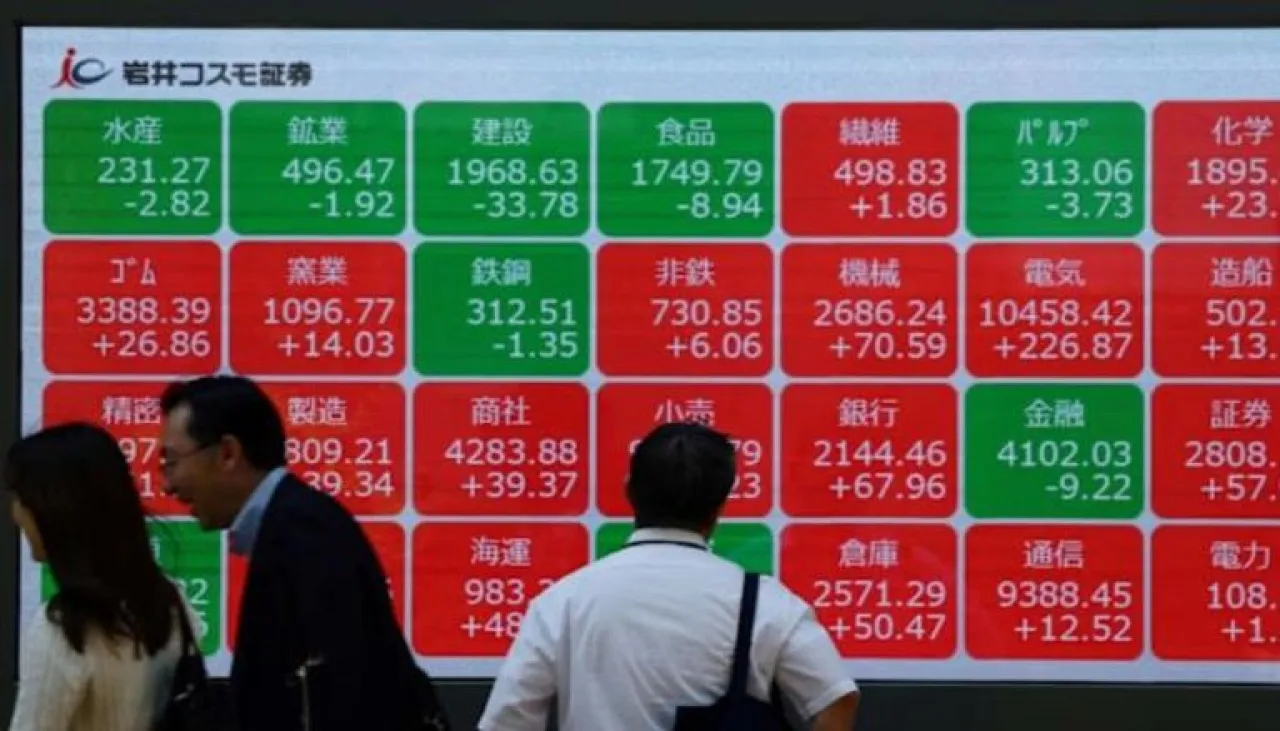
Khaberni - Shocks in the Asian financial markets renewed with the return of concerns about the inflation of AI company valuations, triggering a broad sell-off in technology stocks and bringing back investor anxiety after a brief calm.
The reassurance caused by Nvidia's results did not last long, as fears of overvalued technology evaluations quickly returned, prompting investors to engage in intensive selling, causing widespread turmoil in the Asian stock markets.
Anxiety returned to dominate the Asian financial markets after major technology companies in South Korea, Japan, and Taiwan recorded sharp declines during Friday's trading, amidst rising concerns over the overvaluation of AI companies.
This quickly dispelled the short wave of optimism sparked by the results of the American company "Nvidia" and statements by its CEO Jensen Huang, who denied the existence of a speculative bubble in the AI sector, according to what was reported by the French economic newspaper "Les Echos."
Although investors initially received Nvidia's results with some relief on Thursday, this feeling did not last long, as traders resumed heavy selling of giant technology stocks that pour huge investments into artificial intelligence.
Fears increased that the current price levels of these stocks exceed their real economic values, leading to a collective downturn in various Asian stock exchanges.
In Tokyo, the "Nikkei" index closed down by 2.4% at 48,625.88 points, while the "Kospi" index in Seoul lost 3.78% of its value. In Taiwan, the main index recorded a drop of 3.57%. The Chinese stock exchanges were not left out of this scene, as the Shanghai index fell by 1.9%, and the Shenzhen index dropped by 2.7%.
These declines were also affected by the decreases experienced in the American markets the day before, which are closely monitored by investors in Asia.
On the "Nasdaq" index, Nvidia's stock lost 3.1% at the close of Thursday's session, just minutes before the opening of Asian trading, increasing the tension and prompting investors to take more cautious investment stances.
This collective decline reflects the growing anxiety about the future of AI stocks, amidst a clear divide between those who see these companies as a key driver of global technological growth, and those who view them as a financial bubble that could burst at any moment.
Amid these escalating fears and rapid technological and financial changes, Asian markets remain hostage to fluctuations in global investment mood.