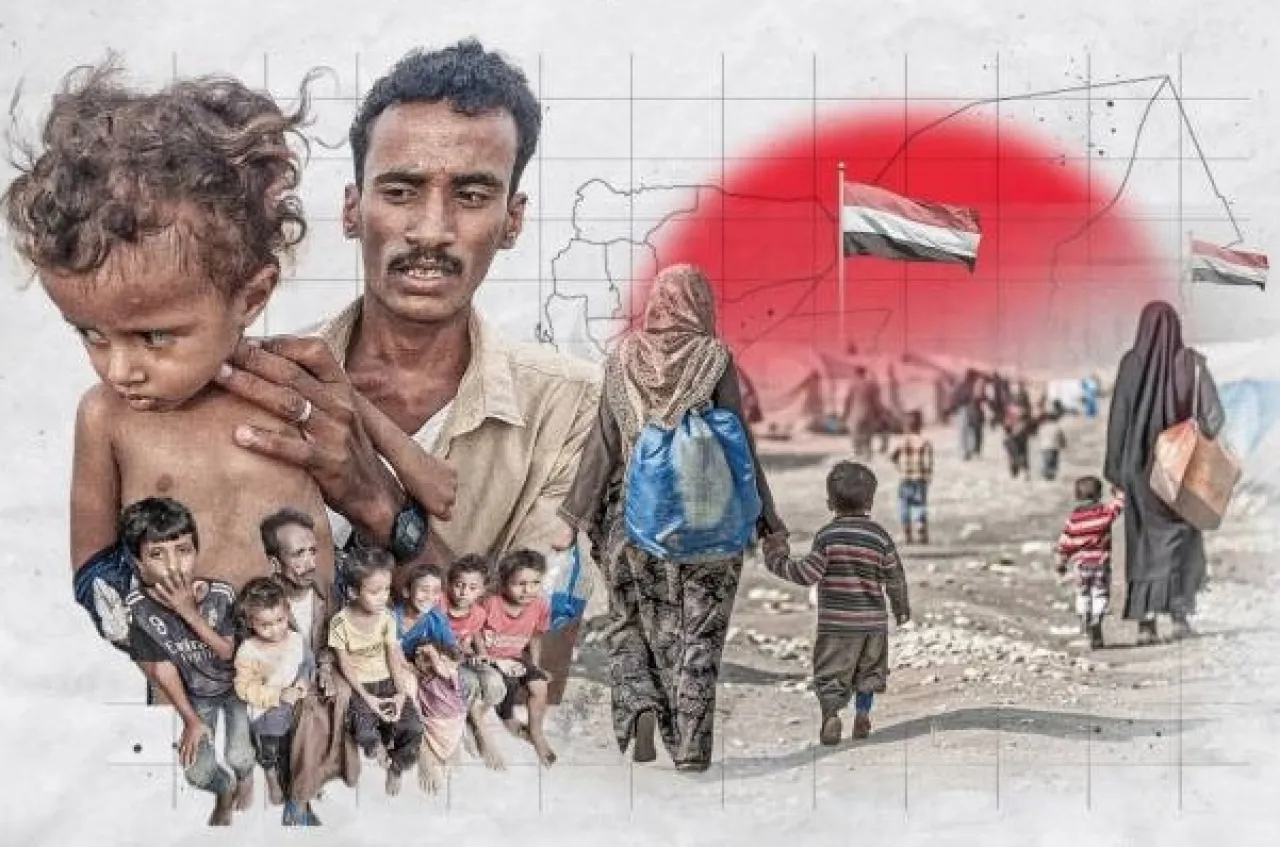
Khaberni - The Arab region is witnessing unprecedented levels of food shortages with 198 million people suffering from severe or moderate hunger last year, a situation attributed by a UN official to the absence of social justice and the fragility of local food systems.
Six UN organizations issued a joint statement saying that Arab countries face levels of poverty not seen in two decades, and that 77.5 million people (representing 16% of the region’s population) suffered from severe hunger last year.
These organizations attributed the worsening hunger crisis to the disturbances in the region, including the war in Gaza Strip and the armed conflict in both Yemen and Sudan.
The report also highlighted that slowing economic growth, depreciating local currencies, rising food and fuel prices, and increasing debt burdens are major reasons for the prevalent hunger rates.
It also indicated that Arab countries face issues in maintaining subsidies, declining social protection, and enhancing local food production, stating that 198 million suffered a severe or moderate food shortage in the year 2025, a 65% increase over 2015 levels.
The report warned that the sharp rise in the cost of healthy food has made it unaffordable for 186 million people, nearly 40% of the region's population.
Abdel Hakim Elwaer, the FAO Deputy Director-General, described the situation as a "disturbing precedent" and said it contradicts the 2030 Sustainable Development Goals aimed at eliminating hunger, noting that the region "is moving further away from the goal year after year."
Elwaer stated that hunger is measured in two ways: food security related to the abundance of food, and the ability to purchase it. Malnutrition is measured by access to healthy food, according to Al Jazeera.
He estimated the cost of accessing healthy food at $4.30 per person per day, a figure that exacerbates people's inability to afford it because it exceeds the average income of many, according to Elwaer.
Absence of Justice
Conflicts play a significant role in exacerbating hunger and malnutrition crises, but the absence of equality within a country is also a major factor -according to Elwaer- who said that people in remote villages and cities are unable to fairly buy healthy food due to high prices or inaccessible supply chains.
Many countries in the region are no longer able to provide a minimum level of self-sufficiency in food, a situation attributed by a UN official to climate change, drought, water scarcity, and the extreme fragility of food systems.
To overcome this critical crisis, Elwaer says governments must focus on social protection systems and deal with class disparities more fairly so that people can access the minimum healthy food.
Besides, these governments should increase spending on scientific research to maximize local production through smart agriculture, and increase government support systems.
Healthy food is still viewed as a luxury in the Arab region, which Elwaer describes as erroneous, because it has led to unprecedented levels of stunting, wasting, obesity, diabetes, and anemia.