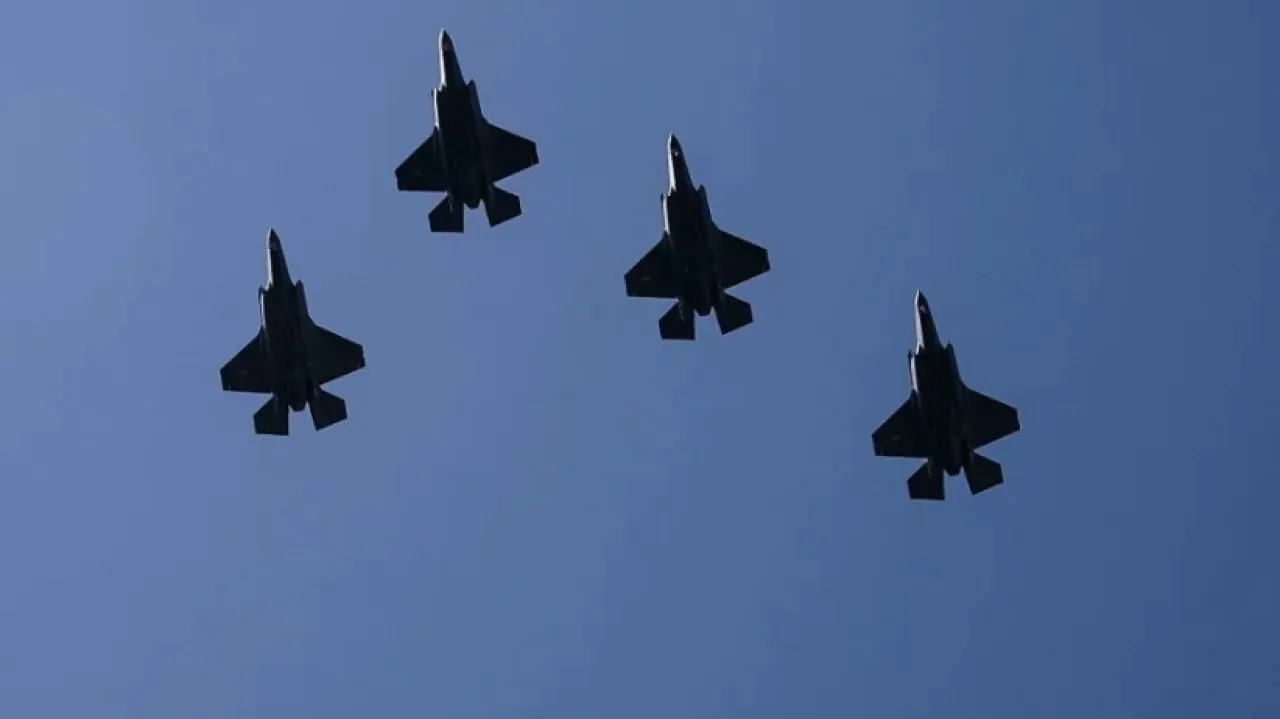
Khaberni - Israeli estimates indicate that Tel Aviv is not very concerned about the possibility of Saudi Arabia acquiring F-35 fighters, after U.S. President Donald Trump, on the eve of the visit of Saudi Crown Prince Mohammed bin Salman to Washington, announced his intention to supply Riyadh with the advanced aircraft.
The Israeli reading bases that it will take years for the Kingdom to receive the planes, during which Israel will have obtained more advanced versions, in addition to the possibility of receiving "qualitative compensation" in exchange for passing the deal, as is historically done in the security relationship with the United States.
Amos Harel, a military analyst at Haaretz, wrote that "warnings about the loss of Israeli air superiority in the Middle East seem a bit premature."
He mentioned that Israel proved overwhelming air superiority just five months ago, when its aircraft carried out a continuous series of strikes for 12 days deep inside Iranian territory, in one of the most complex operations in years.
Harel saw that the success of the operation was linked to the "F-35" fighters that Israel possesses, but "is not explained by them alone," as Israel also excels in "air force planning and execution capabilities," which are "currently unparalleled in the region."
He added that the Saudis "are certainly not just camel riders," as Minister Bezalel Smotrich mockingly described them, but that closing the professional gap will take a long time, whether for the Saudis or even for the Turks.
In a comparative context, he mentioned that a similar deal between the United States and the UAE within the framework of the Abraham Accords in 2020 was not implemented, due to fears of the American security establishment about the potential leakage of sensitive information to China. Therefore, Harel rules out the possibility of Trump retracting the new deal, given the expected economic and political gains if the defense and economic agreements with Riyadh are completed.
Harel saw that what Israel needs now is "compensation," as has occurred in previous deals according to the principle of qualitative military superiority legally stipulated in the United States. This compensation usually includes Israel receiving precise munitions, advanced systems, and broader opportunities for accessing intelligence, in exchange for allowing the sale of American weapons to non-directly hostile countries.
Harel concluded his article with a political question: "What is Netanyahu's bargaining power against Trump?" considering the relationship between the two men gives the Prime Minister preferential treatment, but "it is quite clear who has the last word."
For his part, Walla's envoy to the White House, Eidan Kolir, pointed out that the security aspect was the most prominent during the meeting between Trump and bin Salman. The two signed a strategic defense agreement, which is not a full defense alliance but clearly aims to enhance deterrence and expand military cooperation between the United States and Saudi Arabia.
Trump also approved a large arms deal that includes future shipments of F-35 aircraft, along with about 300 American tanks.
The White House considered this step as direct support for the American military industry and thousands of jobs.
Kolir confirmed that maintaining Israel's qualitative superiority is legally stipulated in the United States, and it would be "difficult, and perhaps impossible," for Trump to change this principle. Therefore, U.S. officials expect Washington to opt for a "less advanced version" for Saudi Arabia, whether by modifying software or subsystems of the aircraft.
Retired Major General Yaakov Nagal, former head of the Israeli National Security Council and chair of the Military Power Building Committee since 2024, in an interview with "Walla", stated that Israel's biggest concern is not about the aircraft, but about the issue of uranium enrichment inside Saudi Arabia.
Nagal said: "Uranium is the core issue. I have always been opposed to its enrichment on Saudi soil, not because of the Saudis themselves, but because their obtaining it would push the Egyptians, Emiratis, Turks, and other countries to demand the same." He considered that this "would open an unpredictable nuclear arms race", noting that "currently, preventing this scenario are Netanyahu and the surrounding circumstances."
Regarding the F-35, he assured that he is relatively calm, because "the UAE has not yet received the aircraft despite Israeli approval in 2020", and if the Saudis get them, it will be "at least five years from now", predicting that Israel will have entered the era of "the sixth generation of more advanced aircraft" by then.