Khaberni - Barefoot, Nevin Abu Zareena works to stop the flow of water into her tent, after heavy rains hit a temporary displacement camp in Gaza City.
The Palestinian, with her hijab soaked, says "I've been trying since morning to remove the rainwater that flooded our tent."
She adds, "The scene is telling. The rainwater flooded our clothes and bedding," as a relative of hers also tries barefoot to remove the water.
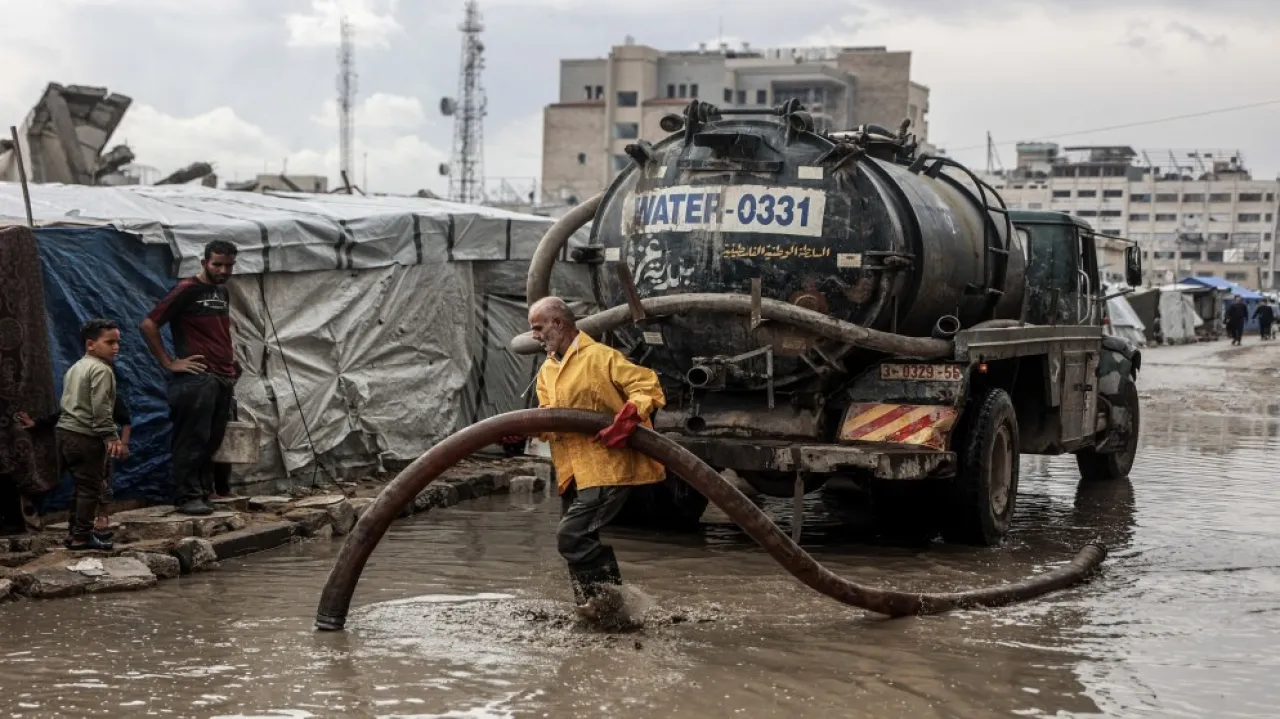
On Friday, the spokesman for the civil defense in Gaza, Mahmoud Basal, warned that water had flooded thousands of tents set up to house displaced people who had fled to the camps from the war.
Basal said, "Since dawn today, we have received hundreds of pleas from displaced people whose homes and tents were flooded," pointing out that the available tents are not sufficient to house those affected.
"What to do?"
In the Gaza Strip, situated between Sinai and the Negev Desert on one side and the Mediterranean on the other, most of the rainfall occurs in autumn and winter.
With Israel imposing strict restrictions on the entry of goods and humanitarian aid, Gazans set up tents and established temporary shelters that do not protect against heavy rains.
After the ceasefire that came into effect last month, the restrictions were partially lifted, but with about 92% of residential buildings damaged or destroyed in the war, according to the United Nations, the needs far exceed what enters the sector of goods and aid through trucks.
A source active in humanitarian affairs reports that the restrictions on the entry of many materials needed to build shelters in Gaza, such as some types of tent poles, have not yet been lifted.
In another part of the camp adjacent to the Mediterranean, a man uses a broom handle to remove water accumulated on top of a tarp he used as a cover for his tent.
In the low-lying areas of the camp, water pooled and accumulated before making its way to the sea. Footage by France-Presse showed children roaming the camp where the water level reached the ankle.
Inam Batraikhi, an activist in a displacement camp, says she felt powerless after women came to seek help from her, wondering "How do I save them?" explaining that her tent was also flooded.
Noura Abu Al-Kas, also displaced, says she found her mattresses, blankets, and clothes all wet, adding that her son sent her a piece of tarp "but it does not protect us (from the rain). What to do? Where do I go?"
"We live in a cemetery"
In Khan Yunis in southern Gaza, Mohammed Shabat and his wife and five children suffer due to the weather, with the cold seeping into their tent.
Shabat, sitting on the sand between graves, says, "We live in a cemetery, and I have a child. This tent does not protect us from the cold or rain."
He adds, "Winter will come soon, and it will be extremely difficult."
Sitting next to a stove made of stacked concrete blocks, his wife Alaa dreads the upcoming winter season.
She says, "The tent is not a safe place to live with young children. The cold winds penetrate the tent in the evening, and the temperature drops significantly."
In Gaza, temperatures drop to between 15 and 20 degrees Celsius at night. But any drop in temperature exacerbates the suffering of the residents of the sector who are already suffering due to the primitive nature of the shelters and a lack of proper nutrition.