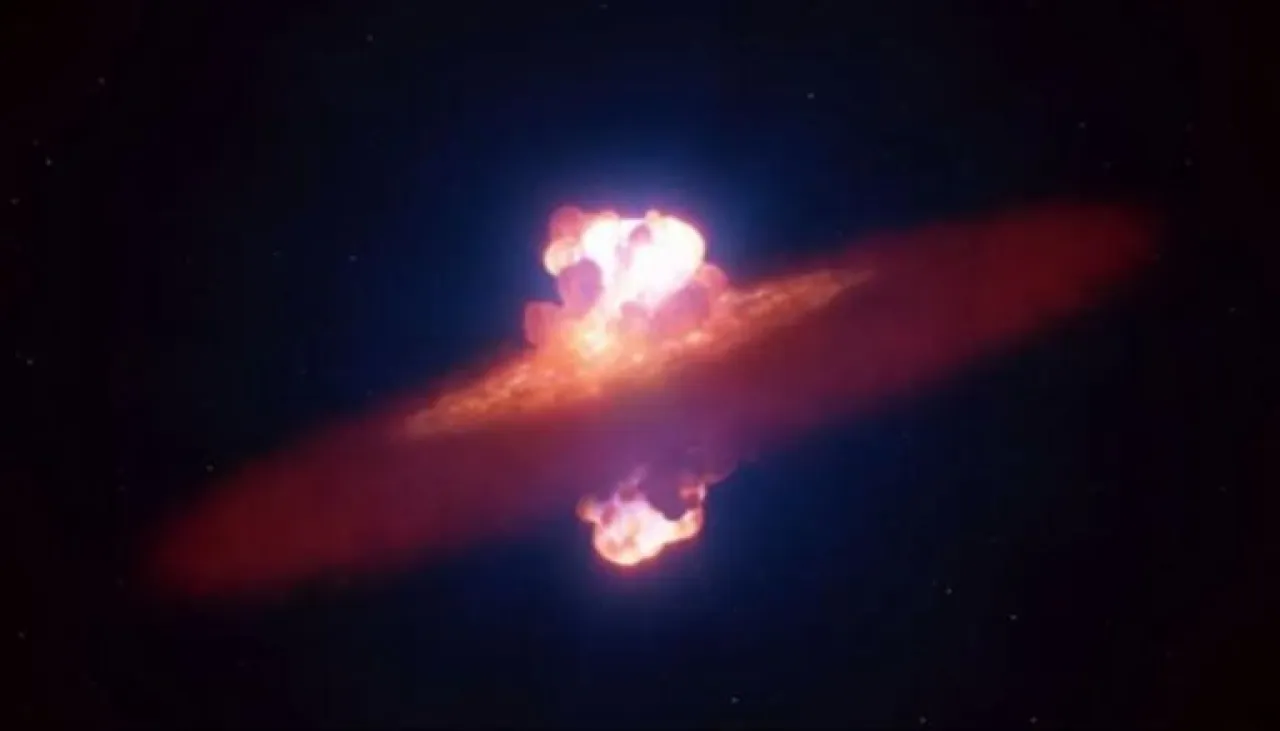
Khaberni - For the first time, astronomers have managed to observe the moment a shock wave is released from an exploding star prepared to die, revealing an unexpected astonishing explosion.
Usually, it is difficult to observe this moment in detail, because stars that explode as supernovae are rare, and often too far from telescopes before the explosion process begins.
But when the star "SN 2024ggi" exploded on April 10, 2024, within the relatively nearby spiral galaxy "NGC 3621" at a distance of 22 million light-years in the constellation of Hydra, astronomer Yi Yang from Tsinghua University in Beijing realized that this was an opportunity that had to be seized.
Yang and his international team, consisting of scientists from China, Europe, the Middle East, and the United States, quickly moved to secure observation time using the Very Large Telescope (VLT) at the European Southern Observatory in Chile, and just 26 hours after the explosion was detected by the ATLAS cameras, data began arriving from the telescope.
Dieterich Bade from the "European Southern Observatory" said: "The initial recordings showed the stage at which the matter resulting from the explosion accelerated at the star's core and broke through its surface, and for a few hours, it was possible to observe both the star's architecture and the explosion together."
The star that exploded was a massive red giant, weighing about 12 to 15 times more than the sun. These stars die when nuclear reactions in their core stop, leading to the gravitational collapse of the core and the formation of a neutron star, as the surrounding layers roll back outward causing an explosion that destroys the star from inside out.
Although the explosion appeared as a simple point of light, the polarization of the light revealed the architecture of the shock wave, and by using the "FORS 2" spectrograph and light polarization measurement technology at its different spectra, the team was able to measure the details of the explosion's shape.
Yang says: "The architecture of the explosion provides fundamental information about star evolution and the physical processes that lead to these cosmic fireworks."
The measurements showed that the shape of the explosion was flat resembling an olive or grape, yet it spread with stunning symmetry even when colliding with a ring of material around the star.
Yang added: "These results indicate the existence of a common physical mechanism behind the explosion of many massive stars, characterized by clear axial symmetry and operating on a large scale."
These observations allow scientists to rule out some theoretical models and strengthen others that describe how the shock wave transitions from the star's core to its surface, indicating that the variances observed in subsequent supernova explosions could be caused by strong magnetic fields and not by neutrino absorption.
The results of the study were published on November 12, in the journal "Science Advances", and are available on the website of the "European Southern Observatory", representing an unprecedented step in understanding the moment-by-moment death of massive stars.