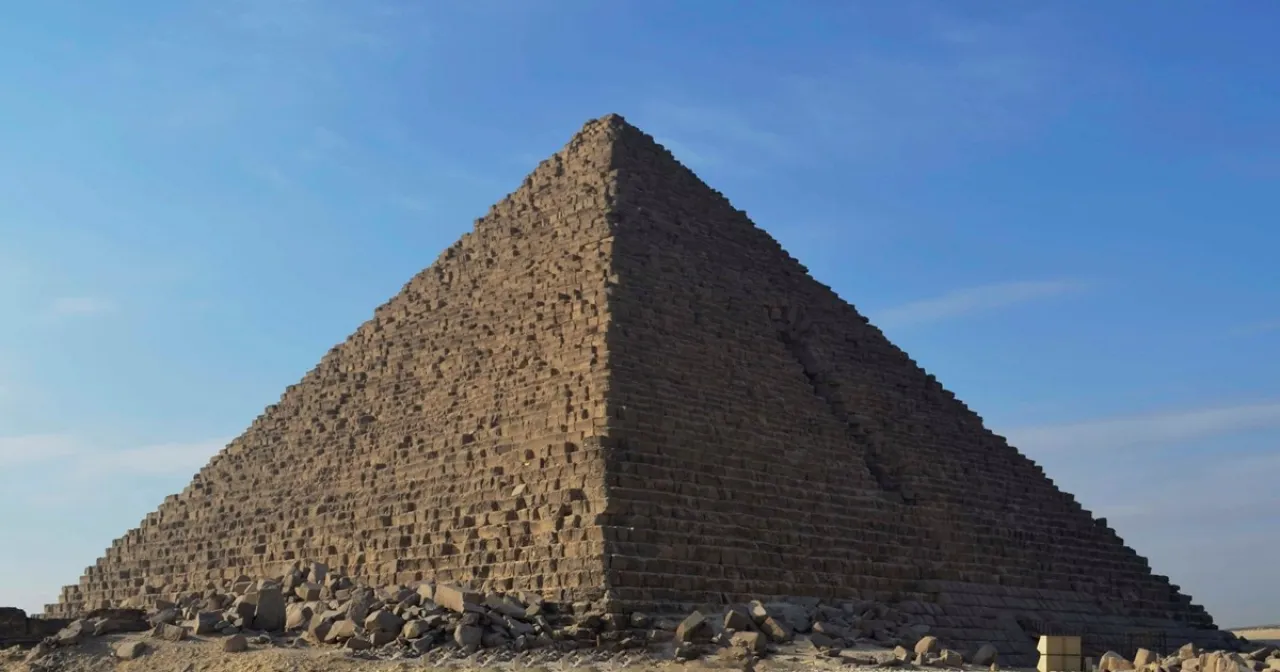
Khaberni - More than four thousand years after it was built, the Pyramid of Menkaure, the third largest of the Giza pyramids, continues to pique the curiosity of scientists and gradually reveal its secrets. A team of Egyptian and German researchers announced the discovery of "mysterious voids" within its inner structure, believed to possibly be remnants of an undiscovered hidden entrance.
The Pyramid of Menkaure, constructed around 2510 BCE to serve as the tomb of King Menkaure from the Fourth Dynasty, is the smallest among the three pyramids in the famous Giza complex, standing at about 200 feet (61 meters).
Its historical allure increased after the mysterious loss of the king's sarcophagus at sea in 1838 while being transported to the British Museum aboard the merchant ship “Beatrice,” which disappeared under mysterious circumstances after leaving the port of Malta.
In the latest study published in the journal NDT & E International, scientists from the Technical University of Munich (TUM) and Cairo University employed advanced non-invasive scanning techniques including radar, ultrasonics, and electrical resistance tomography (ERT), allowing them to look behind the massive granite walls without dismantling them.
The results revealed two air-filled voids behind the pyramid's eastern facade, located just a few feet beneath the outer surface, varying in size and height. It is believed that these voids are linked to a possible secret passage or entrance on the east side facing the Nile River, contrary to the known entrance on the north side.
Professor Christian Groß, a testing specialist at the Technical University of Munich, said: "This is an important discovery in Giza, and our methodology allows for very precise conclusions about the nature of the pyramid's interior," indicating that the findings strongly support the hypothesis of another undiscovered entrance.
Interestingly, the granite stones on the eastern side appear unusually smooth and polished, resembling the pattern of the stones at the main entrance in the north, which reinforces the belief in the existence of a second entrance that was overlooked through the ages.
Although these results still require further discussion among Egyptologists, they open the door to new possibilities regarding chambers and passages yet to be discovered inside the pyramid, and possibly even royal treasures that modern eyes have not seen for thousands of years.
The Pyramid of Menkaure, like the rest of the Giza pyramids, remains a symbol of the mystery surrounding the ancient Egyptian civilization, which continues to fascinate the world with its precise engineering, mysterious astronomical alignments, and construction secrets that have not been fully deciphered to this day.