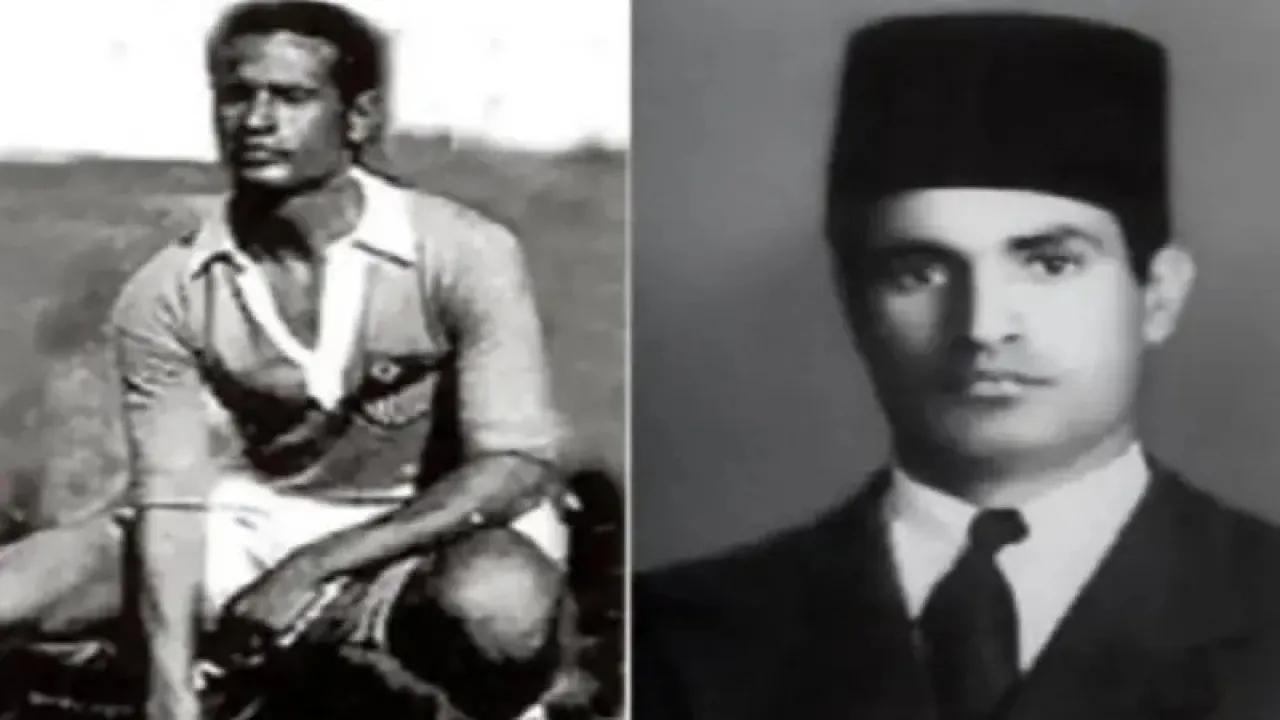
Khaberni - Abdel Rahman Fawzi is considered one of the forgotten stars of Egyptian football, although he is one of the names that prominently marked its presence in the country's sports history by being the first Egyptian, Arab, and African player to score a goal in the World Cup finals.
His achievement in 1934 in Italy was a defining moment in Egyptian sports history, not only because it represented Egypt's first appearance in the World Cup, but also because it initiated African and Arab participation in the scoring records of this major global competition.
The beginnings
Abdel Rahman Fawzi was born in the Egyptian city of Port Said on August 11, 1909, at a time when football was still in its early stages, and no one could have imagined that a child from this coastal city would leave a historic mark on Egyptian football.
Fawzi grew up in a modest environment, showing an exceptional passion for football from a young age, spending most of his time playing in alleys and streets before joining the Islamic Charity School.
There, his true talent began to show as he and his peers formed a small team called "Team Nile." They played matches against other school teams, and this modest team was Abdel Rahman Fawzi's gateway to fame.
Over time, Fawzi and his friends founded a popular club carrying the same name "Nile," and the team played matches inside and outside Port Said, until Fawzi caught the attention of the officials of El Masry Club of Port Said. In 1927, he officially joined the ranks of the club, marking the beginning of his real soccer journey.
He was a fast player, strong in shooting, with striking dribbling and scoring skills, and he was known for his rocket-like shots which he practiced in innovative ways. He would place the ball in water for hours to make it heavier, training with it to strengthen his leg muscles, then switch to regular balls finding them lighter on the field, and shoot them powerfully.
In the late 1920s, Fawzi moved to Cairo to study at the Sa'idiyya High School, where he excelled in school matches to the extent that the famous Al Ahly goalkeeper Mustafa Kamel Mansour recommended him to join Al Ahly club.
Indeed, Fawzi played for Al Ahly for a year, but he did not stay long as he responded to an invitation from the governor of the Canal region, Hassan Fahmy Rifaat, to return to his home club, El Masry, leading it to a series of historic successes.
Fawzi was one of the key players of the team that won the Sultan Hussein Cup in 1933 after beating Olympi Alexandria two goals to one, and then he repeated the same achievement the following year against Al Ahly four goals to two.
After this double achievement, he was selected to represent the Egyptian national team, at a time when the country was preparing for a new adventure in the qualifications for the 1934 World Cup in Italy.
The road to the World Cup
The first edition of the World Cup took place in Uruguay in 1930 with the participation of 13 teams invited directly without qualifications, and the African and Asian teams were absent.
Egypt was invited to the 1930 edition but considered the long boat journey too arduous, so it decided to give up its chance to participate in the first World Cup.
However, the second edition in 1934 was held in Italy from May 27 to June 10, 1934, in 8 Italian cities such as Bologna, Florence, Genoa, Milan, Naples, Rome, Trieste, and Turin.
32 teams participated in the qualifiers, including the host country, which did not automatically qualify at that time, and 16 teams qualified for the final tournament.
Africa and Asia were given one joint seat, and three teams applied to participate: Egypt, Palestine, and Turkey, although the latter withdrew before the qualifiers began.
Egypt participated in the qualifiers representing the African continent, while Palestine, which was mainly composed of Jewish players, represented the country under the British mandate.
The Egyptian team won the home match in Cairo by a score of 7-1 on March 16, 1934, with Mukhtar El-Tetsh scoring three goals, and both Mustafa Kamel and Mohamed Latif scoring two goals each.
In the return match in Tel Aviv on April 6 of the same year, the Egyptian team won again by a score of 4-1, with Mukhtar El-Tetsh scoring two goals, while both Mohamed Latif and Abdel Rahman Fawzi scored one goal each, qualifying Egypt with an aggregate score of 11-2, according to the official website of FIFA.
This qualification was a historical moment for Egyptian football, which was then under the administration of its nascent national federation. The team included only 18 players, although the regulations allowed for 20 players to be registered, selected from six clubs, while the team was coached by the Scottish coach James McRee.
The Egyptian delegation traveled to Italy aboard the ship "Helwan," a maritime journey that took four days, heading to the city of Naples, which hosted the anticipated match against the Hungarian national team on May 27, 1934.
Mustafa Kamel Mansour, the goalkeeper of the Egyptian team during that tournament, described the sea journey in an interview with BBC in 2002 as "an enjoyable experience," but he added that it marked the end of the fun for Egypt.
Hungary match
The 1934 World Cup was managed under a knockout system, and the match against Hungary was tough from the start as the Hungarians were one of the strongest European teams. Yet, Abdel Rahman Fawzi and his teammates showed competitiveness during the match.
Hungary took the lead with two goals scored by Pal Teleki and Giza Toldi within just half an hour from the start, but Egypt came back strongly thanks to their star, Fawzi, who scored two consecutive goals in the 35th and 39th minutes, becoming the first Egyptian, Arab, and African player to score a goal in World Cup history.
In the second half, Hungary regained control and scored their third goal through Gyony Ventzy in the 53rd minute, then Giza Toldi added the fourth goal after an hour of play, ending the match with a 4-2 victory for the Hungarian team.
However, the Egyptian team was not satisfied with the performance of the match referee, as the goalkeeper Mustafa Kamel Mansour stated in an interview with BBC in 2002 that the referee canceled a goal scored by Fawzi when the score was 2-2, despite the player "starting from midfield to bypass Hungary's defense before scoring." Mansour also mentioned that Hungary's fourth goal occurred despite him being fouled by a Hungarian player, but the referee overlooked the infraction.
Mansour was 87 years old when he told this story, and he died two months later in July of the same year.
Hungary exited the tournament in the quarter-finals after losing to Germany 2-1, while the Italian national team won the championship after defeating Czechoslovakia 2-1 in the final.
Some may wonder why the outstanding Egyptian team did not qualify for the 1938 World Cup in France. The team had to play home and away matches in the qualifiers against Romania, but Egypt objected to the date of the first match scheduled on September 17, 1937, because it coincided with Ramadan. FIFA considered Egypt's objection as a withdrawal, so Romania qualified directly to the tournament without playing.
As for Abdel Rahman Fawzi, he became a symbol of Egyptian and Arab football after scoring two historic goals in Egypt's first World Cup participation.
After the 1934 World Cup
With the return of the national team from the World Cup, Abdel Rahman Fawzi's fame increased, and he received offers from major clubs. Just one year later, the president of Zamalek, Mohamed Haidar Pasha, successfully incorporated him into the ranks of the "White Club" in 1935, opening a new chapter in his eventful sports career.
Fawzi was an exemplary player, a respected leader by his peers, and was known for his intelligence on the field and his ability to read opponents' moves, in addition to his powerful shots, which were one of his distinguishing features.
With Zamalek, Fawzi continued to shine for 12 years, until 1947, contributing to several local championships. After retiring from playing in 1947, Fawzi did not stray from the football world as he turned to coaching, working as a technical director for Zamalek, and discovered several Zamalek stars in the 1950s such as Alaa El Hamouly, Sharif El Far, and Essam Bahieg.
In fact, he had taken over coaching Zamalek while still a player in 1946, and continued in this role until 1956, the longest period for any technical director in the club's history.
In 1956, Fawzi became the first technical director in the history of Egyptian football to coach two clubs at the same time, as he coached Ghazl El Mahalla, which was playing in the second division, in addition to managing Zamalek, and he led Ghazl El Mahalla to their first promotion to the Premier League.
He was also part of the national committee supervising the training of the Egyptian national team during the period from 1953 to 1954, which led the team to win the gold medal at the Arab Games in 1953.
Fawzi was the first coach of the Saudi Arabian national football team, taking over in 1957 and remaining at the helm of its technical management until 1962.
He later coached the Railway Club after returning to Egypt in the early 1960s and returned to coaching in 1975.
Abdel Rahman Fawzi was known for his humility and simplicity, living a balanced life away from the spotlight, focusing on his family and children.
Death and Legacy
Abdel Rahman Fawzi died on October 16, 1988, at the age of 79, after leaving a historical legacy in the memory of Egyptian football.
Until his death, he remained the only Egyptian player to have scored goals for his national team in a World Cup tournament until Magdi Abdel Ghani scored a goal in his country's match against the Netherlands in the 1990 World Cup.
Fawzi was not just a player or coach, but a sports figure with a broad vision for the future of Egyptian football. He was among the first to advocate for organizing independent African tournaments at a time when Africa was completely absent from international forums, and from here, many considered him part of the generation that later paved the way for the launch of the African Nations Cup in 1957.
Even today, Fawzi still holds his title as the first Egyptian scorer in the history of the World Cup, a record not matched by anyone except Mohamed Salah, who scored two goals in the 2018 edition in Russia, 84 full years later. Fawzi remains to this day the record holder as the first Arab to score two goals in a single World Cup match and in just 4 minutes.
The International Federation of Football Association (FIFA) has dedicated several reports on its official website in honor of his historical role, confirming that "he was not only the first to score, but the first to inspire an entire continent to dream of participating in the World Cup."
The story of Abdel Rahman Fawzi is not just the tale of a talented athlete, but a chapter of national resurgence in Egypt during the 1930s, when football was a means of self-expression in the face of colonial powers.
Fawzi represented the generation that believed that sports could be a means for a nation's presence on the global stage, which indeed came true decades later through new generations who followed in his footsteps.
The indoor hall at Zamalek Club was named after him, in recognition of his efforts and career.
Abdel Rahman Fawzi was more than just a scorer; he was a national pioneer who changed the world's view of African and Arab football, opening the door for entire generations of players to dream of reaching the World Cup. If every nation has its pioneers who shaped its footballing glory, Abdel Rahman Fawzi will always be the pioneer of Egypt, the Arabs, and Africa in the World Cup, and the name from which the great dream began.