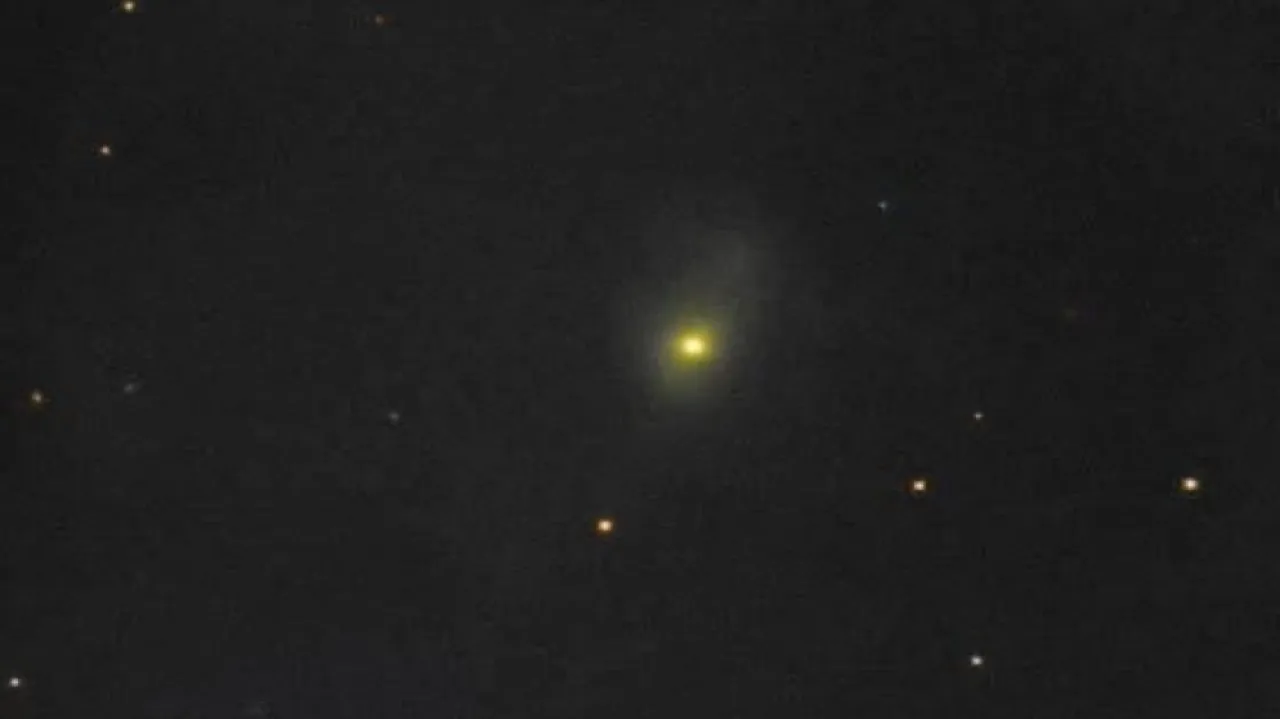
Khaberni - A Jordanian team managed to track and photograph Comet 3i/Atlas from the Southern Jordanian desert, after a precise follow-up on its path, in the first observation operation of its kind from the skies of Jordan. The operation was performed while the comet was 325 million kilometers away from Earth, according to Ammar Alsakaji, head of the Jordanian Astronomical Association.
The mysterious Comet Atlas 3i/Atlas is among the rare objects that do not belong to the solar system we are part of, but instead came from interstellar space and crossed the boundaries of the solar system, sparking wide controversy in the media and communication platforms due to its unique nature. It is considered the third confirmed interstellar object discovered to date, after ʻOumuamua and Borisov, and scientists confirm that it is a "natural comet" and not an artificial object or spacecraft as some rumors had suggested.
The comet was first discovered on July 1, 2025, by the ATLAS sky survey system in Chile, when it appeared with an apparent brightness of about 18, moving at a speed of about 220,000 kilometers per hour towards the sun, according to Alsakaji.
Following the discovery, a series of terrestrial and space-based observations ensued, while the European space agency’s JUICE spacecraft continues to closely monitor the comet.
Given its open path not bound by the sun’s gravity, the interstellar object classification committee granted it the "3i" designation, indicating it as the third confirmed interstellar visitor. The comet follows a hyperbolic trajectory with extreme speeds reaching about 209,000 kilometers per hour as it enters the solar system.
According to Alsakaji, calculations by NASA's Jet Propulsion Laboratory indicate non-gravitational acceleration in the comet’s movement due to the sublimation phenomenon, with a radial value near one in a million, and tangentially about one in ten million, which is expected to lead to the loss of a tenth of its mass.
The speed of the ascending gases is a few hundred meters per second, with a half-life of evaporation estimated at six months.
Data from the STEREO, SOHO, and GOES-19 spacecraft have shown a clear increase in the comet’s brightness between September and October due to intense sublimation, although some phenomena are still under study, the most prominent being the unusual blue color that appeared as it approached perihelion.
According to Alsakaji, the European probe JUICE is scheduled to begin a more detailed observation phase in the first week of November, before the comet approaches Earth on December 19, 2025, at a distance of 269 million kilometers, with hundreds of terrestrial and space telescopes, including Hubble and James Webb, participating in the observation of its details.
The peak of its approach to the sun occurred on October 29, 2025, at a distance of 1.36 astronomical units, that is between the orbits of Earth and Mars.
The observation team in Jordan included Adli Al-Halabi, Samih Sofan, and Ammar Alsakaji, with Haytham Hamdi and Anas Sowalha handling the processing of more than 300 photographic frames taken during the observation.
Scientists at NASA and the European Space Agency confirm that the comet poses no threat to Earth, and it is likely to leave the solar system again after its passage.
The diameter of the comet's nucleus is estimated to be between 0.32 and 5.6 kilometers, with a possibility that it is less than one kilometer due to its association with dense dust clouds around it. Observations using the James Webb Telescope revealed that it is unusually rich in carbon dioxide gas, with small amounts of ice water vapor and carbon monoxide observed. Atomic CN and Ni emission was observed in its gaseous envelope, against a noticeable absence of iron Fe I, which are rare characteristics in known comets.
The comet is surrounded by a visibly evolving dust tail, and its composition rich in unusual gases and metals provides scientists with a unique opportunity to study a body dating back to before the formation of the solar system, perhaps more than 7 billion years ago, older than the age of the sun and the planets.
Although it cannot be seen with the naked eye, its observation contributes to expanding the understanding of interstellar objects and raises new questions about the diversity of comet origins and the properties of chemical materials in deep space. It also serves as a reminder that the solar system is not isolated, and that visitors from beyond its borders carry materials and secrets that may change what we know about the universe.