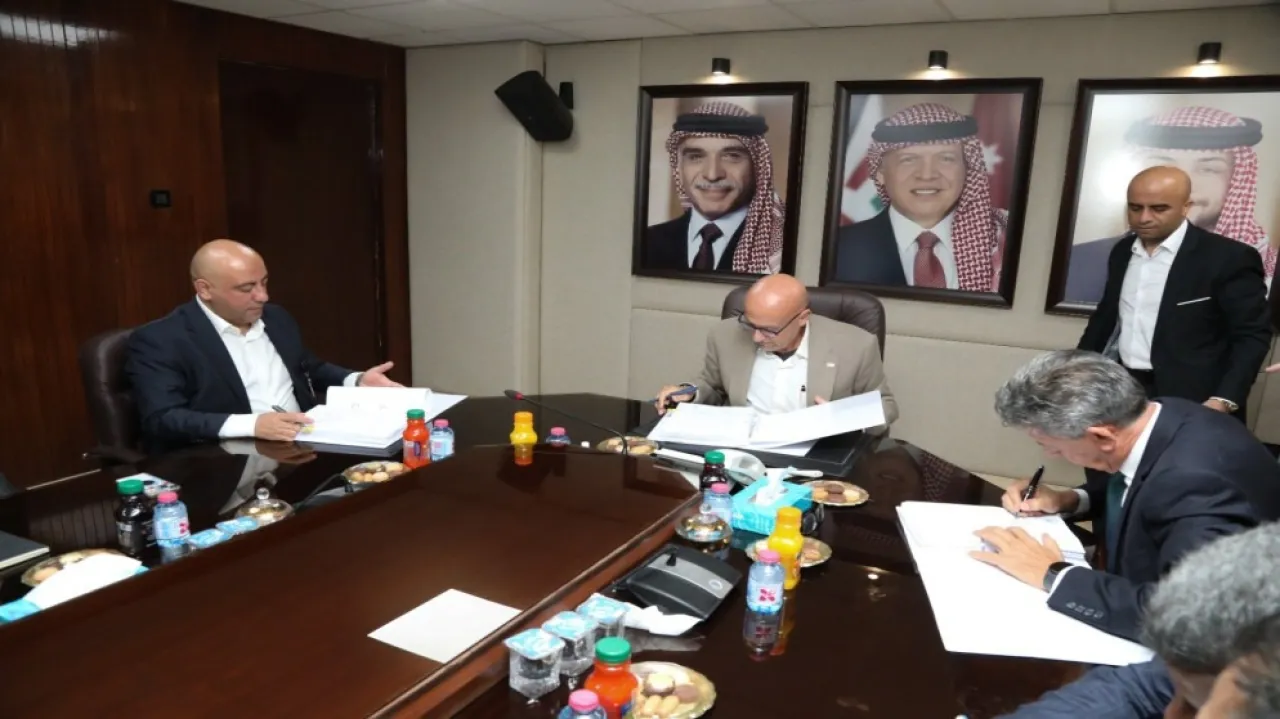
Khaberni - Minister of Water and Irrigation Raed Abu Saoud signed, on Monday, at the ministry's headquarters, the two agreements to execute the sanitation projects in West Irbid – the second package, and in Southwest Amman – the third package, in the presence of the Secretary-General of the Water Authority, Engineer Sofyan Al-Btayneh, the assistant for sanitation affairs, Engineer Ghada Safa, and a number of water sector representatives.
The signing of the agreements is part of the vision for economic modernization and the strategic water plan for 2023 – 2040, within the framework of the ongoing government efforts to improve services provided to citizens, with a total value of approximately $27.7 million, funded by the European Union and the European Bank for Reconstruction and Development (EBRD), in addition to self-financing from the Water Authority.
Minister Abu Saoud affirmed that the government, through the Ministry of Water and Irrigation/Water Authority, continues to accelerate the implementation of vital projects to improve sanitation services in various areas. He explained that the second package, valued at $18.47 million, funded by the European Bank for Reconstruction and Development and the EU MADA Fund, targets areas like Kafr Asad and Qum in Irbid Governorate, and includes the installation of sanitation pipelines with diameters ranging from 300 to 600 mm, spanning 45 kilometers, and household connections extending 10 kilometers, to serve about 31,800 citizens.
As for the third package, the minister said it is implemented with self-financing from the Water Authority at a cost of 9.23 million dinars, covering areas like Marj Al-Hamam and parts of the Naour district in Southwest Amman, by extending sanitation pipelines up to 32 kilometers, executing 5 kilometers of household connections, and rehabilitating 2 kilometers of Wadi Al-Seer’s carrier line, serving approximately 13,900 citizens.
Minister Abu Saoud emphasized that these projects represent a qualitative leap in the development of sanitation services in the kingdom, resulting in significant environmental and service improvements, in alignment with the goals of sustainable development and the national vision for water.