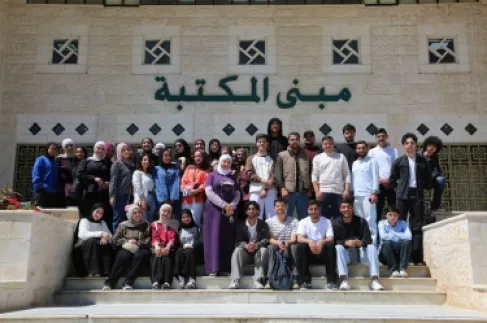
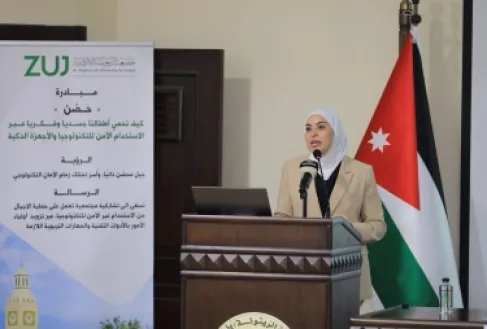
Khaberni - In the context of the preparations for the 8th Arab Youth Conference in early 2026, the Arab Thought Forum, in collaboration with Petra University, organized a youth session titled "Arab Youth: The Face of the Future Arab Nation" at the Anbat Theater in the university, attended by the university president, Professor Rami Abdel Rahim, several deans, academic and administrative bodies, and a large number of university students.
The session was held in the spirit of partnership that the Forum has adopted with universities and youth institutions, with the desire to engage youth in sharing their ideas and to consider their proposals and observations before the conference. The meeting, which included two dialogical sessions, discussed the most prominent issues concerning Arab youth and their role in building the future.
The first session was opened by the Dean of Student Affairs at the university, Professor Iyad Mulaah, with a speech by the Secretary-General of the Arab Thought Forum, Dr. Sadeq Al-Faqih, who emphasized the pivotal role of youth in leading the Arab renaissance, noting that since its establishment in 1981 at the initiative of His Highness Prince Hassan bin Talal, the Forum has paid special attention to the youth and their role in renewing Arab thought and building the future of the nation.
Dr. Al-Faqih highlighted the depth of the partnership with Jordanian universities, especially Petra University, which represents an exceptional academic environment that enhances the values of thought and dialogue, affirming that the intellectual renaissance can only be achieved with the awareness of the youth and their belief in their role in shaping tomorrow.
His Excellency Professor Dr. Abdullah Oweidat, Minister of Culture, Youth, and Antiquities (and former Minister of Social Development), stressed the importance of dialogue between generations to understand the challenges and aspirations of youth, pointing out that the true concept of citizenship is based on justice and meritocracy, not lineage or affiliation, urging youth to participate consciously in nation-building.
Dr. Mohammad Al-Hourani, former President of the Arab Writers Union in Syria, spoke about the importance of empowering youth in decision-making positions, asserting that true democracy involves the participation of new generations in shaping the future, calling for the harnessing of their creative energies in media and social communication to enhance sustainable development and protect the national identity based on diversity.
The second session, managed by the Dean of the Faculty of Arts and Sciences at Petra University, Professor Mahmoud Al Salman, covered various topics including development, artificial intelligence, and drug control.
Dr. Mahmoud Al-Sarhan, Secretary-General of the Arab Youth Forum, delivered a lecture discussing the importance of empowering Arab youth as the real wealth of the nation, urging the adoption of realistic policies that meet their needs, and enhancing their communication and dialogue skills, affirming that empowering youth is an investment in the future.
Dr. Noor Al-Kubaisi, a specialist in international law from the Republic of Iraq, presented a segment on "Combating Drugs and Its Impact in Protecting Youth," warning of the growing danger of drugs on young people, and calling for the adoption of modern strategies employing artificial intelligence in prevention, early detection, and treatment.
The session concluded with Dr. Ziad Abdullah, General Manager of the Arab Institute for Training and Financial and Economic Research in the Republic of Lebanon, affirming that artificial intelligence represents an opportunity for Arab youth to participate actively in building the digital economy, emphasizing the importance of linking academic education with practical application and preparing youth for future labor market requirements.
At the end of the sessions, an interactive dialogue took place between the lecturers and university students, where participants expressed their opinions and proposals on ways to enhance the role of Arab youth in development and decision-making.