Khaberni - Two weeks ago, the "Washington Post", in collaboration with a group of European media outlets, published an extensive investigation about a Russian scheme to illicitly acquire Western technologies used in naval warfare, especially in the field of submarines and anti-submarine warfare.
The secret project, known as "Harmony", involved the Russian military using front companies to acquire the technology and deploying a dense network of underwater sensors, including acoustic sensors and other types, as well as unmanned submarines and dual-use commercial and research vessels, according to a report by "National Interest".
The purpose of the project
The main goal of the project was to monitor, track, target, and potentially attack Western anti-submarine forces as they approach Russian northern waters and other coastal areas considered to be "marine fortresses" protected by Russian naval and ground forces. Through this system, Russian military leaders hope to thwart modern Western anti-submarine operations.
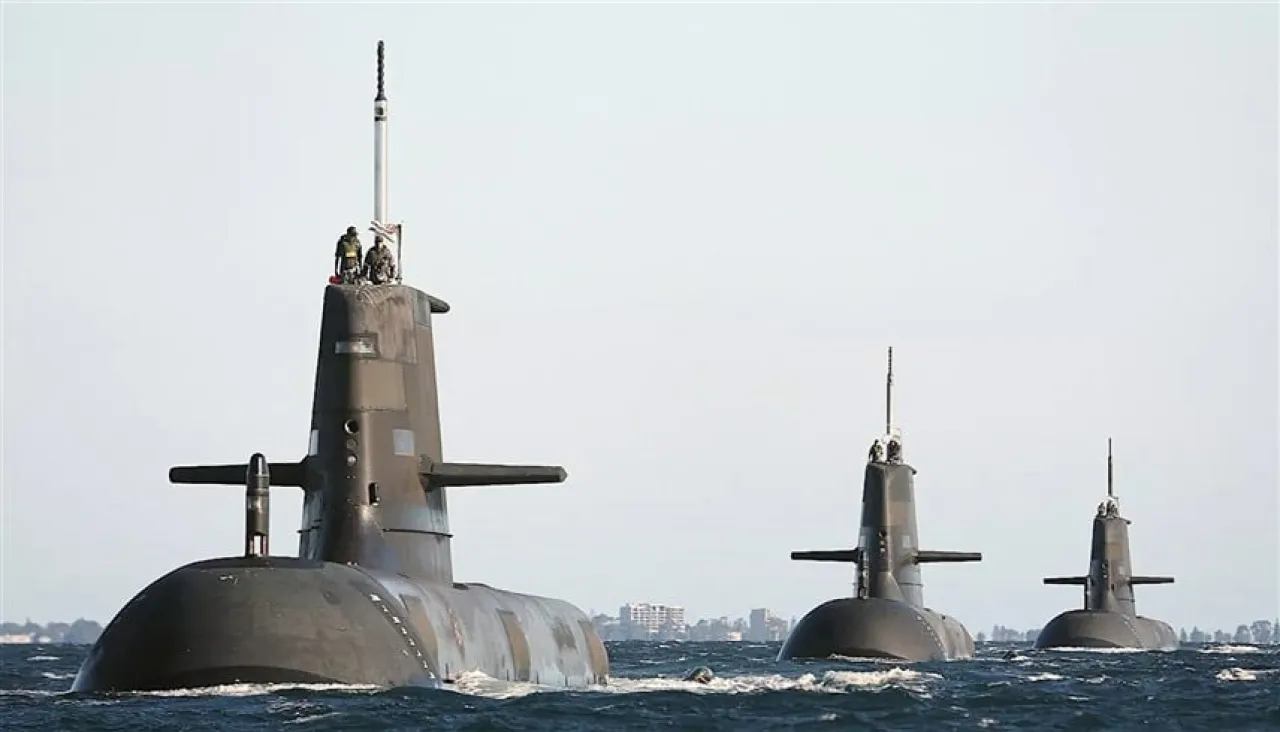
The magazine pointed out that the fundamental goal is to keep Western forces away from Russian ports, complicating their ability to detect, track, and destroy Russian submarines. Typically, an enemy ship can be intercepted at three stages: at launch, during its journey, or upon arrival.
Meanwhile, nuclear submarines carrying ballistic missiles are not headed to a specific destination but hide in the ocean depths to carry out their deterrent mission, making it difficult to detect them at sea. Hence, the importance of protecting their launch ports. Protecting these submarines is one of the main motivations behind the establishment of the "Harmony" system.
The Soviet military command followed what is known as the "Blue Defense Belt", a strategy known today as "A2/AD (Anti-Access/Area Denial)".
The purpose of this strategy is to raise the cost of entering the waters near Soviet coasts to levels that Western military leaders and political decision-makers cannot bear. If Soviet defenses appear impenetrable enough, it would deter the Western navy from attempting forced penetration. If those forces decide to take the risk, the Soviet A2/AD systems can confront them and keep them outside the "Blue Belt".
To achieve this, Soviet air, naval, and missile forces would carry out long-range anti-ship counterattacks, attempting to create a "shock absorption zone" at its maritime borders, capable of bending without breaking. This defensive tendency seems still present in post-Soviet Russia, as evidenced by the "Harmony" project.
Differences
Until now, the most important factors in the fields of underwater stealth and detection were sound (and its control). The nature of the underwater environment also plays a crucial role, as submarines rely on differences in temperature, pressure, and salinity to hide their location, as these differences cause sound waves to refract, helping submarines evade detection, tracking, and targeting. On the other hand, anti-submarine forces work to neutralize these advantages to detect their targets.
According to the International Interest report, the balance between access and denial is changing with the evolution of offensive and defensive military technology. According to prevailing opinion, the Soviet "Blue Belt" had a clear advantage against the US navy in the seventies and early eighties of the last century.
However, things began to change with the introduction of the "Aegis" combat system aboard the cruiser "U.S.S. Ticonderoga" in 1983, enabling naval task forces to defend themselves against air and missile attacks, thus restoring dominance to the offensive, and allowing the United States to regain its ability to penetrate Soviet "marine fortresses".
Consequently, the strategies of access have become resilient and enabled the United States to continue practicing an offensive naval strategy.
The magazine continued, as for today? Russia in its modern form is likely better positioned than the former Soviet Union to prevent access to coastal areas. Advances in underwater technology from "modern sensors", unmanned vehicles, to artificial intelligence, threaten to make the oceans transparent to anti-submarine forces for the first time, weakening submarines' ability to vanish into the depths.
Advanced Technology
However, mass (or volume) is no less important than advanced technology in submarine tracking. Generally, new technologies related to undersea warfare are relatively low-cost. Proponents of air power often praise the concept of "affordable mass," namely systems that can be purchased in large quantities due to their acceptable price.
This concept perfectly applies to the marine environment. The more the entities seeking to prevent access can afford the cost of anti-submarine technology, the greater their ability to spread sensors on the sea floor or within the water column off their coasts.
The more these sensors are supported by autonomy and artificial intelligence, the greater the chances of detecting and dealing with enemy submarines. Combined with innovative methods, tactics, and operations, the "affordable underwater mass" could enhance the chances of success for the "Harmony" project and the effectiveness of the Russian military in general.
It seems that what happened in terrestrial wars is now happening in the depths of the seas, and the ongoing war in Ukraine has shown that modern military technology makes it easier to defend established positions than to control new ones in the face of an opponent possessing similar technologies, indicating that tactical defense imposes its dominance, and stalemate becomes the situation.