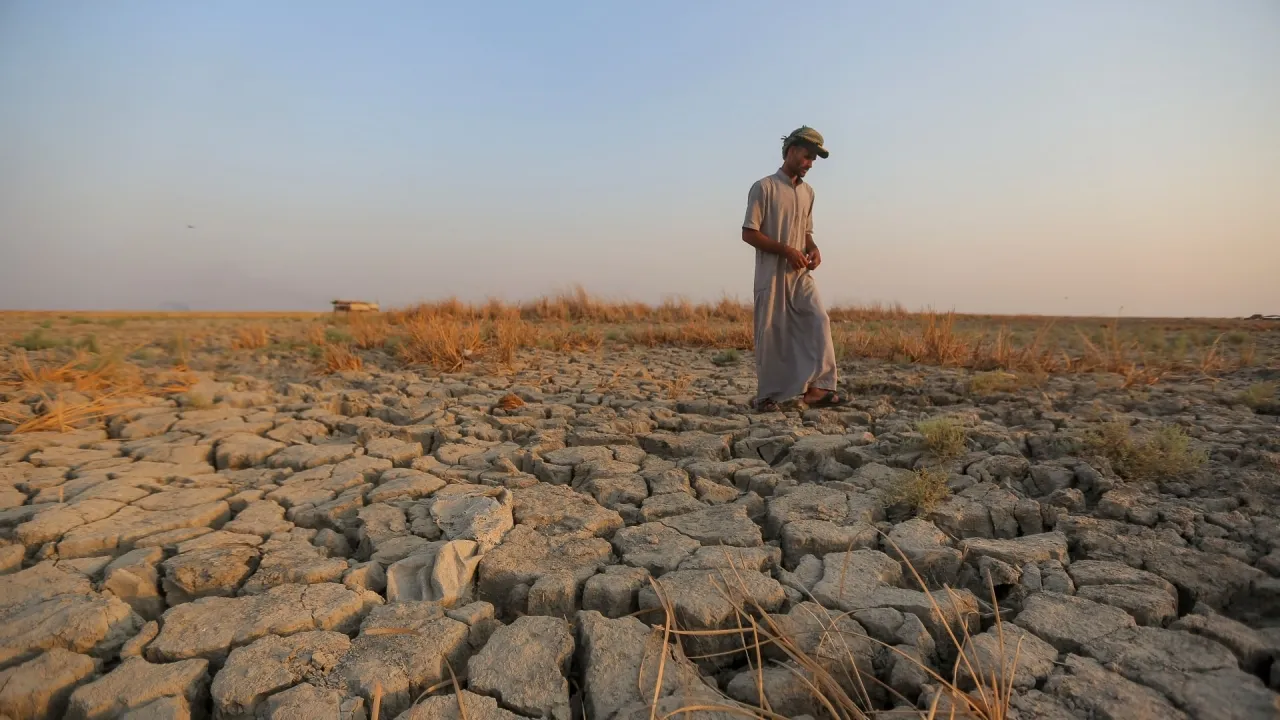
Khaberni - Today, the world is witnessing unprecedented climate transformations, but the Middle East seems to be one of the most affected regions. Between intense heatwaves, prolonged droughts, and increasing sandstorms, temperatures in the region are rising at a faster pace than the global average.
This change has become not just a scientific debate but a reality that people live with daily, from water scarcity and rising energy costs to declining agricultural production.
In this article, we will learn about the main aspects of the impact of climate change on temperatures in the Middle East, its causes, and future predictions according to recent studies.
First: What is climate change?
Climate change is a long-term shift in weather patterns and temperatures on the Earth's surface, primarily caused by increased greenhouse gas emissions like carbon dioxide and methane.
These gases trap heat in the atmosphere, in what is known as global warming, leading to an increase in the planet's average temperatures, changes in rain and wind patterns, and generally altering the climate.
Second: The Middle East.. a hotspot of increasing heat
Reports from international environmental organizations indicate that the Middle East's temperature is rising at nearly twice the global average rate.
Over the past three decades, temperatures in many countries in the region have increased by about 2 to 3 degrees Celsius compared to the mid-20th century.
According to a United Nations report for 2024, it is expected that the region will face a further increase of between 4 to 6 degrees Celsius by the year 2100 if emissions continue to increase at the same rate.
Third: The most affected countries in the region
Though all Middle Eastern countries suffer from the impacts of climate change, some are more vulnerable than others, such as:
The Arabian Gulf: where temperatures during the summer rise to record levels, sometimes exceeding 50 degrees Celsius.
Jordan, Syria, and Iraq: suffer from decreasing rainfall amounts and growing drought periods that affect agriculture and groundwater.
Yemen and Sudan: are affected by rising temperatures and reduced monsoon rains, leading to water shortages and threatening food security.
Lebanon and Palestine: face repeated unusual heatwaves and an increase in summer forest fires.
Fourth: How does rising temperature affect life in the Middle East?
Agriculture and Water
With rising temperatures, evaporation increases and rainfall rates decrease, leading to a decline in agricultural crop production.
For instance, in Jordan and Iraq, the cultivated areas have decreased by about 30% over the last decade due to water scarcity and the heat of summer.
Cities and Energy
Cities consume more electricity to operate air conditioning units, increasing the strain on power networks and leading to higher living costs.
In some Gulf countries, the energy consumption for cooling can exceed 70% of the total household energy during the summer.
Public Health
Higher temperatures double the risk of heat stress and heat strokes, especially among the elderly and outdoor workers.
Also, rising temperatures lead to the spread of some insect-borne diseases, such as dengue fever in coastal areas.
Environment and Biodiversity
Living beings in the desert environment suffer from the loss of natural habitats, while green areas in mountainous and forested regions are declining.
Also, rising temperatures lead to a decline in fish resources due to the warming of sea water and changes in its salinity.
Fifth: Extreme Climate Phenomena
Climate change in the Middle East not only manifests in rising temperatures but also in the increase of harsh climatic phenomena, such as:
Sand and dust storms that are becoming denser and more widespread in the Gulf and Iraq.
Sudden floods in areas that have been dry for many years, such as Jeddah and Muscat.
Forest fires in Lebanon, Syria, and Morocco due to prolonged droughts and high temperatures.
These phenomena have become more frequent and last longer, confirming that the region is undergoing an unstable climatic phase.
Sixth: What do scientists say about the future?
According to reports by the "Intergovernmental Panel on Climate Change (IPCC)", if countries do not take urgent actions to reduce emissions, some areas of the Middle East may become uninhabitable in the summer by the end of the century due to high temperatures and water scarcity.
Studies also predict an increase in extreme heat days (more than 45 degrees Celsius) by 200% in some countries, and that summer seasons will be 40 days longer compared to the current situation.
Seventh: Possible solutions to address climate change
It is not possible to completely stop climate change, but its impacts can be mitigated through practical steps, such as:
Transitioning to renewable energy: like solar and wind energy, to reduce dependence on fossil fuels.
Reforestation and planting green belts around cities to reduce temperatures.
Improving water management through seawater desalination and reusing greywater.
Adopting smart urban designs that rely on thermal insulation and provide natural ventilation.
Raising community awareness about the importance of conserving energy, water, and reducing pollution.
Eighth: The role of Jordan and the Gulf countries in addressing the phenomenon
Many Arab countries have started taking serious steps:
Jordan launched the "National Climate Change Strategy 2023–2050" focusing on reducing emissions by 30%.
The UAE and Saudi Arabia have adopted massive solar energy projects like "Masdar City" and "Neom Green".
Egypt hosted the Climate Conference (COP27) to highlight the region's environmental issues.
These initiatives represent the beginning of a real awareness of the situation's severity and the importance of collective action.
Conclusion
Climate change in the Middle East is an existential challenge, not just an environmental one, as it threatens food, water, health, and economic security.
Addressing this crisis requires regional and international cooperation to reduce emissions and adapt to the new reality.
Every additional degree of temperature means a harder life for millions of people, but there remains hope that the region can direct its energies towards a more sustainable future.