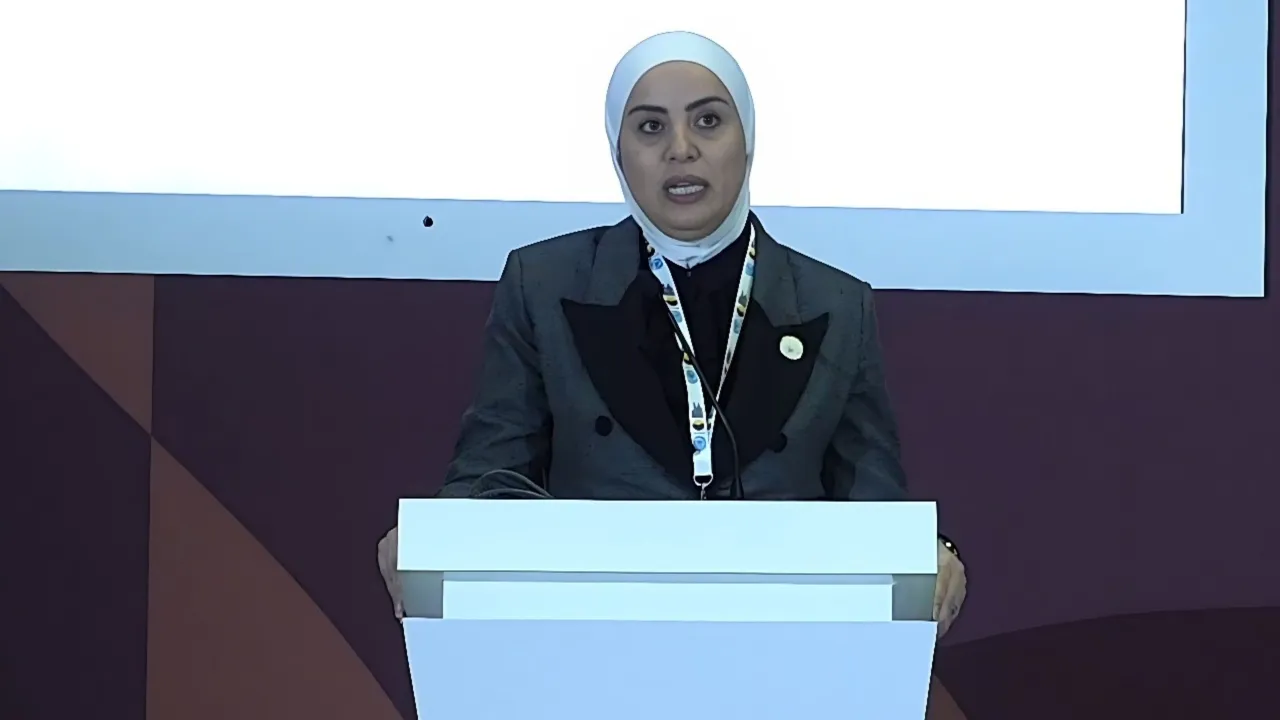
Khaberni - The Minister of Social Development, Wafa Bani Mustafa, participated today, Tuesday, in the dialogue session: "Decent work as a basis for recovery from crises, expanding solutions through human relations, development, and peace", organized by the Ministry of Social Development in cooperation with the International Labor Organization and the United Nations Development Programme, on the sidelines of the Second Global Summit for Social Development held in Doha.
Bani Mustafa, during her intervention titled "Best Practices from Countries Affected by External and Regional Crises," stated that Jordan is considered one of the most prominent regional models in dealing with external and regional crises.
Bani Mustafa elaborated that Jordan has developed an integrated social protection system that combines cash and in-kind support and economically empowers individuals to move from dependency to production.
She emphasized Jordan's leading role in enhancing developmental dialogue, both regionally and internationally, and sharing its experiences at all times, especially in crisis management and building a system based on protection and stability, confirming what was stated in the speech of His Majesty King Abdullah II, in his address to the European Parliament, when he mentioned two main areas of work: the first is supporting development because the prosperity of the Middle East provides an opportunity that benefits us all, and the second area is taking decisive and coordinated actions to ensure global security.
She mentioned that Jordan launched in May of this year the National Strategy for Social Protection 2025-2033, which included 4 axes: dignity, empowerment, opportunity, and resilience.
Regarding building effective international and regional partnerships, said Bani Mustafa, Jordan has adopted a balanced and realistic foreign policy that enabled it to rally broad international support without compromising its national sovereignty or developmental priorities, pointing to the investment in human capital and capacity building.
She added that Jordan has prioritized human development as the center of development, with investments made in education and technical and vocational training, and expanding programs for digital transformation and innovation, to qualify youth for the modern labor market and keep up with economic transformations.
She indicated that the national legislation is in line with international obligations and with modernization visions to achieve justice and equality and provide a decent work environment, where amendments were made to the Labor Law, Social Security Law, also the Social Development Law, the Child Rights Law, the Anti-human Trafficking Law, the Protection from Family Violence Law, and the Rights of Persons with Disabilities Law, noting that a system for the practice of the social work profession was enacted, which included training and qualification for caregivers for children, the elderly, and persons with disabilities, contributing to providing qualified personnel for care within families and communities.
Bani Mustafa concluded her intervention by discussing how the Jordanian experience highlights that institutional flexibility, proactive planning, and multi-party partnership are key elements in crisis management and transforming challenges into opportunities, as Jordan has been able to present a model to be emulated in achieving a balance between humanitarian response and sustainable development, and between maintaining internal stability and openness to international cooperation.