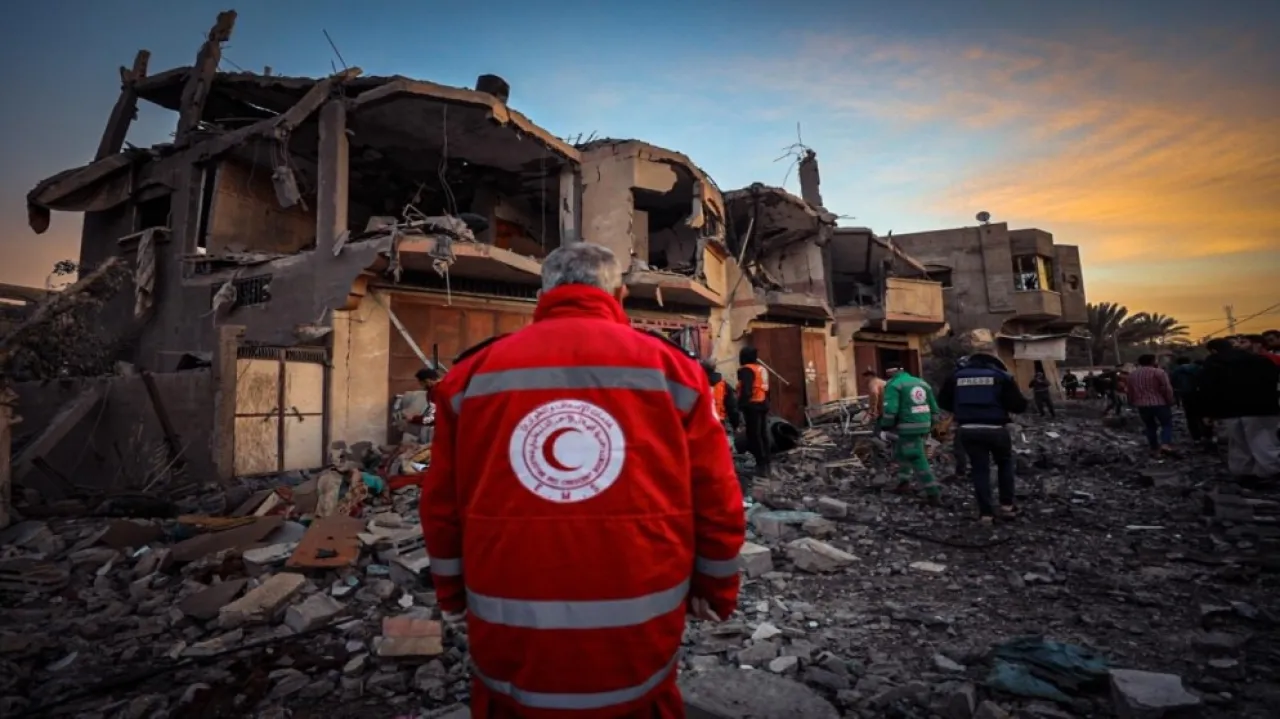
Khaberni - The spokesperson for the Palestinian Red Crescent, Raed Al-Nams, said on Tuesday that many areas of the Gaza Strip never receive humanitarian aid, especially the entire region of Rafah which has been forcibly displaced, in addition to the eastern areas of Khan Younis and the northern parts of the Strip.
Al-Nams confirmed that the aid currently being introduced does not meet the substantial needs resulting from two years of war, which have caused a real famine leading to the deaths of hundreds of the region's inhabitants, mostly children and the elderly suffering from chronic diseases.
He reported that since the ceasefire, Red Crescent teams have dealt with hundreds of injuries that were received and provided emergency and health services through the society's field hospitals, in addition to more than 35 field medical points that were established to support the staggering health sector.
He said that the health sector faces a significant shortage of medical supplies, medicines, and treatments, due to limited resources and the occupiers deliberately following a policy of rationing what is allowed to enter in terms of medical aid.
Al-Nams pointed out that the society faces significant difficulties in transporting the wounded or providing essential medical supplies, as roads leading to hospitals have been deliberately targeted by the occupiers, in addition to a severe shortage of ambulances and the necessary fuel to operate them, which has led the society to distribute ambulances geographically to ensure faster access to patients and the injured.
He confirmed that the humanitarian situation in Gaza after the ceasefire agreement is extremely difficult, and the need for relief and humanitarian aid, fuel, oxygen, anesthesia tools, sterilization, and surgical supplies is very significant.
He added that hundreds of thousands of families are sleeping on the ground and lack the most basic necessities of life in displacement camps and shelter centers, and urgently need tents, mattresses, and blankets with the approach of winter, in addition to the educational, health, humanitarian, and relief sectors needing urgent support after deterioriating significantly over two years of war.
He clarified that the bodies being delivered to families fall under the jurisdiction of the Palestinian Ministry of Health, noting that there are more than 10,000 missing persons reports at the competent authorities, whether they are detained or under rubble.
He expressed his hope that efforts will lead to information about their fate and that the occupiers will reveal the numbers and names of those detained.
Al-Nams confirmed that the Red Crescent services have not stopped since October 7, 2023, with the society establishing more than five field hospitals and more than 35 medical points, noting that there is a statistic speaking about more than a million medical services provided to Palestinians during the war, in addition to ambulance services, psychological support programs, relief, and the establishment of more than 30 refugee camps.
He revealed that the war led to the martyrdom of 56 members of the Red Crescent staff while performing their humanitarian duty, more than 40 others were injured, and 39 workers were detained, in addition to about 39 ambulances being put out of service due to direct and indirect targeting by the occupiers. In addition, the society documented 488 violations against its crews, facilities, and headquarters in the Gaza Strip. Nonetheless, the society continues to work providing humanitarian and health services despite systematic targeting and a severe shortage of resources.
Al-Nams added that the society was previously present at the Rafah border crossing in the southern part of the Strip, but after the occupiers took over the Palestinian side, it no longer has a presence there, making the aid reaching it extremely scarce.
He confirmed that the society operates according to the available capabilities to reach the largest possible number of those affected, and expressed its aspiration to open crossings and the flow of aid and for the task of coordinating, receiving, and distributing it to be assigned to international organizations specializing in aid, rather than being controlled by the occupiers in terms of the quantity and quality of aid being entered.