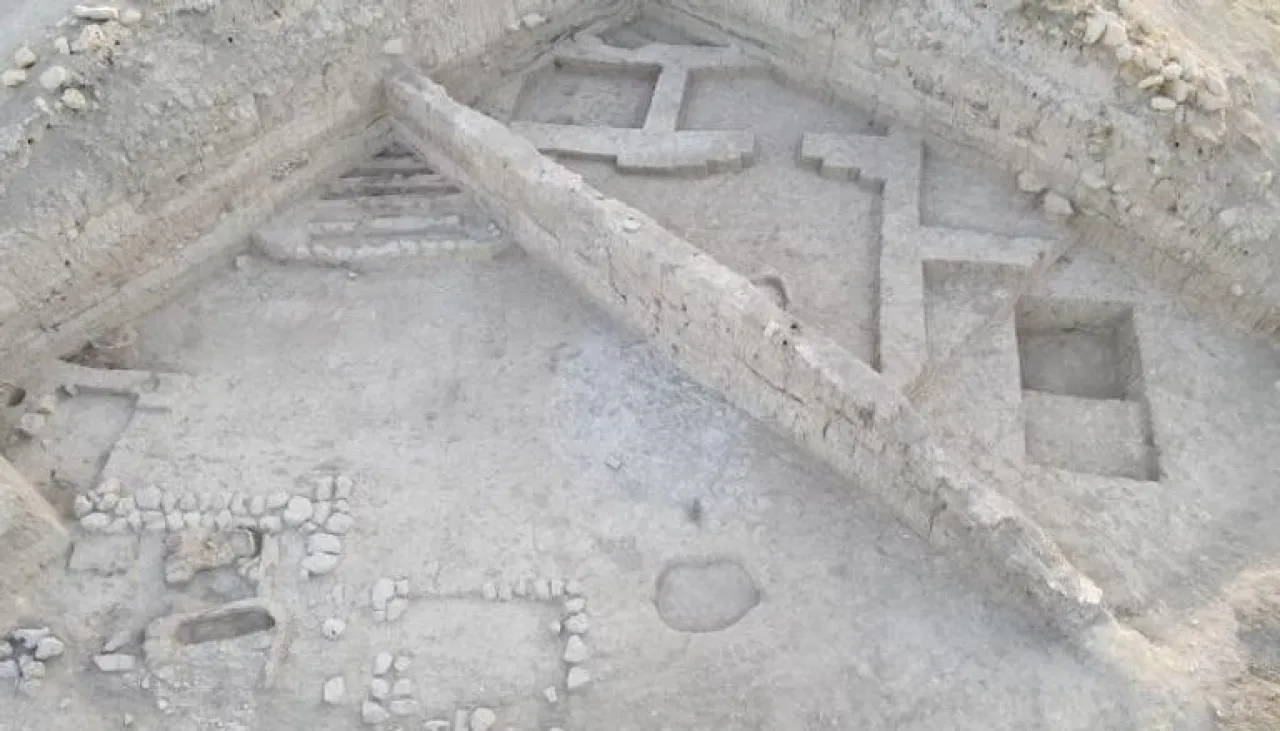
Khaberni - A team of archaeologists in the Kurdistan region of Iraq announced the discovery of a massive archaeological building dating back about five thousand years.
It is believed to be one of the oldest temples built in human history, located at an archaeological site known as "Kani Shaie" in Sulaymaniyah province in the north of the country.
This discovery provides a new insight into the early period of civilization, when the first cities in the world were being formed and flourishing.
The building dates back to the Uruk period (3300 – 3100 BC), which is associated with the famous city of Uruk - or Warka - in southern Mesopotamia, which was a major center of power and religion at the time.
According to researchers, the building's remarkable size and unique architectural style indicate that it was used for official or ceremonial purposes, and perhaps designated for worship, making it of exceptional significance in understanding the beginnings of religious and social organization in the region.
Experts believe that this discovery may contribute to the reassessment of cultural relations between the ancient urban centers in Mesopotamia.
The excavations inside the building revealed a collection of rare items, most notably parts of a gold necklace that indicate manifestations of wealth and social influence at the time, alongside cylinder seals that were used as symbols of power and administration in the Uruk civilization.
Decorative cones made of baked clay also appeared; they were aligned on the walls to form stunning geometric mosaic shapes.
The "Kani Shaie" site is located approximately 480 kilometers north of the city of Uruk, a distance that would have taken about two weeks to walk in ancient times. This discovery confirms that the region was not as isolated as previously thought, but was part of a political and cultural network that stretched across Mesopotamia.
Uruk is considered one of the most prominent urban centers in human history, with a population of about 80,000 people. It saw the emergence of the first known writing system in the world — cuneiform writing — and the creation of the first numbers used for inventorying crops, as well as the development of early arts and architecture.
Excavation works at "Kani Shaie" have been ongoing since 2013, where the mission has uncovered a complete archaeological sequence documenting the continuity of life at the site from the Chalcolithic period around 6500 BC until the third millennium BC. The layers of the earth there narrate consecutive chapters of human development, while each archaeological piece found serves as a testament to the beginning of a civilization journey that still leaves its marks today.