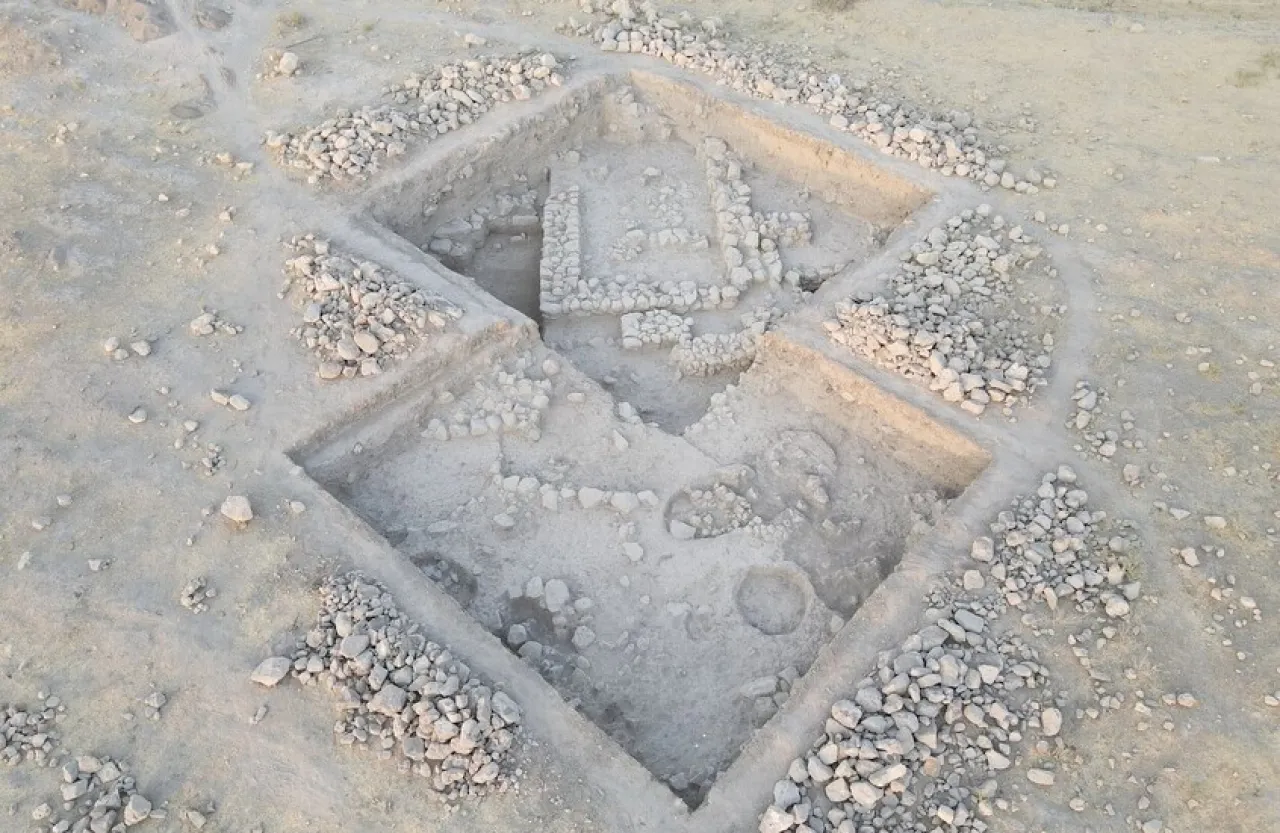
Khaberni - Archaeologists in Iraq have unveiled an astonishing engineering achievement in the remnants of a massive building dating back 5,000 years, which may be one of the oldest temples in the world.
This unique archaeological discovery at the "Kani Shaie" site in the Sulaymaniyah Governorate, northern Iraq, offers a window into the dawn of human civilization, when the world's first cities began to take shape.
This architectural monument dates back to the Uruk period (3300-3100 BC), named after the legendary city of Uruk (or Warka) in southern Mesopotamia.
Scientists say the massive nature of the building and its unique architectural design suggest that it was an important official building, possibly a temple or a place of worship. This discovery could rewrite the history of relations between ancient civilizations in the region.
Adding to the discovery's magnificence is the archaeological treasures found within the building, including pieces of a gold necklace reflecting the social opulence and ostentation of that era, alongside cylindrical seals - symbols of authority and administration in the Uruk civilization.
But what is even more astounding are the decorative wall cones, exquisite artistic pieces made of burnt clay that formed geometric mosaic panels adorning the building’s walls.
The "Kani Shaie" site is located about 480 kilometers north of the city of Uruk, a distance that would take approximately two weeks to traverse by foot in ancient times. Yet, this discovery carries an important historical message: it refutes the previous notion that this region was marginal and remote, and confirms that it was part of a connected cultural and political network that extended across Mesopotamia.
Uruk represents one of the greatest centers of human civilization, where the world's first true city emerged with a population reaching 80,000 people. There, cuneiform writing, the first writing system in history, was invented, the first written numerals used for crop inventory appeared, and the arts and the first architectural engineering developed.
Work has continued at the "Kani Shaie" site since 2013, with excavations revealing a unique archaeological record documenting continuous human settlement from the Chalcolithic period around 6500 BC, through to the third millennium BC. Each layer of earth here tells a chapter of humanity’s story, and every discovered artifact is a testament to the genius of prehistoric humans who laid the first foundations of the civilization we know today.