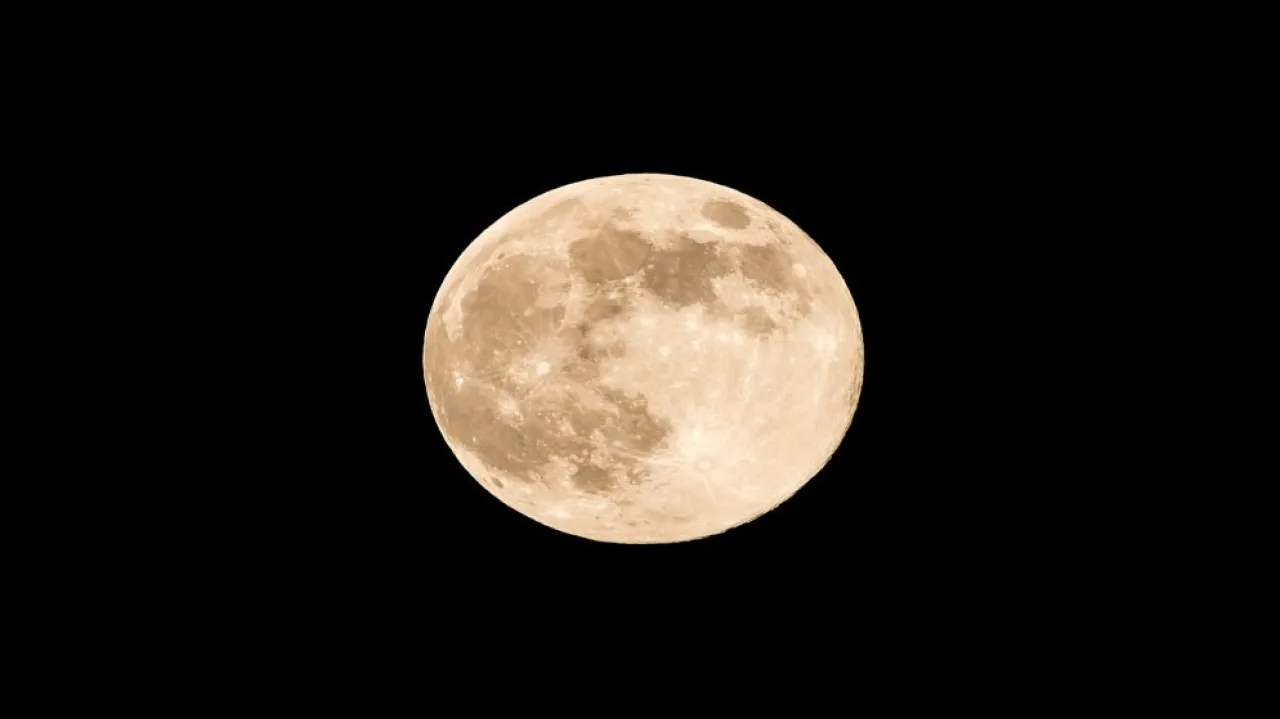
Khaberni - The giant "Beaver Moon" or what is known as the "Supermoon" will be complete next Wednesday at 4:19 PM Jordan time; that is about an hour and six minutes before the moonrise with its red color behind the eastern horizon of Jordan, according to Ammar Alsakaji, the president of the Jordanian Astronomical Society.
The moon will be in the Taurus constellation at the moment of its fullness, and it is the second supermoon this year, followed by another supermoon on December 4th, which is the last for this year.
The giant full moon will rise on Wednesday evening, at 5:25 PM from the east, and will set on Thursday morning at 6:36 AM from the west, where it remains bright throughout Wednesday/Thursday night according to Jordan time.
Alsakaji said that the term "supermoon" is not a linguistic exaggeration, but a relative scientific expression that refers to the full moon when it is in its orbit close to the lunar perigee by no less than 90%.
He explained that "in this case, the moon appears about 14% larger and 30% brighter compared to a regular full moon at lunar apogee, although accurately distinguishing this difference with the naked eye requires some astronomical skills."
This full moon is known in global cultures as the "Beaver Moon", a name dating back to the Algonquin tribes in North America, as November was the time when beavers were active in building their homes and tunnels in preparation for winter, making it a season for hunting them and utilizing their fur.
The name carries a symbolic value, expressing hard work and preparation for the future, just as beavers do before winter. It is also known as the late autumn full moon or the digging and scratching moon, a reference to the behavior of animals that begin to dig their homes in preparation for the cold days, and is also called the frost moon or snow moon, according to Alsakaji.
He added that this full moon is the closest giant to Earth during this year; astronomical calculations show that the distance between the Earth and the moon at the moment of its fullness on Wednesday is 356,980 kilometers, the closest to Earth since February 2019, with a diameter of 33.47 arc minutes, a value exceeding the diameter of the previous supermoon in October (33.06 arc minutes).
Alsakaji indicated that the upcoming apogee distance will be 406,693 kilometers (on November 20 at 5:48 AM Jordan time), and its diameter will be 29.38 arc minutes, while the upcoming perigee will be 356,833 kilometers (on November 6 at 1:29 AM Thursday) and its diameter will be 33.49 arc minutes.
He clarified that the astronomical calculations show a standard ratio value of 99.7%, which is higher than the required threshold (90%), confirming that the November full moon qualifies as a supermoon according to the adopted astronomical standards.
It is worth mentioning that the arc minute (sixty minutes in one degree) can be easily estimated by stretching out the little finger (pinky) with the arm fully extended toward the horizon, and it is a simplified method for estimating angles and arc distances in the sky with the naked eye.
The supermoon appears red or pink when it is close to the horizon due to the Earth's atmosphere effect on the moonlight reflected from the sun; as the light passes through a thicker layer of the atmosphere, air molecules, dust, and water vapor absorb the shorter wavelength colors like blue and green, while the longer wavelength red remains able to reach our eyes, making the moon appear red, pink, or orange in a scene combining the beauty of nature and the splendor of atmospheric physics.
From the skies of Jordan after the moonrise, the view becomes even more beautiful; Saturn appears followed by Jupiter, while Venus, the icon of love and beauty, shines on Thursday morning, and it is possible to see the star Aldebaran, the star Canopus, and the constellation Orion with its dazzling stars, especially Orion's Belt, in addition to the Pleiades (the Seven Sisters) cluster that dominates the sky in a captivating scene, according to Alsakaji.
Alsakaji invited astronomy and photography enthusiasts to document the moments of the supermoon, especially at moonrise or moonset, where its colors range between red, pink, and orange. It is preferable to choose backgrounds of tourist, archaeological, or natural sites in Jordan to make the photos a canvas combining the beauty of Jordanian nature and the magnificence of astronomical phenomena.
As for the environmental and geophysical effects, they are very limited. On the level of tides and ebbs, the influence of lunar gravity increases slightly due to the proximity of the moon to Earth; for example, in the Gulf of Aqaba, relying on the cubic tide equation, it is expected that the tide level will rise by an additional 5 to 10 centimeters only, and its effects are limited to minor differences such as covering slightly larger parts of beaches or coral reefs, and it may have a limited impact on marine organisms in the areas of tides and ebbs. In case the supermoon coincides with strong low-pressure areas or maritime storms, it may contribute to amplifying the level of coastal floods, but it remains a secondary factor.
On land, the most significant effect is the increase in night lighting by up to 30% compared to a regular full moon, which may slightly affect the behavior of some nocturnal animals such as bats, migrating birds, and insects, and may cause mild sleep disturbances due to the brightness, but it remains within natural limits and has no association with natural disasters like earthquakes, according to Alsakaji.
Although the supermoon is purely a natural scientific phenomenon, it has been surrounded through the ages by astrological myths and legends linking it to unstable behaviors or disasters and wars, yet modern studies have proven that its physical effect is limited to a slight increase in tides and ebbs by a few centimeters, along with a higher brightness of the moon. Thus, the supermoon remains an astonishing optical astronomical event that reminds us of the beauty of the universe and its regularity, not a source of mysterious or mythical effects.