Khaberni - What if you could measure your nutritional status in real time, directly from your wrist? This question launched the research.
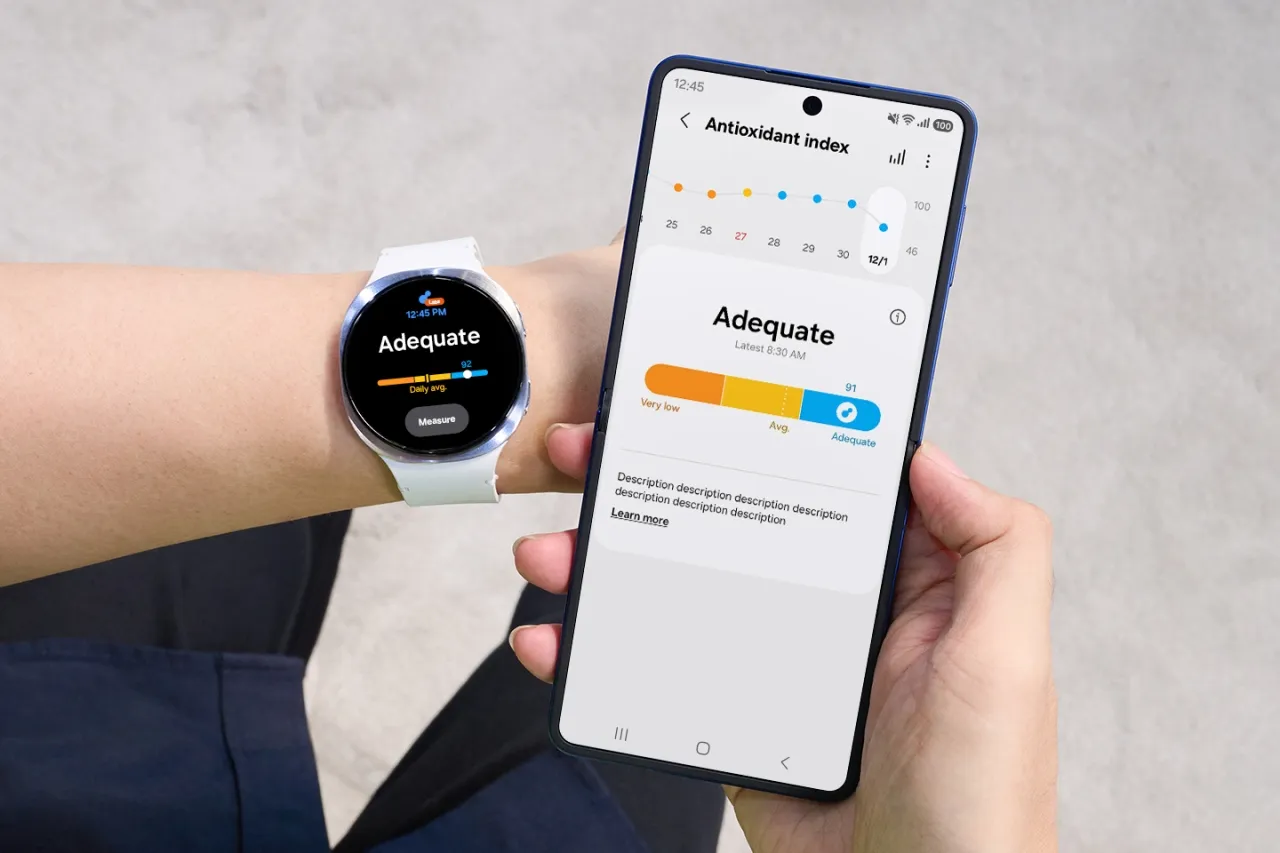
Antioxidant Index technology in Galaxy Watch8 turns what once seemed like science fiction into a tangible reality in our daily lives. In just five seconds, a quick thumb scan provides an accurate reading of the body's carotene levels, the first nutrition index measurable in this field.
Thanks to the miniaturization of high-precision laboratory sensing technologies to fit the size of the watch, it's now possible to turn your diet into an effective gauge that helps you age more healthily. Achieving this feat required years of intensive research and development, dozens of prototypes, and relentless perseverance.
New Horizons in Nutrition Tracking
In 2018, Samsung identified a significant gap in the world of wearable devices; while counting steps and calories became easy, there was no simple way to measure the impact of diet on our health. Nutritional analyses, accurate but confined to specialized, costly, and slow labs, were out of reach for most people.
With life expectancy increasing, the focus is shifting from just living longer to improving the quality of those extra years. In this context, Dr. Hyo-Jeong Jeong, a public nutrition expert from Seoul National University who collaborated in developing the technology, stated, "Antioxidants are increasingly important as a means to slow the aging process. If their levels are not regulated, reactive oxygen species accumulate, increasing the risk of chronic diseases like heart disease, diabetes, and cancer."
From this standpoint, Samsung has made antioxidants a central element of its new vision. Its engineers and scientists focused on carotenoids – key antioxidants and proven indicators for the intake of fruits and vegetables – to develop a small device to fit on the wrist, yet powerful enough to turn complex data into simple and actionable health insights.
The First Challenge: How could we miniaturize laboratory sensor technology?
From day one, the idea of developing a wearable device for nutrition tracking faced an immediate challenge, as traditional methods of measuring carotene levels - like Raman spectroscopy - are precise and non-invasive, but relied on cumbersome laser devices that could not be worn.
The first challenge was to scale down lab technology to a small sensor that could be integrated into a watch. After seven years of extensive testing and continuous improvement from the initial prototype, the team successfully developed the BioActive sensor, an innovative device that combines multi-wavelength LED lights and a custom photodetector array to deliver precise readings of carotenoid levels in a compact design.
Jin-young Park from Samsung's digital health team explained, "The real breakthrough was in integrating reflective spectrometry technology with LED lights, allowing us to scale down the technology while maintaining high accuracy."
Unlike lasers emitting narrow, sharp wavelengths, LED lights produce a broader range of light. By analyzing the amount of light absorbed by the skin at multiple wavelengths using photodiodes, the watch can estimate carotene levels with high accuracy. Advanced algorithms calibrate in real time to provide accurate and personalized readings for each user.
The Second Challenge: How could we make the technology accessible to everyone?
After developing the compact carotene sensor, the next challenge was ensuring its accuracy across different skin types, making it a comprehensive and accessible solution for everyone.
To overcome the effect of melanin in darker skin tones, Samsung's engineers relied on the fingertips for measurement, given their lower melanin concentration across all races. They also added simple enhancements like gentle pressure on the finger during scanning, which temporarily reduces blood flow and minimizes interference from hemoglobin, thereby improving the accuracy of the results.
Extensive tests were conducted at the Samsung Medical Center with the participation of hundreds of volunteers, to confirm the accuracy and reliability of the sensor. With this, the technology shifted from a lab-based idea to a practical feature that users around the world can easily benefit from, embodying an inclusive innovation that serves everyone.
How the Technology Works
Carotenoids are natural red, yellow, and green pigments found in fruits and vegetables. Since our bodies do not produce them, their levels reflect how much we consume of these foods.
Here, the Antioxidant Index comes into play, reflecting the body's carotene levels according to the following categories:
- Very low: Less than 50% of the daily intake recommended by the World Health Organization (400 grams per day).
- Low: Between 50% and 100%.
- Ideal: 100% or more.
Dr. Heo-Jeong Jeong says, "Carotenoids accumulate gradually in skin tissue, so short-term changes in fruit and vegetable intake don't appear immediately in the results. Our research shows that increasing carotenoid consumption leads to a significant rise in its skin levels after about a week to two weeks, making the index an effective tool for tracking long-term dietary habits."
Lifestyle factors such as sleep quality, stress levels, and physical activity also impact the index, making it comprehensive for general health. When combined with other features of the Galaxy Watch 8, such as sleep training, physical activity tracking, and vascular load monitoring, the index offers a comprehensive health picture, aiding users in making smarter decisions for healthier aging.
Your Health... A New Perspective
Professor Yoonho Choi from the Samsung Medical Center says, "Wearable sensors can play a pivotal role in helping people build healthy dietary habits by tracking and reminding them to consume enough fruits and vegetables daily. In the long term, this simple practice can contribute to preventing certain types of cancer and age-related diseases."
While antioxidants remain a promising area of study, accurate measurement was a prevailing challenge until now. The Antioxidant Index in Galaxy Watch 8 surpasses current research levels, offering a meaningful innovation. Samsung's ability to measure antioxidant levels with unprecedented precision is acknowledged by experts as a new standard for future health monitoring research. By enabling users to detect health risks early and take proactive preventive steps, Samsung paves the way towards a smarter, more health-conscious approach and elevates the role of wearable devices as effective tools in preventive healthcare.