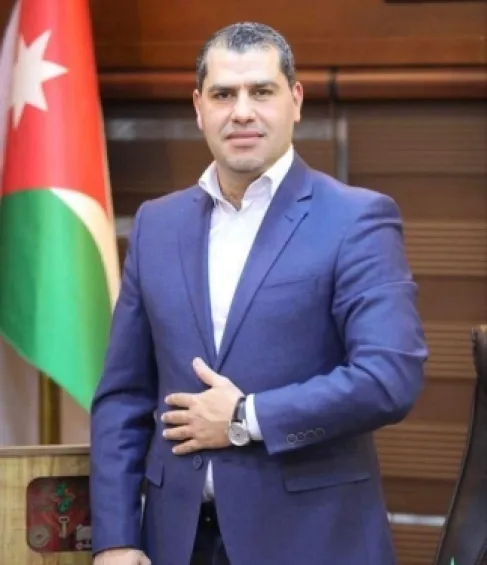
Khaberni - An event organized by the Abdul Hameed Shoman Cultural Forum, in collaboration with the Arab Center for Research and Policy Studies in Doha, shed light last night on "The Historical Doha Dictionary of the Arabic Language", with the presence of a group of thinkers, academics, and stakeholders.
Speaking at the event titled: "Historical Dictionaries of Languages and the Historical Doha Dictionary of the Arabic Language", were the executive director of the dictionary Dr. Azzedine Bouchikhi, Professor of Literature at Mutah University Dr. Jaza Musarwah, Professor of Pre-Islamic Literature at the University of Jordan Dr. Omar Al-Fajawi, and Professor of Language at Petra University Dr. Khaled Jaber, with the event managed by Dr. Ismail Al-Qiyam.
The Historical Doha Dictionary of the Arabic Language represents a significant scholarly effort by the Arab Center for Research and Policy Studies in Doha, aimed at documenting the vocabulary of the Arabic language from its inception in pre-Islam inscriptions, through the Quranic text, Arabic poetry, texts of prophetic sayings, and works in various fields of knowledge, across successive stages to the modern era.
Dr. Azzedine Bouchikhi emphasized that it will contribute to restoring the respect for the Arabic language as a living, evolving being, influenced by civilizational and intellectual contexts, representing a solid institutional step towards building a revivalist Arab linguistic project, comparable to what has been achieved by global languages in the fields of historical dictionaries. Many linguists from across the Arab countries have participated in editing, verifying, and approving the lexicographical material.
He mentioned that the project provided an interactive online platform that allows researchers and enthusiasts access to a massive linguistic database, opening unprecedented avenues for studying dictionaries from a temporal and cultural perspective. It not only focuses on the linguistic aspect but also serves historical, social, and intellectual studies as it highlights how the Arabic language expressed transformations in the Arab society over centuries.
He also pointed out that the dictionary employs strict and precise standards and guidelines for dealing with words and building its lexicographical entries, stating that the data provided by the dictionary both scientifically and in volume is also used in artificial intelligence applications and in developing AI systems for the Arabic language.
Bouchikhi revealed that the dictionary would be launched on December 22, coinciding with a conference about artificial intelligence and Arabic language features, lasting two days.
Dr. Jaza Musarwah referred to the historical attempts to build historical dictionaries, but they were never completed for various reasons, including financial support.
He explained that the Historical Doha Dictionary would open new horizons in scientific research, suggesting that the dictionary could lead to the development of the Arabic lexicographical industry and the production of new dictionaries derived from the Historical Doha Dictionary, as well as opening up prospects for new research projects particularly in developing semantics and semantic rootedness and core meaning.
Dr. Omar Al-Fajawi, with precise examples, stated that the Historical Doha Dictionary confirmed some matters and corrected others. For instance, the term “Ignorance” was not used in the pre-Islamic era, and the word for apostasy was not in use in that era with its first use being in the poetry of Al-Kumayt ibn Zayd al-Asadi who died in the first third of the second Hijri century.
He indicated that some expressions not used in the pre-Islamic era have implications that the Arabs of the time had virtues and valor, a judgment we came to confirm as the Historical Doha Dictionary informed us of their first use.
Dr. Khaled Jaber highlighted the importance of the dictionary, noting the efforts made to complete it, as well as the ongoing efforts to continue developing it in the future, to remain as a cultural force supporting researchers, scholars, and writers.
Jaber presented insights on topics such as meaning and history and their interrelationship as discussed in the Historical Doha Dictionary.
Dr. Ismail referred at the beginning of the event to the exceptional quality of the Doha Historical Dictionary's work, both linguistically and in computing and ease of access, adding that what reassures is that the management of the dictionary has taken it upon itself to continue its development and update according to continuous review which will keep working on updating the dictionary, based on feedback or ideas received by looking at the complete dictionary after announcing its completion at the end of this year.
It is worth noting that "The Historical Doha Dictionary of the Arabic Language" is a significant scientific project launched by the Arab Center for Research and Policy Studies in Doha in 2013, and it is the first of its kind in the Arab world in terms of methodology and goals. It does not merely define the meanings of words but tracks their semantic evolution across ages, based on documented and dated texts from various fields of knowledge: religious, literary, historical, jurisprudence, scientific, media, and social networks.