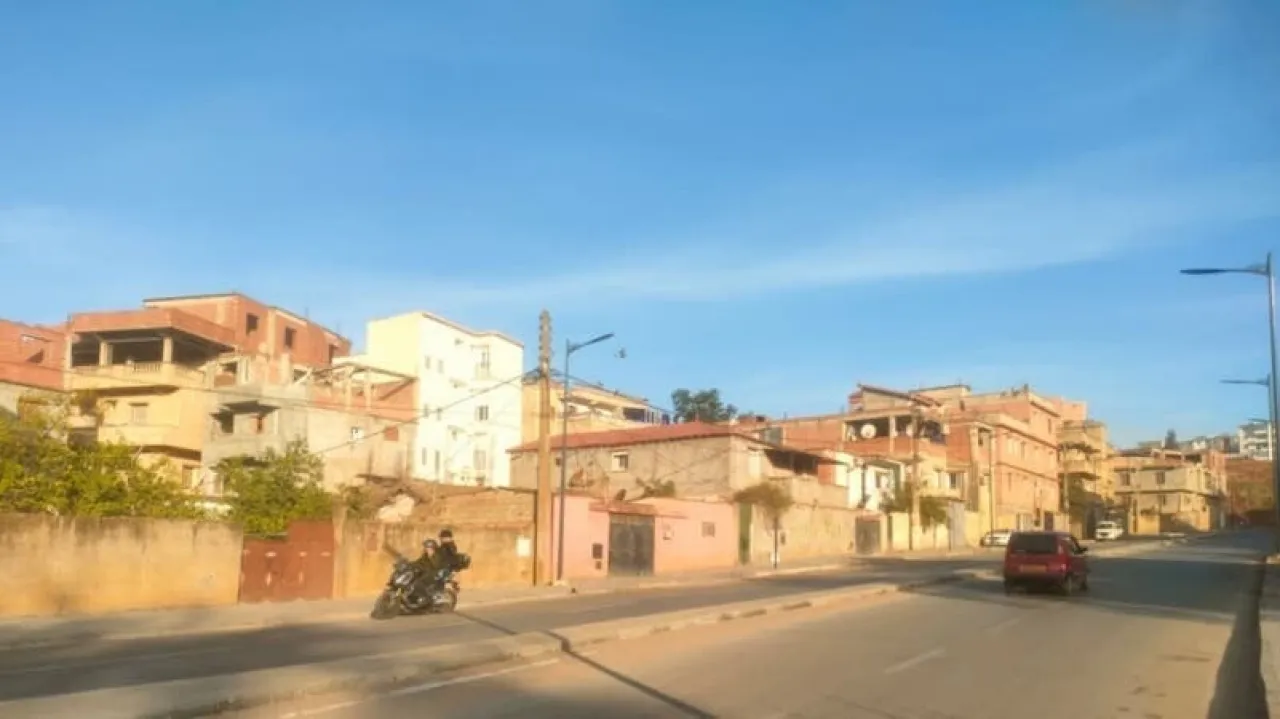
Khaberni - Public and private unfinished buildings are considered a problem in Algeria, worrying authorities and tarnishing the general appearance of streets even in cities, attributed by experts to economic, social, and even cultural backgrounds. These have resisted active laws and decrees, which include severe penalties against violators.
In many city streets, including the capital, Algeria, you see unfinished buildings, remaining as construction sites for decades, some of which belong to housing programs like the participatory ones carried out by contractors who threw in the towel mainly due to rising construction material prices. As for the buildings and houses owned by private individuals, they too mar the general street appearance, due to either their incompleteness or lack of facade painting. Even many Algerians consider the external facade the last phase of construction, or even a stage that might be skipped to avoid the expense or even to ward off envy, according to some.
This is what we noticed in the streets of the upscale city, west of the Algerian capital, Draria, which has many unfinished buildings along its main street leading to the city of Sehaoula, as well as in the city of Bir Mourad Rais. Here too, despite the completion of the work at their level and the opening of stores on their lower floors, the facades remain bricks, tarnishing the general appearance.
On the subject, the international urban development expert and president of the Arab Higher Council for Architecture and Urban Development said, "..there are political, historical, security, and social remnants that led to this situation, which includes even the upscale neighborhoods in Algeria's capital, like Hydra and El Mouradia, where you find asphalt touching the walls of houses, fences, iron bars, and more.".
The speaker also mentioned to "Al Arabiya.net" that "the currently applied law is Law No. 90-29 issued in 1990, despite that urban laws worldwide change, they are not fixed, because standards vary and evolve as social and urban services develop. Despite the subsequent executive decrees, they were not sufficient."
The speaker added: "Following that era in which the law was issued, Algeria went through several phases including the Black Decade, which entrenched chaotic construction, where there were citizens fleeing security threats to build chaotic and tin constructions, and even when security stabilized, practices such as real estate fraud, seizing public properties, and building without licenses and contracts occurred, producing millions of chaotic buildings in the capital alone."
From here, Sharfi added "the need to enact a new law emerged, thus Law 15/08 of 2008 concerning the regulation of unfinished buildings was issued, which I consider one of the worst laws witnessed by Algeria, as it legalized urban crime. Among its clauses were the settlement of chaotic neighborhoods, and yet the law has not been implemented, and since 2013 it has been annually extended in the finance law, since those concerned by it have not complied with it, and the authorities have not enforced the penalties on the violators, ranging from financial fines to demolition and even imprisonment, and it remained ink on paper."
All this, according to the urban development specialist "encouraged citizens to be lax in completing their buildings and not painting the facades, without fear of legal penalties."
Socially, the social specialist Amar Balhasan explained that "apart from the laws and respecting them and the extent of adherence to them, the culture of urban development varies among peoples, and it is what determines the behaviors of its residents."
The speaker added to "Al Arabiya.net" saying: "In the Algerian mentality, construction is linked to economic and other social backgrounds, usually the same family partakes in building a building of two to three floors or more, which is joint construction that drains much of the family's income, barely allowing them to finish the construction, even though most families live in these buildings while they are unfinished, thus the last of their concerns becomes the external facade and it remains for years and sometimes decades without completing the painting of facades."
As for the social aspect, Balhasan added: "There is a belief that unfinished buildings do not attract envy, even sometimes we see buildings where they hang car tire rims to ward off the evil eye, and other practices that are still prevalent in the society to this day."
All this, the social specialist said "would have disappeared if there was proper urban upbringing for the individual, as Algerians grew up seeing unfinished buildings, therefore this appearance is no longer strange even in the heart of cities."