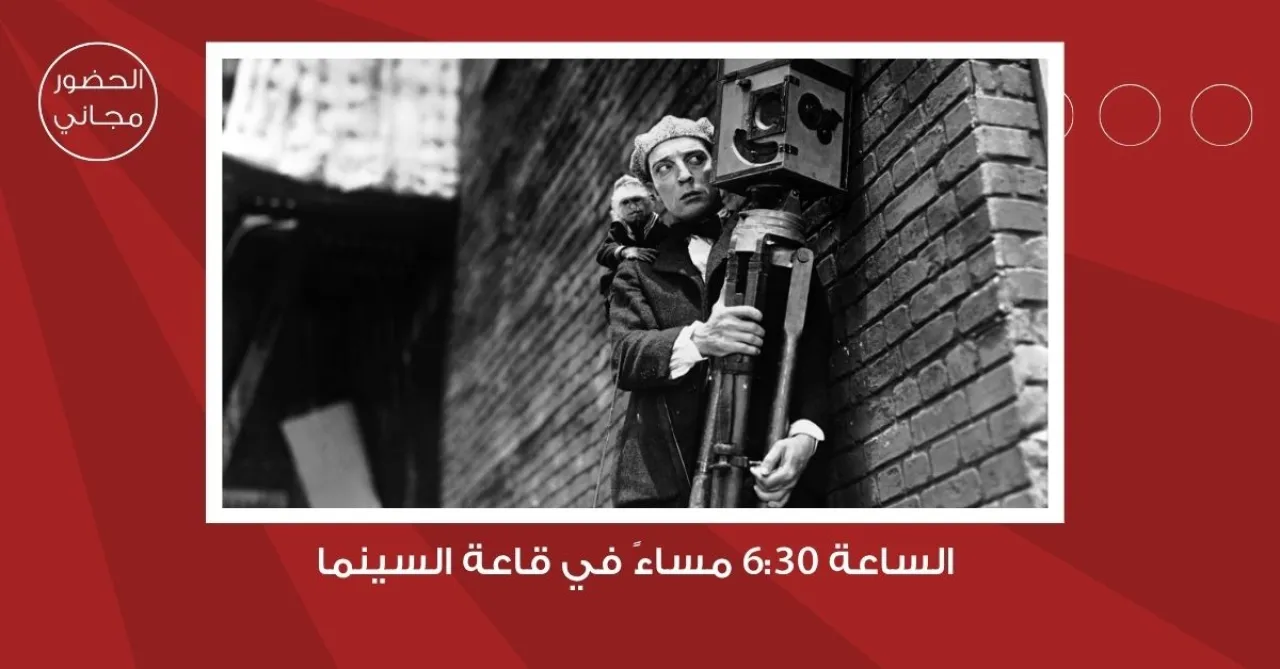
Khaberni - The Cinema Committee at the Abdul Hameed Shoman Foundation is presenting tomorrow, Tuesday, the American film "The Cameraman" directed by Edward Sedgwick, at exactly six thirty PM in the cinema hall at the foundation’s headquarters in Jabal Amman.
The silent comedy film "The Cameraman" (released in 1928) is one of the most important of three feature films starring director and comedian Buster Keaton during the 1920s.
The film is unique for its subject matter, being one of the first films in cinema history that focused on the newsreel cameraman's work, his relationship with the camera, and the struggles he endures in order to capture events, all portrayed within a creative comedic framework.
The film was almost completely unknown in cinema history due to the loss of the original copy, and the only available version for screening was incomplete until 1991, when the full negative was found in a warehouse and restored, allowing the complete film to be shown again.
In this film, Buster Keaton plays a street photographer who decides to become a cinematic photographer after meeting a film crew covering a major celebratory demonstration, where he becomes enamored with a crew assistant and takes her photograph.
The film begins with short shots showing news photographers at work in dangerous locations to capture events. Then we see Buster Keaton as a photographer, surprised by a rush of movie photographers jostling for the best spot to photograph mass celebratory marches heading towards the center of the square. The director focuses on the photographers racing to secure the best positions, packing Buster Keaton into a comedic situation, finding himself stuck next to the beautiful assistant.
In this scene, the director captures stunning shots full of power and beauty, showing thousands of flyers, clippings, and colorful decorative papers swirling in the air above the crowds and covering the ground. When the celebration ends and everyone disperses, we see the ground littered with these papers and Buster Keaton standing beside the beautiful girl.
The story then unfolds with Buster Keaton's adventures in cinematic photography and his efforts to secure a job at the famous "Metro-Goldwyn-Mayer" company where the girl works, attempting to win her heart.
Buster Keaton sells his photographic camera and buys a used cinematic camera, which is not very advanced. He then finds himself in Chinatown amidst a fierce battle between local gangs using guns, fists, and sticks.
This sequence contains some of the strongest directorial scenes expressing Keaton’s great comedic ability.
Buster Keaton risks his life to film the battle in detail, and he does even more by intervening in the fight and directing the brawlers to capture the best, most expressive, and thrilling shots, as if he were a movie director managing actors in a battle scene. This long sequence includes multiple comedic situations and introduces new dramatic elements, the most important being Buster Keaton's companionship with a small monkey, which plays a role in the rest of the events and increases the comedic dose of the film.
The film emphasizes the relationship between the photographer and the camera without ignoring the necessity of narrating an innocent love story interspersed with rivalry over the beautiful girl’s heart with another man, also a cinematic photographer.
The film "The Cameraman," as usual in cinema, ends happily with the hero winning the girl’s heart and fulfilling his dream of becoming a cinematic photographer. However, this conventional ending of the film does not lack meaning and additional significance related to cinema itself and the cinematic camera's role not only in capturing reality, but also in revealing the truth where the camera footage becomes evidence of the event's accuracy.
The final scene of the film features an adventure at sea near the coast where a boat carrying the film crew sinks during a boat race. The rival photographer swims away without attempting to rescue his colleague, while Buster Keaton, who was standing on the shore filming, leaves the camera recording and jumps into the water to save the girl, placing her unconscious on the shore and then pulling back. When the girl wakes up, she finds her colleague beside her and believes he rescued her. But the camera that filmed the event reveals to the girl who truly saved her and exposes her colleague's cowardice.
Today, Buster Keaton's films are considered masterpieces of silent cinema, yet they remind us of the tragic fate of this artist who stopped his film activity at an early age after having to close his production company and the commercial failure of his last films produced for other companies, leading to his disillusionment and death impoverished in 1966. Ironically, Buster Keaton returned to the forefront of media attention after the end of the twentieth century with television programs about his life and films, as well as a new book published in his memory.